


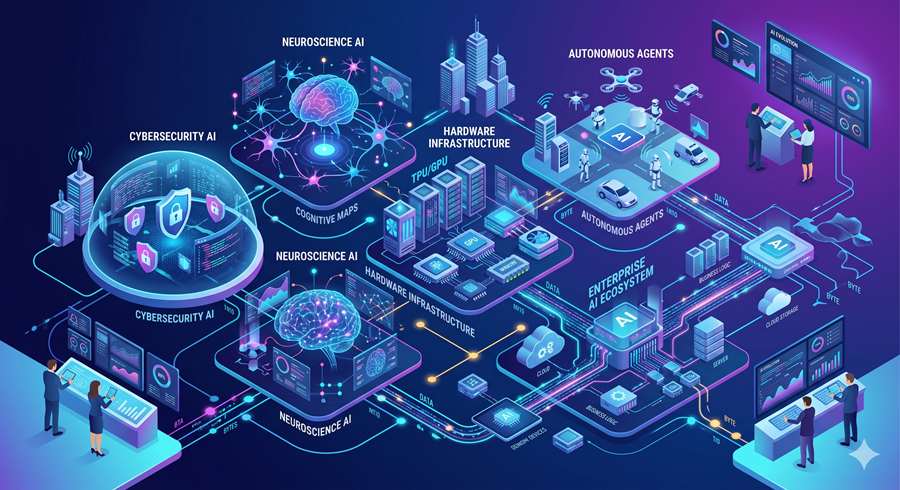
Artificial intelligence is evolving faster than ever, and the latest developments from major technology companies show that the industry is entering a completely new phase. Over the past few days, several important announcements revealed how AI is moving beyond simple chatbots and becoming more deeply connected to cybersecurity, neuroscience, autonomous agents, and specialized hardware. Companies like Anthropic, Meta, Alibaba, and the Open Guanaco community are all approaching AI from different directions, but together they reveal one clear trend: AI systems are becoming more powerful, more independent, and more integrated into real-world operations.
Anthropic Accidentally Leaks Claude Mythos
One of the biggest stories came from Anthropic after the company accidentally exposed information about an unreleased AI model called Claude Mythos. The leak reportedly happened because thousands of internal files were mistakenly stored in a publicly accessible content cache. Security researchers and journalists quickly noticed the issue, and Anthropic removed the files after being informed. However, the incident revealed important details about the company’s future AI plans.
The leaked documents described Claude Mythos as a major upgrade over Anthropic’s current AI systems. Right now, Anthropic offers three main model tiers: Haiku, Sonnet, and Opus. Opus is currently the company’s strongest public model, but Mythos appears to belong to an entirely new class internally referred to as “Capybara.” This suggests that Anthropic is building a more advanced generation of AI focused on deeper reasoning, coding, and cybersecurity capabilities.
Meta Develops AI That Predicts Brain Activity
While Anthropic focuses on reasoning and cybersecurity, Meta is exploring how AI can better understand the human brain. Meta’s FAIR research team recently introduced Tribe V2, a powerful AI system designed to predict brain responses to videos, speech, audio, and written language.
Traditionally, neuroscience studies different brain functions separately. One research team might focus on language, while another studies vision or emotion. Meta’s goal with Tribe V2 is to create a unified system capable of analyzing multiple forms of information together and predicting how the brain reacts in real time.
The AI was trained using hundreds of hours of fMRI brain scan data collected from people watching movies, listening to podcasts, and interacting with different media. After training, the system was tested across a much larger group of participants.
Guanaco Introduces Self-Evolving AI Agents
Another major development comes from the Open Guanaco community, which introduced a new AI agent called Guanaco. Unlike standard AI assistants that only answer questions, Guanaco is designed to complete long and complicated tasks while adapting to changes during the workflow.
One of the biggest problems with current AI agents is that they often lose context or restart tasks whenever instructions change. Guanaco addresses this issue using a three-layer memory system that keeps track of user identity, long-term context, and live task progress simultaneously.
The system also uses something called “context slimming,” which removes unnecessary information while preserving important details. This helps the AI stay stable during long workflows without consuming excessive computational resources.
Alibaba Builds AI Chips for the Future
The hardware side of AI is also advancing rapidly. Alibaba recently introduced a new processor called the XuanTie C950, specifically designed for AI agents and inference workloads.
Most people focus on GPUs because they are essential for training large AI models, but CPUs remain extremely important when AI systems are actively performing tasks in real-world environments. AI agents often require sequential reasoning and multi-step processing, which CPUs handle efficiently.
Alibaba claims the C950 delivers significant performance improvements compared to traditional processors and can be customized for specific AI workloads. The chip is based on the open-source RISC-V architecture, allowing Alibaba more independence and flexibility compared to relying on foreign chip technologies
