AI Deployment Company (DeployCo) marks a major shift in how artificial intelligence is being commercialized. Instead of focusing only on building and selling AI models, OpenAI appears to be expanding into something much closer to traditional IT services and consulting embedding AI directly into enterprise systems and workflows.
The key idea behind DeployCo is simple but powerful: selling AI tools is no longer the main value driver. The real money lies in deploying AI inside organizations, restructuring operations, and integrating systems at scale. This is the same space historically dominated by large IT and consulting firms such as Accenture, TCS, Infosys, Wipro, Cognizant, McKinsey, and Bain.
According to estimates shared in the discussion, for every $1 a company spends on AI software, it spends nearly $6 on deployment, integration, and transformation services. That means the “deployment layer” is significantly larger than the model-building layer itself.
Why Deployment Is Bigger Than AI Models
Building an AI model is only the beginning. The real challenge for enterprises is making it work inside complex environments. Companies have legacy software, outdated databases, internal approval systems, compliance rules, and human workflows that cannot simply be replaced overnight.
This is where deployment becomes essential. It includes tasks like:
Redesigning internal workflows
Integrating AI into existing software systems
Training employees to use AI tools
Ensuring compliance and data security
Building automation pipelines across departments
Traditionally, this work has been handled by consulting giants and IT service providers. DeployCo appears to be OpenAI’s attempt to enter that layer directly.
Forward-Deployed Engineers: The Core Strategy
At the center of DeployCo’s model is the concept of forward-deployed engineers. These are technical experts placed directly inside client organizations. Instead of working remotely or delivering tools from a distance, they sit within enterprises and actively redesign systems around AI.
Their responsibilities include:
Rebuilding business processes using AI tools
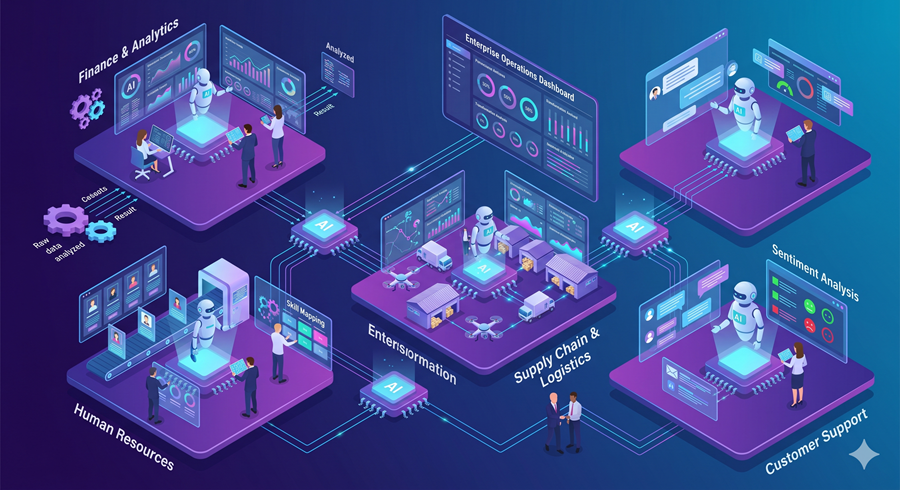
Automating finance, HR, supply chain, and support systems
Integrating AI into internal dashboards and workflows
Continuously optimizing performance after deployment
This approach is similar to the model used by companies like Palantir, where engineers embed deeply into client operations to ensure tight integration between software and business processes.
Major Financial and Industry Backing
DeployCo is reportedly backed by a powerful coalition of investors, including TPG, SoftBank, Goldman Sachs, Brookfield, Warburg Pincus, McKinsey, Bain, and Capgemini, along with several other global firms.
What makes this particularly significant is not just the funding reportedly over $4 billion at a $10 billion valuationn but the strategic network behind it. Many of these investors collectively influence thousands of companies worldwide.
This creates a potential distribution advantage. Instead of convincing enterprises one by one, AI deployment could now spread through entire investment portfolios. Private equity firms and consulting networks may effectively become channels for large-scale AI adoption.
Acquisition Strategy and Immediate Capability
To accelerate its rollout, OpenAI has reportedly acquired a London-based AI consulting firm called Tomorrow, bringing in around 150 experienced deployment engineers. These teams already have enterprise experience working with companies such as Tesco, Virgin Atlantic, Red Bull, Mattel, and Supercell.
This acquisition gives DeployCo immediate operational capability rather than requiring years of internal hiring and training. It also signals that OpenAI is not just experimenting—it is moving directly into enterprise execution.
Convergence of AI Labs into Services
OpenAI is not alone in this shift. Anthropic has also reportedly explored similar enterprise deployment structures, partnering with major financial institutions like Blackstone and Goldman Sachs. This suggests a broader industry trend where AI companies are no longer just model developers but are evolving into full-stack enterprise solution providers.
The convergence is clear:
AI labs build models
Deployment companies integrate them into businesses
Consulting firms evolve or collaborate to stay relevant
What This Means for the IT Industry
If this model scales, it could significantly reshape the global IT and consulting landscape. Companies like TCS, Infosys, and Accenture have long dominated enterprise transformation services. But AI-native deployment companies could automate or replace parts of that work.
However, it is not a simple “replacement story.” Large enterprises are complex, and human expertise in systems integration, compliance, and operations is still critical. Instead, the industry may shift toward a hybrid model where AI systems and human consultants work together.