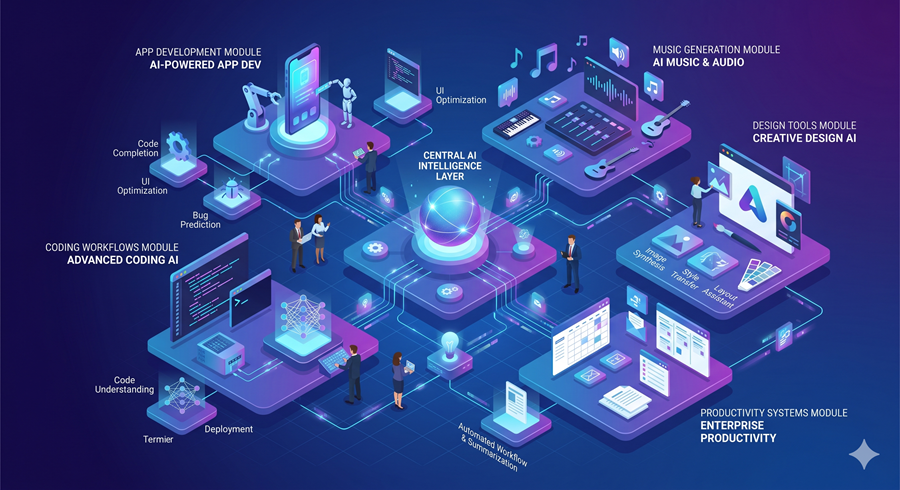
Over the last few days, Google rolled out a massive wave of AI updates, and together they reveal something important. The company is no longer treating AI as a standalone chatbot feature. Instead, Google is building an entire AI ecosystem where music creation, app development, coding, design, and productivity tools are all connected into one continuous workflow. From Gemini and AI Studio to Lyria 3 and Stitch, these announcements show that Google is moving aggressively toward AI-powered creative infrastructure.
AI Studio Is Becoming a Real App Development Platform
One of the biggest updates came inside Google AI Studio. Google upgraded its “vibe coding” experience with a new coding agent called Anti-Gravity. The goal is simple but ambitious: instead of generating rough prototypes, AI Studio now aims to build applications that are much closer to production-ready software.
The most important improvement is support for real-time multiplayer apps. That changes everything because multiplayer systems require much more than simple front-end design. They need synchronized data, live communication, authentication systems, and backend infrastructure that can handle multiple users at once.
Google is solving this by deeply integrating Firebase into the workflow. The AI agent can automatically detect when an application needs cloud storage or user authentication and then configure Firebase services after user approval. That dramatically reduces the complexity of building modern applications.
Support for frameworks like React, Angular, and Next.js also pushes AI Studio closer to professional development territory. Instead of acting like a toy app generator, Google wants this system to become a serious software creation environment.
Gemini Is Expanding Beyond the Browser
At the same time, reports suggest Google is preparing a dedicated Gemini app for macOS. While Gemini already works through browsers, a native desktop application changes how users interact with AI entirely.
A desktop-level assistant can potentially access files, manage workflows, organize documents, and integrate more deeply into the operating system. That moves Gemini beyond simple chatbot interactions and turns it into a full productivity assistant.
This is especially important because of Google’s growing partnership with Apple. If Gemini eventually integrates into Siri or Apple Intelligence features, Google’s AI could become embedded directly into one of the world’s most tightly controlled ecosystems.
That possibility makes this much larger than a simple app release. It suggests Google wants Gemini operating as an always-available AI layer across everyday computing.
Lyria 3 Brings AI Music Generation Into Mainstream Products
Another major announcement was Lyria 3, Google’s newest AI music generation model. Unlike earlier experiments, Lyria 3 is now integrated directly into Gemini and YouTube’s creator ecosystem.
Users can generate 30-second music tracks using natural language prompts. They can describe genre, mood, tempo, instruments, and even lyrical themes. More importantly, Lyria 3 automatically generates vocals and lyrics instead of requiring manual input.
What makes this especially powerful is multimodal generation. Users can upload images or videos, and the AI creates matching music automatically. That means Google is treating music as a first-class AI medium alongside text and visual content.
Technically, the model outputs production-quality 48 kHz stereo audio and generates complete musical structures rather than stitched loops. This moves AI-generated music much closer to professional creative workflows.
Stitch and AI Agents Are Reshaping Design Work
Google also expanded Stitch, its AI-powered design platform. New agent systems are appearing that can design app interfaces, generate app store assets, and connect directly to coding tools.
One new feature allows developers to automatically create app store screenshots, icons, and descriptions directly from app designs. That removes several manual production steps for indie developers and small teams.
Another major upgrade is native MCP integration. MCP, or Model Context Protocol, allows AI systems to interact directly with external tools and coding environments. With this integration, Stitch can connect directly to platforms like Cursor, Claude Code, and Gemini CLI.
This means developers can move from AI-generated designs directly into active coding environments with minimal friction. Google is essentially connecting design, development, and deployment into one AI-assisted workflow.
Google Is Building AI Infrastructure, Not Just AI Features
The biggest takeaway from all these announcements is that Google is no longer focused only on individual AI models. The company is building interconnected AI systems designed to handle creation, coding, music, productivity, and deployment together.
Lyria handles music. AI Studio handles application development. Stitch handles design workflows. Gemini acts as the central assistant layer tying everything together.
Instead of isolated AI tools, Google is creating an integrated creative ecosystem where AI participates in nearly every stage of digital production. That shift may end up being far more important than any single feature announcement.