I often wonder what it would take for humanity to truly change course. Not small adjustments, not temporary fixes, but a fundamental shift in how we live, consume, and coexist with the planet. When I imagine the future stretched across centuries, I do not see a straight line. I see phases. Some are shaped by failure, others by reinvention.
The Reckoning Begins
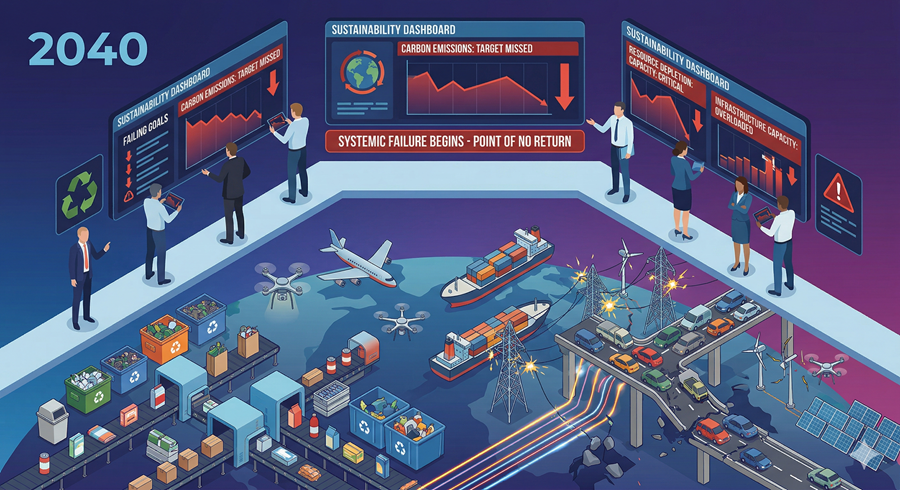
In my mind, everything starts around 2040. This is where intentions collapse under pressure. Despite years of warnings and sustainability efforts, nothing truly changes. Consumption continues to rise, and convenience keeps winning over responsibility.
This moment feels less like a sudden disaster and more like a slow realization. We had the knowledge, the tools, and the opportunity, but we failed to act in time. That failure sets the stage for everything that follows.
A World in Decline
By 2070, the consequences are impossible to ignore. Living conditions deteriorate sharply. Cities become overcrowded and polluted. Waste is no longer just a land problem but a planetary one, extending into space itself.
I imagine a world that feels heavy, both physically and emotionally. Systems break down under poor management, and survival begins to replace progress as the primary goal. It is a period defined not by innovation, but by damage control.
The Great Retreat
By 2100, humanity is forced into a radical decision. Instead of trying to fix everything at once, we step away. For decades, people have lived apart from the surface, allowing Earth to recover without constant interference.
This retreat is not a defeat. It is a restraint. It is the first time we collectively choose to stop dominating and start giving back. It reflects a deeper understanding that sometimes progress means stepping aside.
Rebuilding With Nature
When humanity returns centuries later, everything feels different. Nature has recovered in ways that once seemed impossible. Forests expand, ecosystems stabilize, and the planet begins to breathe again.
This time, we rebuild differently. Technology no longer competes with nature. It works with it. Architecture grows from organic materials. Cities evolve like ecosystems rather than machines. Life becomes more localized, balanced, and intentional.
I imagine communities designed not just for efficiency, but for harmony. The focus shifts from expansion to coexistence.
Beyond Physical Existence
Just when it seems like humanity has reached its peak, another transformation begins. The definition of life itself starts to change. The boundaries between human intelligence and artificial systems blur until they disappear entirely.
Eventually, physical limitations are no longer necessary. Consciousness moves into digital realms, freeing humanity from the constraints of the body. This is not just technological progress. It is a redefinition of existence.
In that moment, humanity becomes something entirely new, capable of exploring challenges beyond the physical world.
Short Paragraph
What stays with me is not just the future itself, but the path that leads to it. Collapse, recovery, and transformation are all part of the same story. The real question is not whether this future is possible, but whether we are willing to change before we are forced to.