


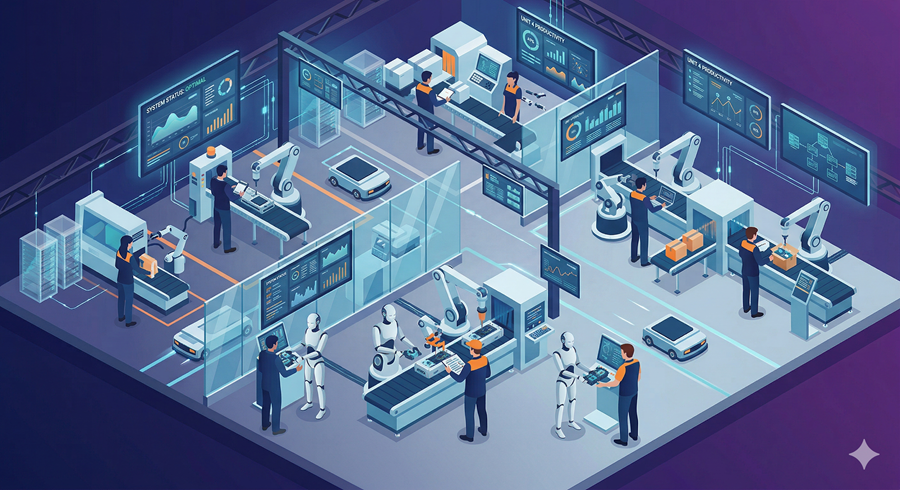
I walked through the idea of modern factories differently after seeing how automation is evolving. These are no longer spaces where machines simply repeat fixed actions. They are becoming environments where machines observe, adapt, and improve over time. In some facilities, humanoid robots are already being tested alongside thousands of human workers, performing tasks that once required physical judgment and coordination.
How Robots Learn Like Humans Now
What surprised me most was how these robots are trained. Instead of traditional programming, they learn through demonstration. Engineers guide them using motion capture systems or virtual reality setups, almost like teaching by imitation. Human movements are recorded and translated into data, allowing machines to gradually replicate complex physical actions. Over time, this creates a feedback loop where performance improves through repetition and refinement.
From Simulation to Real Work
Before entering real environments, these robots practice in massive simulations. Thousands of digital versions of the same machine attempt tasks under different conditions, from slippery surfaces to uneven terrain. The best-performing behaviors are selected and transferred to physical robots. I find it striking that a skill learned virtually can instantly be deployed across an entire fleet, turning one successful model into a shared capability.
The Global Race to Build Humanoid Labor
What is unfolding is not isolated innovation but global competition. Companies in the United States, South Korea, and China are racing to develop humanoid systems capable of performing real-world jobs. Some are backed by major tech firms, others by industrial giants. The goal is no longer just automation, but general-purpose machines that can operate in unpredictable environments like factories, warehouses, and eventually daily life.
This competition is accelerating quickly as investment grows and capabilities converge.
What This Means for Human Work
The most difficult question is not what these robots can do, but what happens next for people. Some of the earliest tasks being automated are physically demanding and repetitive jobs. That could reduce human strain in dangerous environments, but it also changes employment patterns in ways we are only beginning to understand.
I do not see fully independent robots replacing humans overnight. What I do see is a gradual shift where machines handle more physical work while humans move toward supervision, training, and system design. The transition will not be simple, but it is already underway.
Follow Us on:
Clutch
Goodfirms
Linkedin
Instagram
Facebook
Youtube
