The most important part of Google’s latest Gemini update is not that it writes faster. It is that it finishes the job.
That is the real shift.
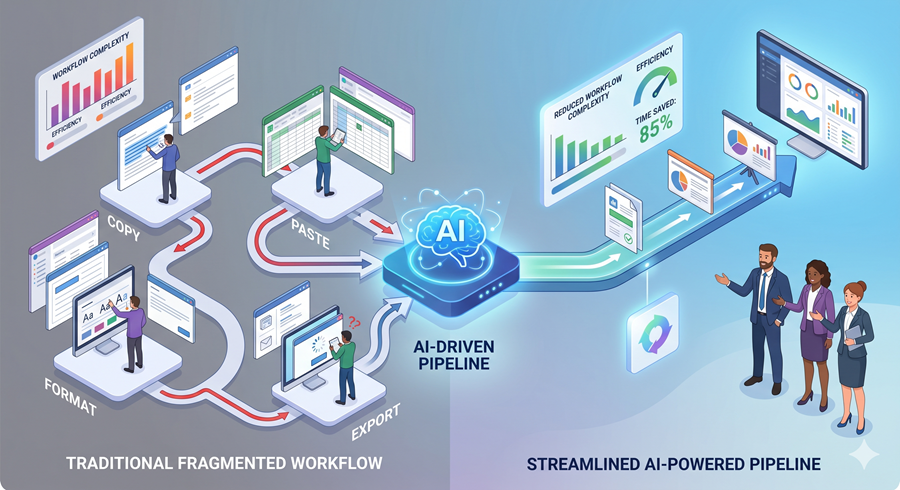
For a long time, AI has been useful but incomplete. It could generate ideas, draft content, and organize thoughts, but the final mile still belonged to the user. Copy the output. Paste it somewhere else. Fix the formatting. Rebuild the tables. Export the file. The work was faster, but the workflow was still fragmented.
Google is now collapsing that gap.
From Text Generator to Workflow Tool
Gemini is no longer just returning answers. It is returning usable outputs in file form.
That changes the role AI plays in actual work. Instead of generating raw text that still needs cleanup, Gemini can now produce structured deliverables: documents, spreadsheets, slide decks, PDFs, markdown files, and more.
This is a much bigger shift than it sounds.
The value is not in generating words. It is in removing workflow friction. That is the point where AI stops being assistive and starts becoming operational.
Why This Matters More Than It Looks
Most AI tools still depend on manual handoff. They generate content, but the user still has to turn that output into something usable.
That extra step is where most productivity gains quietly disappear.
Google’s move matters because it removes one of the most common bottlenecks in AI workflows: format conversion. Instead of treating file creation as a separate task, Gemini now treats it as part of the output itself.
That is not just a better feature. It is a better product philosophy.
The real competition in AI is no longer about who generates the smartest paragraph. It is about who removes the most operational drag.
The Strategic Play Behind It
This is not just a convenience upgrade. It is a platform move.
Google is turning Gemini into an interface layer across the tools people already use to run work: documents, spreadsheets, presentations, reports, and lightweight business operations.
That puts pressure on every workflow product built around manual assembly. Not because Gemini replaces them entirely, but because it reduces how often users need to open them in the first place.
That is the larger threat.
The winning AI tools will not be the ones that help people think better. They will be the ones who help people finish faster.
What Changes Next
The immediate benefit is speed, but the deeper shift is behavioral.
Once users get used to prompting for finished outputs instead of assembling them manually, expectations change. People stop asking AI for help with writing. They start asking it to produce outcomes.
That is a much bigger leap than better text generation.
It is the point where AI stops acting like software assistance and starts behaving like execution infrastructure.
Follow Us on:
Clutch
Goodfirms
Linkedin
Instagram
Facebook
Youtube