The most revealing signal in AI right now is not a model launch. It is pricing behavior.
That is where the market starts telling the truth.
For the last two years, the AI economy has been sustained by hype, subsidized access, and a shared assumption that scale would eventually solve the cost problem. That was always the bet: grow fast, capture users, normalize dependency, and figure out monetization later.
Now the “later” part is starting to arrive.
The Pricing Era Has Started
What matters is not that companies are changing pricing. What matters is why.
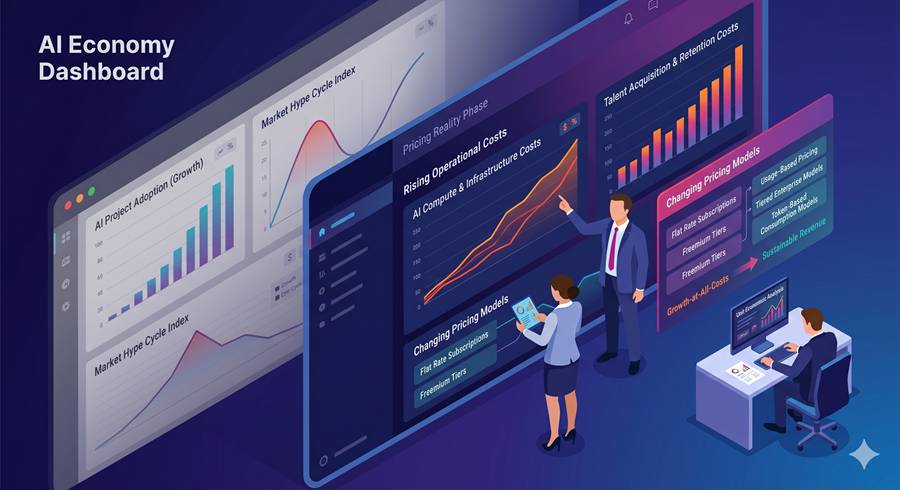
Anthropic testing, pricing elasticity, and Microsoft shifting GitHub Copilot toward token-based usage are not isolated product decisions. They are early signs that the economics of AI are beginning to assert themselves.
That shift was inevitable.
The core issue is simple: frontier AI is expensive to build, expensive to run, and far more expensive to maintain than most users have been conditioned to expect.
The market is now moving from growth pricing to cost reality.
The Real Constraint Is Not Demand
Demand is not the problem. Usage clearly exists. The problem is that usage and profitability are not the same thing.
AI products have been very good at increasing dependency. They have been much less effective at making that dependency economically efficient.
That is the structural tension underneath the current market: users want more usage, better models, and lower prices, while providers are absorbing infrastructure, training, and inference costs that do not scale as cleanly as the narrative suggested.
Eventually, something has to give. What comes first is usually pricing.
Why Google Is in a Different Position
This is where Google becomes structurally different from much of the field.
Most AI companies are trying to prove viability while suffering funding loss. Google is funding AI from its operating strength. That changes the strategic posture entirely.
It can absorb longer timelines, subsidize more aggressively, and compete without needing the same level of narrative urgency. That is why Google can be quieter while remaining credible.
It is not moving with less ambition. It is moving with less financial pressure.
That distinction matters.
The Market Is Growing Up
None of this means AI is collapsing. It means the market is maturing.
The subsidy phase was never permanent. What we are seeing now is the transition from growth theater to operational economics.
That is a healthier phase, even if it is less exciting.
The real winners in AI will not just be the companies with the best models. They will be the ones who can make those models economically sustainable without collapsing usability in the process.
That is the next real test of the AI market.
Follow Us on:
Clutch
Goodfirms
Linkedin
Instagram
Facebook
Youtube