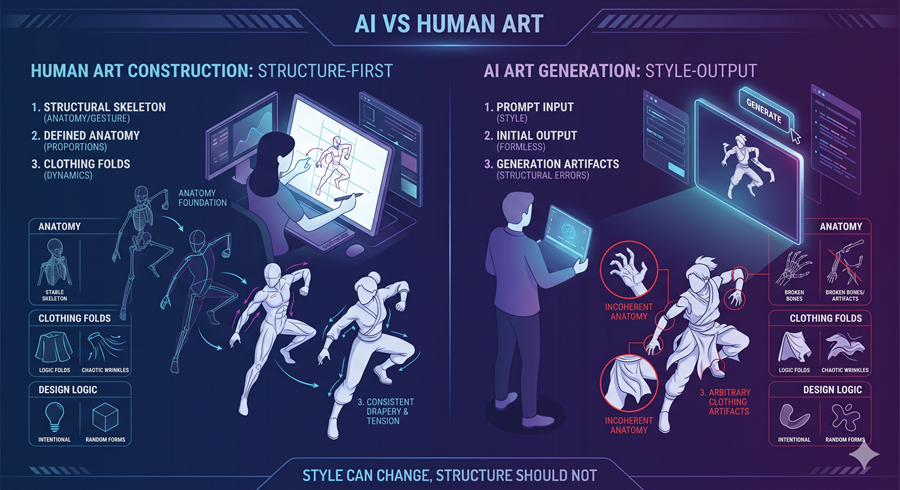
The hardest part about spotting AI-generated art isn’t identifying whether something looks “off.” It’s knowing when inconsistency crosses the line from stylistic variation into deliberate deception.
That distinction matters, especially in commission-based spaces where trust is the product as much as the art itself.
Style Differences Are Not Proof
Artists evolve. They experiment. They simplify, exaggerate, and shift styles depending on the project. On its own, a different rendering style is not evidence of AI use, and treating it that way creates the wrong kind of paranoia.
The real question is not whether two pieces look different. It is whether the underlying visual logic remains consistent.
A real artist may change polish, proportions, or rendering style. What usually remains stable is structural decision-making: how they draw ears, construct clothing, place folds, or solve repeated forms like laces, buttons, and collars.
That internal logic is often harder to fake than style itself.
The Tells Are Usually Structural
What raises suspicion is rarely anatomy alone. It is inconsistency in construction.
A mismatched shirt pocket. Buttons that do not align with buttonholes. Garments that ignore how fabric tension works. Laces that tangle into shapes with no readable structure. These are not just imperfections. They are the kinds of visual errors that suggest image generation rather than human drafting.
Human artists make mistakes. But their mistakes usually follow intention.
AI errors often do not. They tend to look resolved at first glance and collapse under scrutiny.
That difference is subtle, but important.
The Real Issue Is Misrepresentation
The core problem is not whether someone used AI in their workflow. The problem is presenting generated work as handcrafted commission art and charging clients under false pretenses.
That is not a style debate. It is a trust issue.
If someone is selling commissioned art, the expectation is not perfection. It is authorship. Clients are paying for interpretation, decision-making, and human execution—not just an output that looks polished from a distance.
Once that trust breaks, the damage spreads beyond one artist. It makes buyers more skeptical of everyone.
Why These Cases Matter
What makes these situations difficult is that they rarely hinge on one obvious flaw. It is the pattern that matters: repeated structural inconsistencies, evasive responses, and then the familiar disappearing act—accounts gone, profiles locked, commissions quietly erased.
That pattern does not prove intent on its own. But it rarely builds confidence either.
And in creative markets, credibility is often the first thing lost and the hardest thing to recover.
Follow Us on:
Clutch
Goodfirms
Linkedin
Instagram
Facebook
Youtube