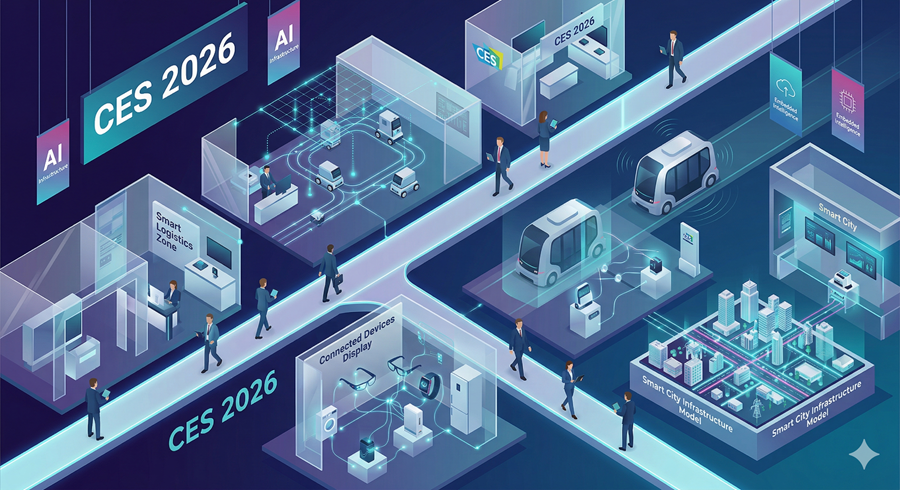
I walked into CES 2026 expecting more of the same buzz around artificial intelligence. Instead, what I saw felt like a shift. AI was still everywhere, but it was no longer the headline. It had quietly moved underneath the surface, powering machines, devices, and systems that operate in the real world. The focus was no longer on software alone. It was physical intelligence.
Robotics Takes Center Stage
I immediately noticed how dominant robotics had become. Booths were no longer showing scripted demos but continuous movement and real-time adaptability. Robots walked, adjusted balance, and reacted to disturbances without stopping. What stood out to me was not perfection but progress. These machines were no longer experimental displays. They were functioning systems being tested for real environments. Precision tasks like object handling and grip control also felt more refined, signaling that physical interaction is finally catching up with digital intelligence.
The Rise of Physical AI in Everyday Spaces
I saw a new category emerging that I think of as physical AI. Home robots, cleaning systems, and assistive machines are now being built to operate safely and reliably in daily life. What struck me most was the emphasis on stability over speed. These systems moved carefully, almost cautiously, which made it clear they are being trained for long-term use, not short-term demonstrations. Even devices like robotic vacuums are evolving beyond simple automation into adaptable machines that can navigate complex environments.
AI Companions and Emotional Technology
I also noticed a growing presence of emotional and companion-style devices. From small robotic pets to desktop AI assistants, these products are designed to interact, respond, and even simulate emotional understanding. What surprised me was how affordable some of these systems are becoming. This is no longer a niche category. It is moving toward mass adoption. At the same time, it raises questions about how comfortable people are with forming connections with machines that are designed to feel human-like.
Hardware Innovation Meets Intelligent Systems
I found it interesting how hardware innovation is evolving alongside AI. Foldable and rollable displays, adaptive screens, and new computing devices are being designed with intelligence built in from the ground up. These are not just form factor experiments. They are attempts to redefine how we interact with technology. Even chips and processors are now being built specifically to handle AI workloads efficiently, enabling longer battery life and more powerful on-device processing.
Infrastructure, Energy, and Global Systems
Beyond consumer tech, I saw AI deeply embedded in infrastructure. From satellite internet networks to fusion energy simulations, the scale of innovation is expanding rapidly. These are not short-term products but long-term systems that could reshape how the world connects and generates power. What stood out to me is how AI is becoming foundational, not optional, in building these large-scale technologies.
A Fully Assembled Future
By the end of it, I realized this was not a preview of the future. It felt like the future had already arrived in pieces and was now being assembled in front of us. AI is no longer something we interact with directly. It is something that quietly powers everything around us. And that shift may be the most important one yet.