I used to think of AI as something invisible, almost weightless. Just text on a screen, answers appearing instantly. But the reality is far more physical. Every prompt I type, every question I ask, quietly consumes resources, and one of the most surprising is water.
The “One Drop” Claim and the Reality
I came across an estimate suggesting that a single AI interaction uses about a teaspoon of water. At first, it sounds insignificant. Just a drop. But when I think about the scale, billions of interactions happening every day, that “drop” quickly turns into something massive.
Some experts, however, are not fully convinced by such low estimates. When I look deeper, I see that depending on the model size and usage, multiple queries could consume hundreds of milliliters of water. That is no longer a drop. That is a glass. The truth likely sits somewhere in between, but what matters to me is that the impact is real and growing.
Why AI Needs So Much Water
I realized the reason is not the AI itself, but the infrastructure behind it. Every time I send a prompt, it triggers complex computations inside powerful chips housed in massive data centers. These machines generate a huge amount of heat.
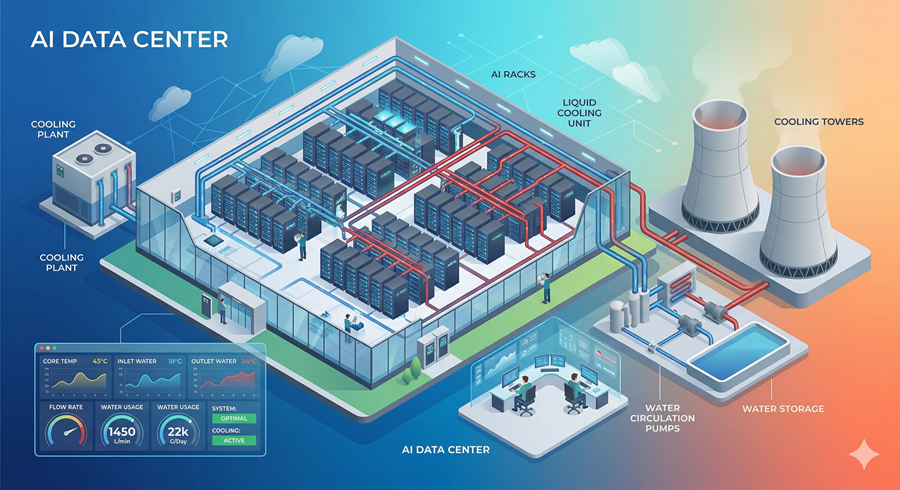
To keep them from overheating, cooling systems are essential. Many modern data centers now rely on liquid cooling, where water plays a central role. Clean water is used to absorb heat and keep systems stable. Without it, the hardware would fail.
The Hidden Cost of Cooling Systems
What surprised me most was how this cooling process works. Water is used to cool a separate liquid that circulates through the chips. That heated water is then sent to cooling towers, where a large portion of it evaporates into the air.
Up to 80 percent of that water can be lost through evaporation. That means it is not reused in the same way. It leaves the system entirely. When I think about this happening across thousands of data centers, the scale becomes difficult to ignore.
Beyond Data Centers: The Bigger Water Footprint
The story does not end with cooling. I also learned that water is used indirectly through electricity generation. Power plants often rely on water to produce steam that drives turbines. So every AI query also carries an energy-related water cost.
Then there is hardware manufacturing. Producing the semiconductor chips that power AI requires significant amounts of water for refining materials and fabrication. This means AI’s water footprint stretches across its entire lifecycle, from creation to operation.
The Growing Pressure on Global Resources
I find it concerning that communities around the world are beginning to push back against data centers. These facilities can strain local water supplies and energy grids, especially in regions already facing scarcity.
At the same time, demand is only increasing. Projections suggest that electricity use for AI-focused data centers could grow dramatically in the coming years. That also means more water consumption unless something changes.
Can AI Become Sustainable?
I do see efforts being made to reduce this impact. Companies are experimenting with new cooling methods that use less or no water. Some are even exploring ways to reuse heat generated by data centers. There are also ideas about relocating infrastructure to colder regions or entirely new environments.
For me, the key takeaway is not to reject AI, but to understand its cost. This technology is still young, and how we shape it now will determine whether it becomes sustainable in the long run. Every prompt may feel small, but together, they are part of a much bigger system that we are only beginning to understand.