I have been watching AI progress accelerate, but this week felt like a clear inflection point. It no longer feels like these systems are just improving in isolation. Instead, they are converging on a shared direction: AI agents that can plan, execute, and even refine their own performance across different domains. Coding, productivity, creative tools, and reasoning systems are all moving toward the same idea of autonomy.
AI Moves Into Self-Evolving Coding Systems
I see a new wave of coding models designed not just to generate code, but to behave like full engineering agents. These systems use a mixture of expert architectures, where only relevant parts of the model activate depending on the task. That makes them more efficient while still capable of handling complex workflows.
What stands out is how they are designed for real engineering environments. They are not just solving isolated coding problems, but working across repositories, debugging production issues, analyzing logs, and fixing broken workflows. In some cases, they can even trace deployment timelines and identify root causes of system failures.
Even more interesting is the self-improvement loop. These models run repeated cycles where they evaluate their own mistakes, adjust internal workflows, and test whether those changes improve performance. Over multiple rounds, they refine their own behavior. That creates a system that does not stay static after training, but continues to evolve through structured feedback.
AI Agents Enter Everyday Workflows
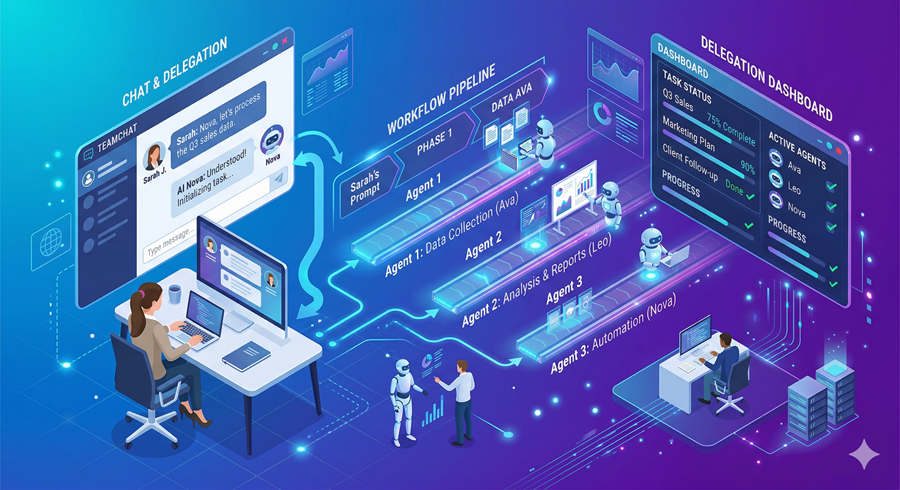
I also notice AI shifting into communication platforms like Slack, Discord, and Telegram. Instead of switching between tools, I can now assign tasks directly in chat. The system asks clarifying questions, builds a plan, and then executes the work step by step in the background.
This changes the relationship between the user and the system. I am no longer just prompting for outputs. I am delegating tasks. These agents can handle multi-step workflows, coordinate tools, and return results once complete. It feels much closer to working with a digital teammate than using a traditional app.
Google Turns Boards Into Voice-Driven Workspaces
Google is also pushing toward a more fluid creative environment. Collaborative boards are evolving into interactive workspaces where I can generate, organize, and refine ideas using both text and voice.
With voice control, I can rearrange elements, generate visuals, and structure content without touching the interface. Combined with automatic export into structured documents, it turns brainstorming directly into usable output. This noticeably reduces friction between ideation and execution.
OpenAI and the Rise of Persistent Agent Systems
I also see a shift toward long-running AI processes. Instead of single interactions, systems now support background tasks that continue working over time. Multiple agents can run in parallel, coordinate subtasks, and report progress back when ready.
This makes AI feel less like a tool you repeatedly query and more like a system that keeps working on your behalf. It introduces persistence, memory, and workflow continuity into everyday use.
Meta’s Parallel Thinking Approach
Meta is exploring a different but related direction with multimodal models that process text and images together. Instead of relying on a single reasoning path, multiple agents generate responses in parallel and refine them into a final output.
This improves both speed and quality of reasoning. It also makes these systems more capable of handling visual and structural tasks like interfaces, documents, and complex diagrams.
Across all of this, the pattern is clear to me. AI is no longer just assisting workflows. It is starting to execute them, coordinate them, and improve itself within them.
Short Paragraph
What stands out most is not any single model or product, but the shared direction across the entire industry. AI is moving from passive response systems to active agents that can work continuously across software, communication, and reasoning tasks. It feels like the beginning of a new operational layer for digital work.