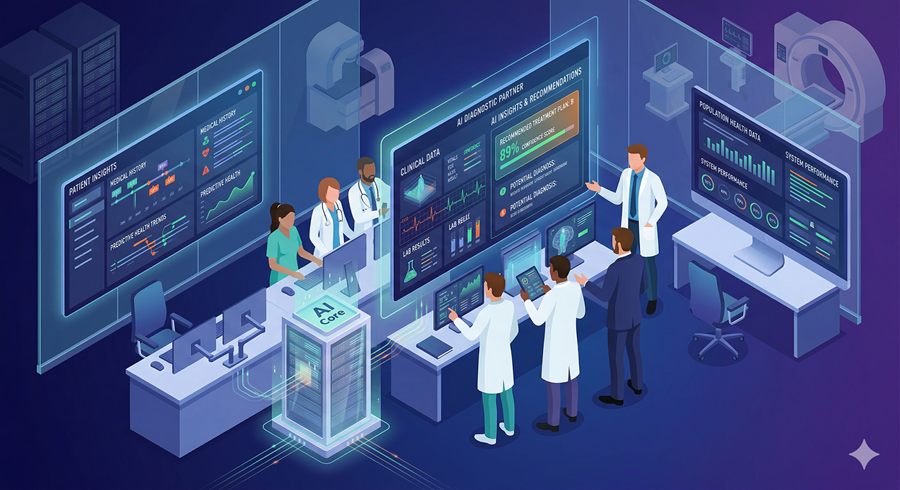
I have been following AI in healthcare for a while, but what stands out to me now is how it is shifting from a supportive tool to something that actively participates in medical reasoning. Instead of simply helping doctors analyze scans or retrieve information, these systems are beginning to simulate the diagnostic process itself. That shift feels significant because it moves AI closer to the core of medical decision-making rather than staying at the edges of it.
How the Multi-Agent Diagnostic System Works
I find the structure of this new diagnostic approach particularly interesting. It is built like a virtual medical panel, where multiple AI agents each take on a different role. One agent might focus on generating hypotheses, another on selecting appropriate diagnostic tests, and another on refining conclusions based on new evidence.
These agents do not work in isolation. They interact in a structured loop, debating and revising their reasoning step by step until a final diagnosis is formed. This process is designed to mirror how real clinical teams think through difficult cases, where no single opinion is considered final without discussion and validation. The system is trained on hundreds of complex medical case studies, allowing it to learn patterns from some of the most challenging diagnostic scenarios documented in medicine.
Chain of Debate as a New Reasoning Method
What I find especially notable is the use of a structured reasoning method often described as a “chain of debate.” Instead of producing a single linear answer, the system builds its conclusion through intermediate steps that reflect different perspectives. Each step adds clarity, corrects potential errors, and reduces the risk of missing rare or complex conditions.
By combining multiple large language models from different research ecosystems, the system also avoids relying on a single reasoning style. This diversity of models creates a broader analytical base, which seems to improve consistency in difficult cases.
Reported Accuracy and Its Implications
The reported diagnostic accuracy, around 85 percent in complex cases, immediately caught my attention. These are not simple, straightforward conditions but difficult medical scenarios where even experienced physicians struggle. In comparison, human performance on similar benchmark cases has been significantly lower.
For me, this does not mean AI is outperforming doctors in every sense. Instead, it highlights how structured computational reasoning can complement human expertise, especially in environments where time, fatigue, and information overload can affect decision quality.
What This Could Change in Healthcare Systems
I see this development as part of a broader transformation in healthcare. If systems like this are deployed responsibly, they could help reduce diagnostic delays, support rural or underserved regions, and assist doctors in handling complex or rare conditions.
At the same time, I also think about the risks. Medical decisions are not just technical outputs. They involve responsibility, context, and patient trust. Integrating AI into this process requires careful validation, regulatory oversight, and clear boundaries between assistance and authority.
Beyond Diagnosis: A Shift in Medical Infrastructure
I also notice that AI is not just entering diagnosis but the entire healthcare pipeline. From advanced imaging systems that reconstruct scans more accurately to experimental tools that estimate health risks from simple inputs, the ecosystem is expanding quickly. Each layer of healthcare, from detection to prediction, is being influenced by machine intelligence.