
How to Build AI Cloud Infrastructure That Stays Up When Everything Else Falls Apart
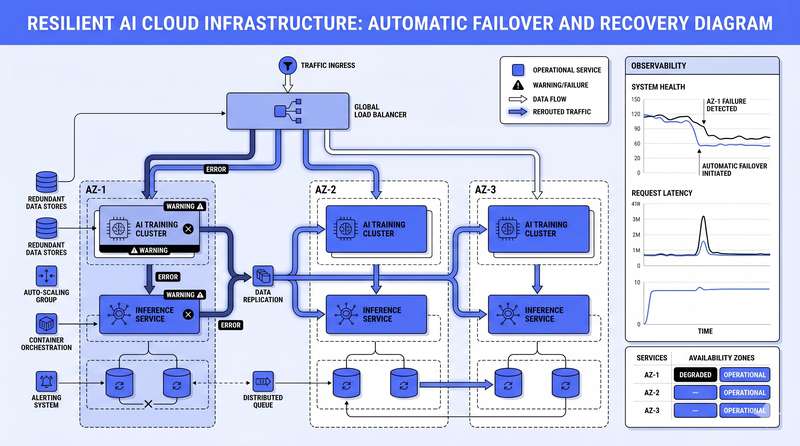
Downtime has always been expensive. Add AI to the equation and the stakes change in ways that many US enterprises have not fully accounted for. When an AI-powered customer service system goes down, for organizations that have reduced human support capacity in anticipation of AI handling the load, an AI system outage creates a customer service crisis. The consequences of AI infrastructure failures are often more severe than equivalent traditional software failures. Why AI Infrastructure Fails Differently Than Traditional Infrastructure The AI-specific failure modes that traditional infrastructure monitoring cannot detect Model serving infrastructure failures – servers or containers running inference going down prevents any AI-powered features from functioning. Model performance degradation is a failure mode traditional infrastructure does not have – your servers can be fully operational while your AI system is effectively failing because the model’s performance has degraded below acceptable thresholds. Dependency failures in AI systems cascade more severely – an AI-powered application typically depends on model serving infrastructure, retrieval infrastructure, data pipelines, embedding services, and orchestration layers simultaneously. Latency spikes under load are a common AI infrastructure failure mode that is easy to underestimate during capacity planning. The Architecture of Resilient AI Infrastructure Redundancy at the model serving layer means running multiple inference infrastructure instances across multiple availability zones, with load balancing that routes traffic away from unhealthy instances instantly. Graceful degradation – rather than failing completely when an AI component is unavailable, well-designed systems fall back to a reduced but functional experience. Circuit breakers prevent cascading failures by automatically stopping requests to a failing dependency before they overwhelm other components. Caching strategies can significantly reduce the load on AI infrastructure components and improve resilience to load spikes for common queries. The key differences in capacity planning for AI workloads versus traditional web applications The Investment That Prevents the Expensive Emergency Building genuinely resilient AI infrastructure costs more upfront than building the minimum viable version. Redundant infrastructure, proper monitoring, graceful degradation, and load testing all require investment that a minimum viable deployment can skip. The cost of skipping this investment is not zero – it is deferred until the first significant outage, at which point it arrives as emergency engineering effort, customer impact, revenue loss, and reputational damage.
AWS or Google Cloud for AI: The Honest Comparison US Enterprises Need Right Now
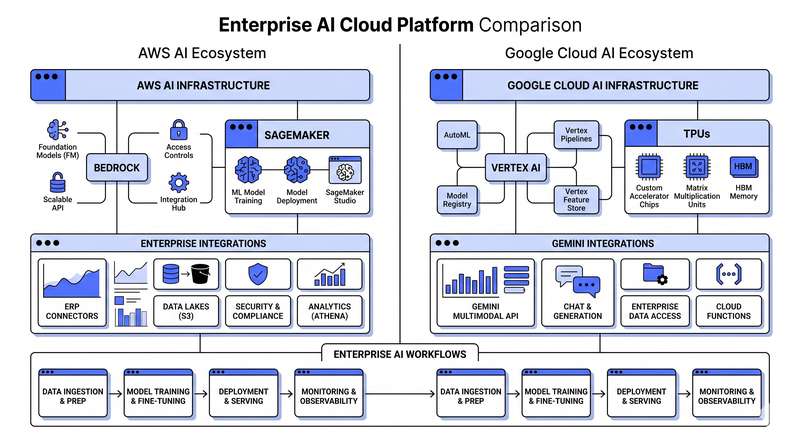
Cloud platform decisions are among the most consequential infrastructure choices US enterprises make, and for organizations building serious AI capabilities, the platform choice has implications that extend well beyond storage and compute costs. The AI tooling, model access, MLOps infrastructure, and developer experience differences between AWS and Google Cloud are significant enough to materially affect how quickly and effectively your organization can build and deploy AI systems. Where Google Cloud Has a Genuine Advantage Google Cloud’s genuine AI advantages for US enterprises in 2026 Vertex AI is Google Cloud’s unified AI platform, covering the full ML lifecycle from data preparation through model training, evaluation, deployment, and monitoring in a more integrated way than AWS’s equivalent services. TPU access is a genuine differentiator – Google’s Tensor Processing Units are purpose-built for neural network workloads and offer significant performance and cost advantages over GPU training. Gemini integration throughout the Google Cloud ecosystem means native access to Google’s frontier multimodal models. BigQuery ML allows training and running ML models directly on data in BigQuery without moving data to separate training infrastructure. Where AWS Has a Genuine Advantage Ecosystem breadth is AWS’s most durable advantage – more third-party tools, more enterprise software integrations, and more specialized services than any other cloud platform. Bedrock provides access to foundation models from multiple providers – including Anthropic’s Claude, Meta’s Llama, and Mistral – through a unified API with enterprise security features. SageMaker remains one of the most widely used managed ML platforms in US enterprise environments. Compliance certifications and enterprise security features are more mature on AWS, reflecting its longer history serving regulated US industries. How to make the right cloud AI platform decision for your specific organization Making the Decision for Your Organization The single most important input to this decision is your existing infrastructure. If your organization has significant existing investment in AWS, the migration cost and operational disruption of moving to Google Cloud for AI workloads needs to be weighed against the capability differences. For most US enterprises, the AI capability gap between the two platforms is not large enough to justify a wholesale migration from an established AWS environment.
What Is MLOps and Why Every US Enterprise Deploying AI Needs to Understand It
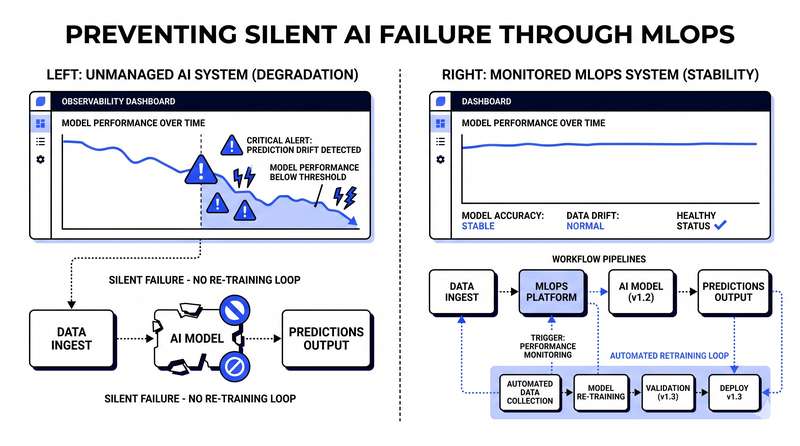
There is a moment that happens in nearly every US enterprise AI project. The model is trained. The accuracy metrics look good. The demo works beautifully. The team deploys to production and moves on. Three months later, the model’s performance has quietly degraded to the point where it is producing worse outcomes than the manual process it replaced, and nobody noticed until the damage was done. This scenario is almost entirely preventable with proper MLOps practice. What MLOps Actually Means MLOps – Machine Learning Operations – is the set of practices, tools, and cultural norms governing how machine learning models are deployed, monitored, maintained, and improved in production. ML systems behave differently from traditional software. Traditional software does what it is programmed to do, consistently, until the code is changed. ML systems do what the data told them to do – and when the world changes, the patterns change, and model performance degrades even though nobody changed a line of code. This degradation, called model drift, is invisible without monitoring. The core components of a mature MLOps practice that keeps AI systems performing reliably The Core Components of MLOps Model versioning and registry provides a systematic way to track which model version is deployed where. Automated training pipelines allow models to be retrained on fresh data without requiring manual engineering intervention every time. Continuous integration and deployment for ML automates testing a new model version and deploying to production when it meets defined quality thresholds. Model monitoring tracks performance metrics in production continuously. Data quality monitoring watches for changes in the statistical properties of data flowing through the system. What Model Drift Looks Like in Practice Data drift occurs when the distribution of real-world inputs changes relative to training data – a fraud detection model trained before a new fraud pattern emerged will not detect that pattern. Concept drift occurs when the relationship between inputs and desired outputs changes even if the input distribution stays the same. Upstream data changes occur when systems feeding data into the model change in ways that alter the data’s meaning without changing its format. The true cost of not investing in MLOps – and why it always exceeds the cost of doing it right The Business Case for MLOps Investment Consider the cost of a customer-facing AI feature that degrades silently over six months – degraded user experience, reduced conversion, potentially incorrect decisions, and the eventual emergency effort required to diagnose and fix the problem when it becomes visible. This cost is almost always significantly larger than the cost of proper monitoring infrastructure that would have caught the drift early. MLOps is not an insurance policy. It is the operational infrastructure that makes AI systems reliably deliver the value they were built to deliver.
The UI and UX Mistakes That Are Killing Enterprise AI Product Adoption in the US
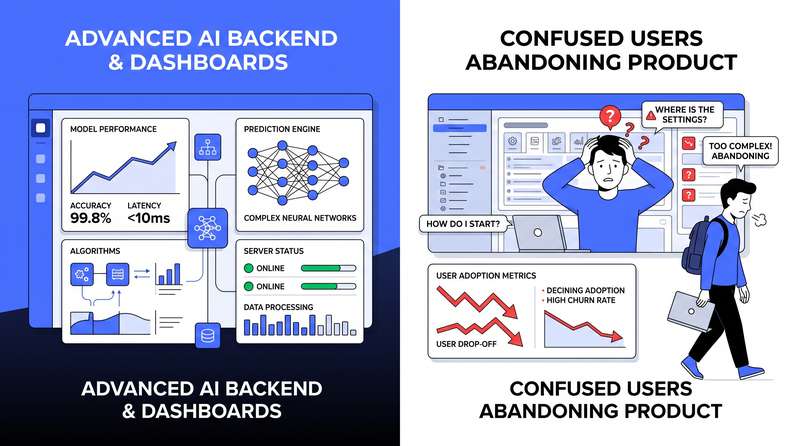
A US enterprise invests months and significant budget building an AI-powered product. The underlying models are excellent. The accuracy is strong. The backend engineering is solid. The product launches. And then almost nobody uses it. This scenario plays out with alarming frequency across US enterprise AI deployments, and the root cause is almost never the AI – it is the interface. Mistake One: Hiding the AI Some enterprise teams design interfaces that give users no indication that AI is involved in generating their outputs. Users who do not know an AI generated something do not know to verify it. They do not understand why output varied from yesterday’s output on the same input. Transparency about AI involvement does not require exposing technical details – it requires giving users enough context to interpret outputs appropriately. Mistake Two: Designing for the Best Case The five most common UI/UX mistakes that kill enterprise AI adoption Most enterprise AI interfaces are designed for the happy path – polished and thoughtfully designed when the AI produces a correct, confident, well-formatted output. Everything else is an afterthought. Production AI interfaces need explicit design for low-confidence outputs, error states that communicate meaningfully without technical jargon, fallback experiences when the AI cannot handle a specific input, correction workflows allowing users to provide feedback without breaking their flow, and escalation paths for situations the AI handles poorly. Mistake Three: Removing User Control in the Name of Simplicity AI outputs in enterprise contexts frequently need to be reviewed, edited, approved, or discarded. Users need the ability to correct AI errors, adjust outputs to fit their specific context, and override AI recommendations when their judgment differs. Interfaces that do not provide this control force users to work around the system rather than with it – and they will choose workarounds every time. Mistake Four: Inconsistent Loading and Response Patterns The most damaging pattern is inconsistency – an interface that sometimes shows a loading indicator and sometimes does not, that sometimes streams responses and sometimes displays them all at once, produces an experience that feels unreliable even when the underlying system is performing correctly. Users can adapt to slow systems. They cannot adapt to unpredictable ones. The design principles shared by enterprise AI interfaces that achieve strong adoption What Good AI Interface Design Actually Looks Like Enterprise AI interfaces that achieve strong adoption are transparent about AI involvement and its limitations without being technical or alarming. They maintain user control at the moments that matter most. They handle errors and edge cases as first-class design scenarios, not afterthoughts. They communicate latency and processing states consistently and predictably. And they are designed for the median user under real working conditions, not the ideal user in a demo scenario.
Why We Still Choose Next.js for AI Applications in 2026 and Why You Should Too
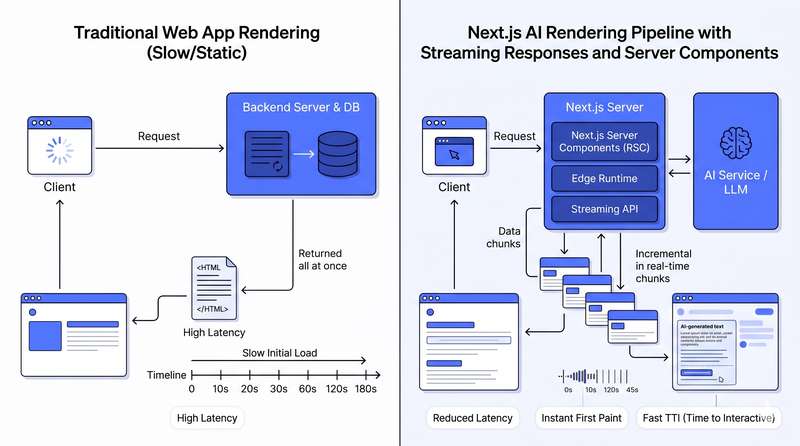
New frameworks emerge regularly, each promising to be better suited to modern AI-integrated development. Despite this, Next.js remains our default recommendation for US enterprises building AI-powered web applications – and the reasons are more nuanced than familiarity or inertia. What AI Applications Actually Demand From a Framework Building AI into a web application changes the fundamental performance and architectural requirements in ways that expose weaknesses in frameworks not designed for these demands. Streaming – LLM responses are generated token by token, and waiting for the entire response before displaying anything produces an unacceptably slow experience. Server-side AI processing matters for performance and security – making AI model calls from the browser exposes API keys and creates latency. Edge deployment is increasingly important where reducing latency between the user and the processing layer directly improves experience. The specific Next.js features that make it well-suited for AI application development in 2026 Why Next.js Handles These Demands Well Server Components allow AI processing to happen on the server with zero JavaScript shipped to the client. Streaming Server Components and Suspense enable progressive rendering of AI-generated content with loading states handled natively. Route Handlers provide a clean way to build backend AI endpoints within the same codebase as the frontend. Edge Runtime support allows specific API routes to run at the edge, reducing latency for AI-integrated endpoints serving users globally. Vercel AI SDK integration provides first-class support for building streaming AI interfaces with pre-built UI components. How Next.js compares to its real alternatives for AI application development Addressing the Real Alternatives Remix offers excellent progressive enhancement but has a smaller ecosystem of AI-specific tooling. SvelteKit produces smaller bundle sizes with an excellent developer experience but has a smaller enterprise adoption base. The honest answer is that a well-built application on any of these frameworks will outperform a poorly built one on Next.js. The reason we recommend Next.js as a default is that its ecosystem, AI tooling, deployment options, and community make it the path of least resistance to a well-built AI application in 2026.
AI-Powered Web Applications vs Traditional Builds: What the Performance Gap Looks Like
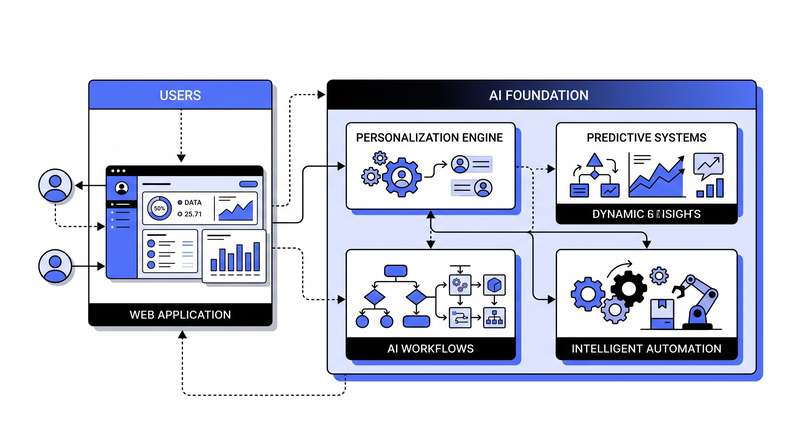
There is a meaningful difference between applications that use data to improve user experience incrementally and applications built from the ground up with AI as a core architectural component. That difference – in user engagement, conversion, and operational efficiency – is becoming one of the clearest competitive divides in US enterprise software. What Makes a Web Application Truly AI-Powered A genuinely AI-powered web application is one where machine intelligence is woven into the core user flows, backend processing, and decision logic. Characteristics include dynamic personalization that adapts the interface and content to individual user context in real time, intelligent automation that handles complex processing without human intervention, natural language interfaces allowing users to interact through conversation rather than menus, and predictive features that anticipate user needs before they are explicitly requested. Where AI-powered web applications consistently outperform traditional builds in key metrics Where the Performance Gap Comes From User engagement increases when applications adapt to individual users rather than presenting a one-size-fits-all experience. Conversion rate improvements in AI-powered e-commerce and lead generation applications range from 15 to 40 percent depending on the baseline and implementation quality. Operational efficiency gains come from the automation of processes that would otherwise require human intervention – customer service handling, document processing, and data enrichment workflows that previously required manual effort can be automated end-to-end. The Next.js and Node.js Foundation We build AI-powered web applications primarily on a Next.js and Node.js stack. Next.js provides server-side rendering capabilities critical for AI-powered applications where personalization needs to be rendered on the server to avoid layout shifts. Node.js provides the non-blocking I/O architecture particularly well-suited to AI application patterns where multiple concurrent model calls, streaming responses, and real-time processing are common requirements. The three integration challenges that separate well-built AI applications from poorly integrated ones
Fine-Tuning Foundation Models: The Development Shortcut US Enterprises Are Finally Using
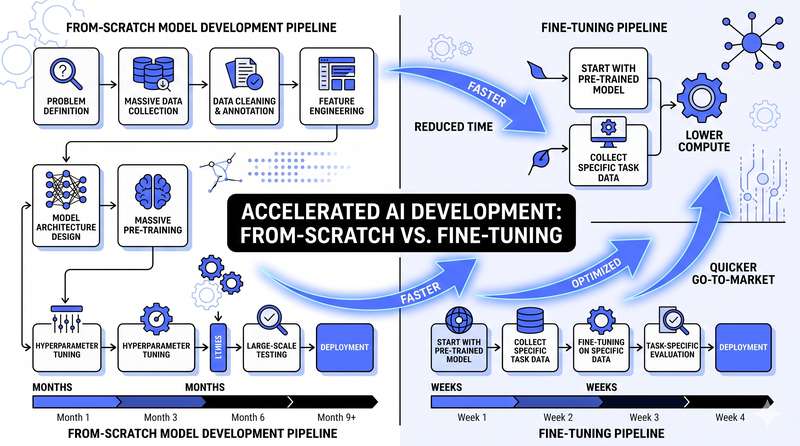
Eight months. That is roughly how long it takes to build, train, validate, and deploy a custom AI model from scratch for a specialized domain application. Now consider fine-tuning an existing foundation model on domain-specific data, reaching production-ready performance in six to eight weeks. This is the reality that US enterprises are discovering as foundation model fine-tuning matures from a research technique into a reliable engineering practice. Why Fine-Tuning Accelerates Development So Dramatically A model like Llama 3 has been trained on trillions of tokens of text. It understands language structure, grammar, reasoning patterns, and factual knowledge across hundreds of domains. When you fine-tune this model on your domain data, you are not teaching it language from scratch – you are teaching it the specifics of your domain, your terminology, your task format, and your quality standards. The equivalent of hiring a highly educated generalist and training them on your specific business versus hiring someone with no education and training them from zero. The data quality characteristics that determine fine-tuning success or failure The Data Requirements for Effective Fine-Tuning Effective fine-tuning data has clear input-output pairs that represent the exact task the model should learn, consistent quality across examples, sufficient diversity to cover the range of real inputs, coverage of edge cases, and accurate high-quality labels throughout. For tasks relatively close to the model’s existing strengths, a few hundred high-quality examples can produce meaningful improvement. Modern Fine-Tuning Techniques Techniques like LoRA (Low-Rank Adaptation) and QLoRA have made fine-tuning significantly more efficient and less risky. These approaches update only a small subset of the model’s parameters rather than all of them, preserving general capabilities more reliably and reducing the compute requirements for the fine-tuning process itself. US industries seeing the strongest results from foundation model fine-tuning Industries Seeing the Strongest Results Legal services organizations are fine-tuning models on contract language, case law, and internal document libraries. Healthcare organizations are fine-tuning on clinical documentation and patient communication data – accuracy improvements on clinical tasks directly affect patient care quality. Financial services firms are fine-tuning on regulatory documents and financial analysis reports to build systems that understand financial instruments and regulatory requirements with genuine precision.
Llama or GPT: A Practical Comparison for US Enterprises Making the Decision Now
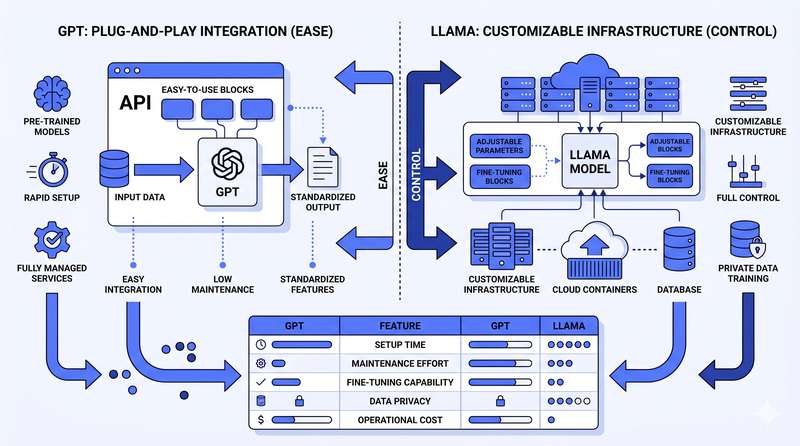
GPT-4 from OpenAI has been the default choice for many organizations simply because it was first to market with impressive capabilities. Llama, Meta’s open-source model family, has grown rapidly and is increasingly a serious alternative or complement to GPT in enterprise deployments. This is a practical guide to which model family makes more sense for different enterprise contexts – not a raw benchmark comparison. The Fundamental Difference: Closed vs Open With GPT, you are using a service. Your data passes through OpenAI’s infrastructure. You pay per token. You accept OpenAI’s terms of service and data handling policies. You have no control over how the model changes between versions. With Llama, you are running software. You deploy it on your own infrastructure. You pay for compute, not per token. Your data never leaves your environment. You have complete control over the model, including the ability to fine-tune it extensively on your proprietary data. When GPT Is the Right Choice GPT makes the most sense when your use case requires the absolute highest level of reasoning capability and you are not handling sensitive proprietary data. For enterprises deeply integrated into the Microsoft ecosystem, GPT models accessed through Azure OpenAI Service provide enterprise-grade security with native integration. For organizations that need strong multimodal capabilities, GPT-4o currently has a more mature implementation. The growing set of enterprise use cases where Llama consistently outperforms GPT When Llama Is the Right Choice Data privacy and security requirements are the most common driver – US enterprises in healthcare, financial services, legal, and defense have data that simply cannot be sent to a third-party API. Llama deployed on private infrastructure is the only viable foundation model option for these organizations. Cost at scale – GPT’s per-token pricing becomes expensive at enterprise scale. Deep customization requirements favor Llama when an enterprise needs to fine-tune extensively on proprietary data with full control over the training process. How leading US enterprises are using both GPT and Llama for different purposes within the same AI architecture The Hybrid Approach Many US enterprises are adopting a hybrid strategy – GPT handles complex, low-volume reasoning tasks where its frontier capabilities justify the cost. Llama handles high-volume, specialized tasks where its deployability, customizability, and cost profile are superior. This approach requires more architectural sophistication but delivers better performance and economics than relying exclusively on either model family.
Foundation Models Explained: Why US Enterprises Are Betting Big on This Technology
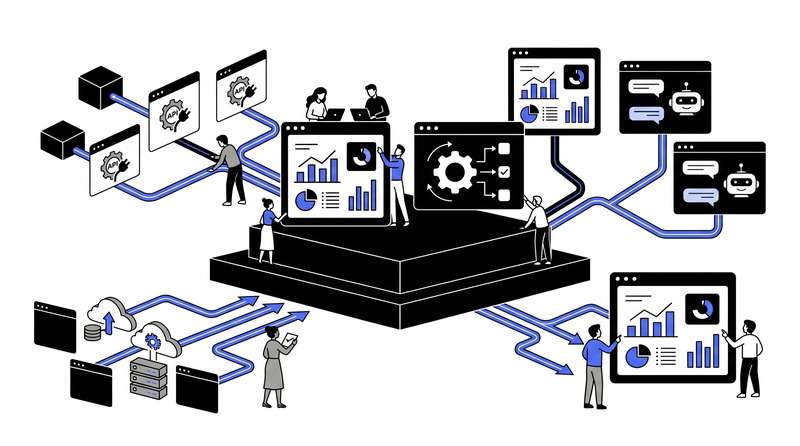
The term foundation model has become one of the most used and least understood phrases in enterprise AI. But foundation models represent a genuinely important shift in how AI is developed and deployed – one that every US enterprise building serious AI capabilities needs to understand clearly. What a Foundation Model Actually Is A foundation model is a large AI model trained on an enormous and diverse dataset, designed to serve as a general-purpose starting point that can be adapted for a wide range of specific tasks. Before foundation models, building an AI system for a specific task meant collecting task-specific training data, designing a model architecture, and training the entire system from scratch – expensive, time-consuming, and requiring significant technical expertise. Foundation models change this entirely. A model like GPT-4, Llama 3, or Claude has already learned a broad representation of language, reasoning, and knowledge. Building a specialized application on top requires far less data, compute, and time than building from scratch. The fundamental shift in enterprise AI development enabled by foundation models Why This Represents a Fundamental Shift Development cost and time have dropped dramatically – a specialized AI application that previously required months can now be built in weeks through fine-tuning. The quality ceiling has risen substantially because foundation models trained on vast datasets have developed capabilities that would be prohibitively expensive to replicate through task-specific training. Adaptability has improved because broad general capabilities allow handling novel inputs and edge cases more gracefully than narrow task-specific models. Fine-Tuning Foundation Models for Enterprise Use Fine-tuning a foundation model is fundamentally different from training from scratch. The model already understands language, reasoning, and general knowledge. Fine-tuning teaches it your specific domain, terminology, format preferences, and task requirements. The amount of data required is dramatically smaller – typically hundreds to thousands of examples rather than millions. The three deployment options for foundation models and what they mean for US enterprises Deployment Options and What They Mean API access through providers like OpenAI, Anthropic, or Google offers the lowest implementation overhead but involves sending data to an external provider. Managed cloud deployment through services like AWS Bedrock or Azure AI provides better data isolation. Private deployment on dedicated infrastructure provides maximum control and data security – the approach preferred by US enterprises in highly regulated industries.
Diffusion Models in the Enterprise: What US Businesses Need to Know in 2026
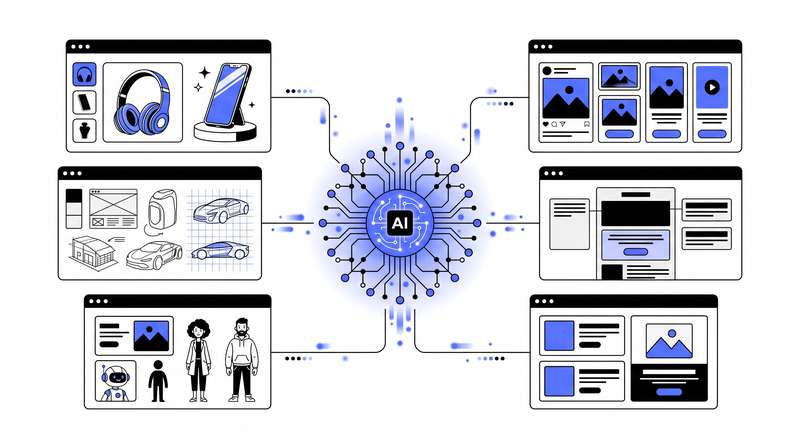
When most people hear the term diffusion models, they think of AI image generators. Reducing diffusion models to an image generation novelty is one of the most significant misconceptions in enterprise AI today. For US businesses in content-heavy, design-intensive, or data-rich environments, diffusion models represent a serious operational capability moving rapidly from research into production. What Diffusion Models Are and How They Work Diffusion models are a class of generative AI that learns to create data by studying the process of gradually adding noise to existing data, then learning to reverse that process. While image generation is the most visible application, the same approach applies to audio, video, 3D shapes, molecular structures, time series data, and more. The range of production enterprise applications being built on diffusion models in 2026 Enterprise Applications Already in Production Visual content production at scale – US companies in e-commerce, retail, media, and advertising are generating product imagery and marketing visuals at a fraction of traditional production cost and time. Product design and prototyping – an emerging application with significant implications for US manufacturing and consumer goods companies. Drug discovery and molecular design – US biotech and pharmaceutical companies are using diffusion models to generate novel molecular structures with specific desired properties. Synthetic data generation – enabling ML development where real data cannot be used directly due to privacy constraints. The Business Case for Visual Content Automation Traditional visual content production involves photographers, studios, art directors, and post-production teams. Cost per image across this pipeline is substantial and time from brief to finished asset is measured in days or weeks. Diffusion model-based content systems produce high-quality visual assets in seconds to minutes at a cost per image orders of magnitude lower. The human creative team shifts from execution to direction and curation. The engineering requirements that separate enterprise-ready diffusion deployments from demos