
What Real Enterprise Generative AI Looks Like Behind the Scenes in 2026
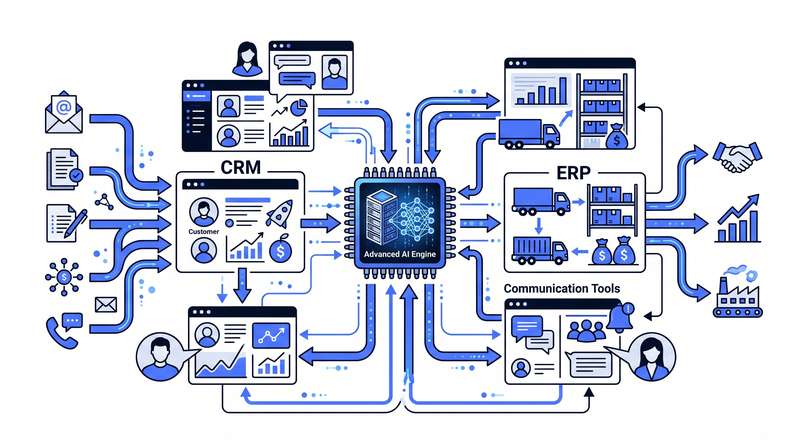
ChatGPT changed how the world thinks about AI. But the conversation that ChatGPT started and the reality of enterprise generative AI in production are two very different things. Consumer AI tools are designed for individual users. Enterprise generative AI is designed for organizations with complex workflows, sensitive data, regulatory requirements, and the need for consistent, auditable outputs at scale. Why Consumer AI Tools Are Not Enterprise AI Systems The critical differences between consumer AI tools and enterprise AI systems Security and data isolation – consumer AI tools process user inputs on shared infrastructure. For enterprises handling customer data or regulated content, this is unacceptable. Reliability and uptime standards for enterprise operations are dramatically higher than what consumer tools guarantee. Integration depth – consumer tools are standalone applications while enterprise generative AI is woven into CRM platforms, ERP systems, and workflow automation. Auditability and explainability requirements exist across virtually every regulated US industry. The Architecture of a Real Enterprise Generative AI System The foundation layer consists of one or more LLMs accessed through a private API or deployed on dedicated infrastructure. The data layer connects the generative system to enterprise knowledge bases through retrieval mechanisms. The orchestration layer manages the flow of information between components and handles multi-step reasoning. The safety and governance layer applies content filtering, compliance checking, and brand standard enforcement. The monitoring and observability layer tracks performance metrics and logs all system interactions for audit purposes. The five-layer architecture of a production-grade enterprise generative AI system What Separates Deployments That Succeed From Those That Stall The generative AI deployments delivering the strongest outcomes share consistent characteristics: executive sponsorship extending beyond the initial launch, design around specific measurable business outcomes rather than general AI exploration, genuine change management and user training built into the deployment plan, and a commitment to iteration rather than treating the deployment as a finished product.
Why US Enterprises Are Moving Away From Generic AI Tools Toward Custom LLMs
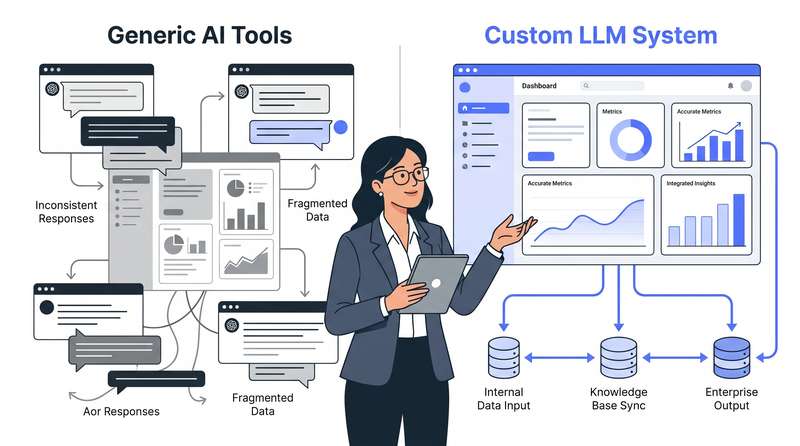
The first wave of enterprise AI adoption was largely about access. Organizations rushed to integrate ChatGPT or Copilot because the capabilities were genuinely impressive and the barrier to entry was low. But as US enterprises have moved beyond experimentation into serious AI-dependent operations, generic tools consistently hit a ceiling that arrives earlier and harder than most organizations anticipated. What Generic AI Tools Are Good At Off-the-shelf AI tools deliver real value for general-purpose writing assistance, broad research support, basic code completion, and simple content generation where your specific business context does not significantly affect quality. For individual productivity enhancement in these areas, generic tools remain excellent. The ceiling appears when you need AI that understands your specific business deeply. The four consistent failure points of generic AI tools in enterprise environments Where Generic Tools Break Down Knowledge boundaries – a generic LLM knows nothing about your products, customers, internal processes, or compliance requirements. Hallucination risk is amplified when the model does not have specific information and generates plausible-sounding but fabricated content. Consistency and brand alignment are difficult to maintain at scale with generic tools. Data privacy and security concerns are significant for US enterprises in regulated industries where data cannot be sent to a third-party API. What Custom LLMs Actually Look Like Custom LLM development does not necessarily mean training from scratch. In most enterprise contexts it means fine-tuning a foundation model on proprietary data; building a RAG system connecting a powerful model to your specific knowledge base; developing a complete LLM application with custom prompt engineering, tool integrations, and memory management; or deploying a model on your own infrastructure to eliminate third-party data exposure. The compounding performance advantage of custom LLMs over generic tools over time The Performance Gap Is Real and Widening US enterprises that move from generic tools to custom LLM deployments consistently report improvements that are not marginal. The gap between a generic model answering questions about your business and a purpose-built system trained on your data is significant across every metric: accuracy, consistency, relevance, and reliability. This advantage compounds over time as foundation models improve at general tasks but still do not automatically improve at your specific tasks.
LangChain and the New Era of Enterprise AI Workflow Development in the US
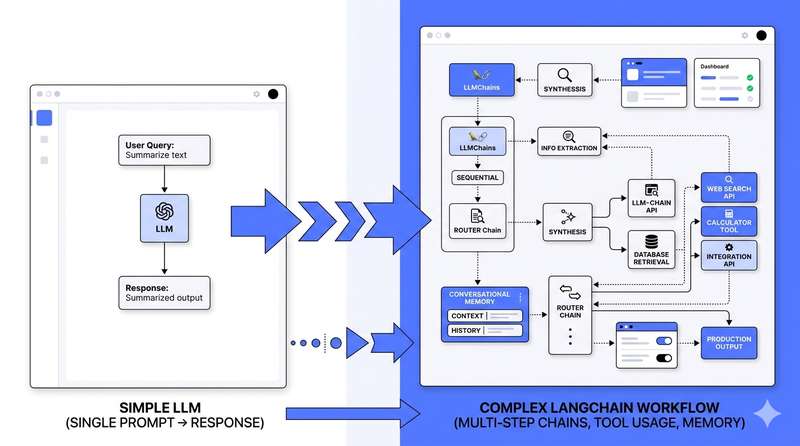
Building useful AI applications is harder than it looks. Taking a powerful language model and turning it into a production-ready system that connects to your data, follows multi-step reasoning, uses external tools, and handles real-world edge cases gracefully requires significant engineering scaffolding. LangChain was built to provide exactly that scaffolding. What LangChain Is and Why It Exists LangChain is an open-source framework that simplifies building applications powered by large language models. It provides standardized components and abstractions for the most common LLM application patterns: connecting models to data sources, building multi-step reasoning chains, managing conversation memory, integrating external tools, and orchestrating complex AI workflows. Before LangChain, building an LLM-powered application that retrieved information from a database, reasoned in multiple steps, and triggered actions in another system required building all of that plumbing from scratch. LangChain’s core components that enable enterprise-grade AI workflow development The Core Capabilities That Matter for Enterprise Chains link multiple LLM calls and processing steps into a single workflow – retrieving documents, summarizing them, comparing against criteria, and generating a structured recommendation. Agents allow the LLM to dynamically choose which tools to use to accomplish a goal – searching the web, querying a database, running calculations, or calling an external API. Memory management is critical for any AI application involving ongoing interaction. Retrieval integration is built into LangChain’s architecture, making it a natural foundation for RAG systems. Real Applications Being Built With LangChain US enterprises are using LangChain to build intelligent document processing systems that extract and summarize information from large volumes of contracts; customer service automation platforms that retrieve relevant information and escalate intelligently; internal research assistants that search across multiple data sources and generate structured reports; and code generation tools that analyze codebases with context awareness across large repositories. When LangChain wins over custom builds – and when custom architecture pays off LangSmith for Production Observability LangSmith, the observability platform developed by the same team, provides detailed tracing of every step in a LangChain application. For US enterprises that need to debug, optimize, and audit AI workflows in production, LangSmith is increasingly essential. The framework has matured significantly and is used in production by large organizations across the US.
Fine-Tuning or Prompt Engineering: What US Enterprises Need to Know Before Deciding
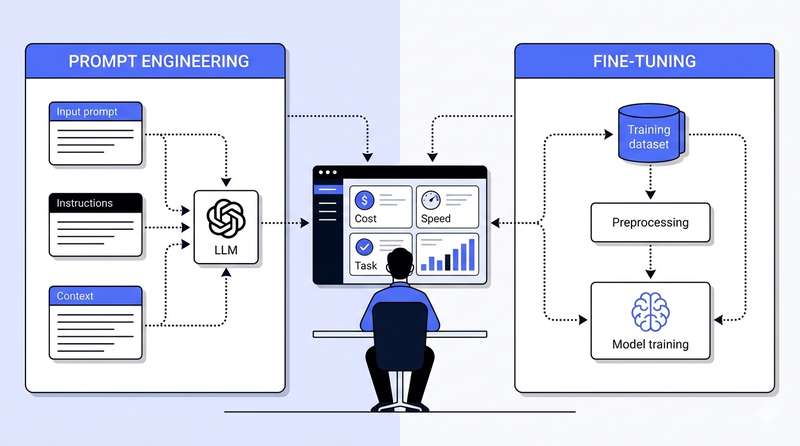
Every US enterprise exploring LLM deployment eventually faces this question. Do you customize the model itself through fine-tuning, or guide its behavior through carefully designed prompts? Both approaches work. Both have real limitations. Choosing the wrong one will cost you time, money, and internal credibility. Understanding the Baseline Modern foundation models have remarkable general capabilities. What they cannot do by default is know your business – your products, internal terminology, compliance requirements, or tone of voice. Closing that gap is exactly what prompt engineering and fine-tuning are designed to do, in very different ways. What Prompt Engineering Actually Is Prompt engineering is the practice of designing the instructions, context, and examples you provide to a model at query time to shape its output. At its simplest it is writing better instructions. At its most sophisticated it involves chain-of-thought prompting, few-shot examples, system prompt design, and output format specification. Advantages: fast to implement and iterate, no training data required, works with any model, lower cost. Limitations: context window constraints, inconsistent results on tasks requiring deep domain adaptation. Advanced prompt engineering techniques that US enterprises are using to customize LLM behavior What Fine-Tuning Actually Is Fine-tuning takes a pretrained foundation model and continues its training on a curated dataset specific to your use case. The model’s weights are updated to reflect the patterns and behavior in your training data – it genuinely internalizes your domain knowledge rather than receiving it through a prompt each time. Advantages: consistent behavior baked into the model, significantly better performance on specialized tasks, lower per-request token costs, better maintenance of consistent tone and style across responses. The Case for Combining Both One of the most effective strategies is using both together: fine-tune the model on your domain data to establish a strong baseline of specialized knowledge, then use prompt engineering at runtime to handle task-specific instructions, formatting requirements, and dynamic context. This combination is particularly powerful for customer-facing applications where consistency and accuracy both matter enormously. The combined approach: fine-tuning for domain expertise, prompt engineering for task-specific guidance Making the Right Call For most US enterprises early in their LLM journey, prompt engineering is the right starting point – faster, cheaper, and reversible. Fine-tuning becomes the right answer when you have validated the use case, have the training data to do it properly, and need performance or consistency levels that prompt engineering cannot reliably achieve.
Custom Machine Learning ROI: What US Enterprises Are Actually Getting Back
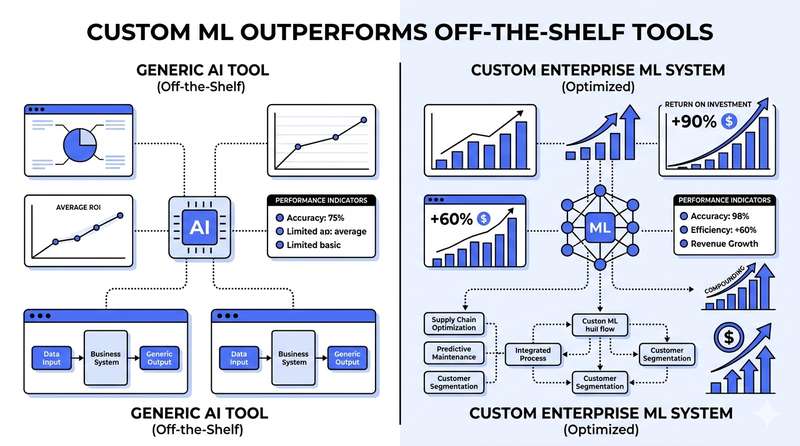
Return on investment is the question every US business leader asks before committing to a machine learning project. It also gets answered most vaguely by vendors who are more interested in closing a deal than setting accurate expectations. Custom machine learning delivers strong ROI for the right problems in the right organizations – the difference between those two outcomes is almost entirely about execution, not technology. Why Custom Beats Off-the-Shelf for Serious ROI Pre-packaged AI tools are trained on generic data and optimized for the average use case. A model trained on your proprietary historical data, engineered specifically for your operational environment, will outperform a generic tool on your specific problem almost every time. The cost of that customization is offset by the performance gap – and for enterprise-scale operations, even a 10 percent improvement in a key metric can represent millions of dollars in annual value. Where US Enterprises Are Seeing the Strongest Returns The highest ROI applications cluster consistently around demand forecasting and inventory optimization (15–30% reduction in carrying costs), predictive maintenance in manufacturing (30–50% reduction in unplanned downtime), customer churn prediction and intervention (10–25% churn rate reduction when model predictions are connected to actual retention workflows), and fraud detection and risk scoring in financial services. The highest-ROI ML applications for US enterprises in 2026 The Timeline Reality Machine learning systems improve over time as they accumulate more data and go through retraining cycles. The first version of a model is rarely the best version. US enterprises that evaluate ROI only at the six-month mark often conclude a project underperformed, when in reality the system was still in its highest-value growth phase. Setting the right expectation – that ROI compounds over 18 to 36 months rather than delivering immediately – is essential for accurate project evaluation. What Reduces ROI Dramatically Several factors consistently erode ML ROI: poor data quality requiring expensive remediation mid-project, scope creep adding complexity without proportional value, lack of end-user adoption because model output was never integrated into actual workflows, no monitoring infrastructure leading to undetected model decay, and rebuilding from scratch every time conditions change instead of maintaining and retraining. Key factors that reduce ML ROI and how to avoid them Setting the Right Expectations Custom machine learning is a capital investment with a risk-adjusted return that depends heavily on how the project is structured and executed. The businesses getting the best returns identified the right problem, built on clean data, integrated output into real decision-making processes, and committed to maintaining the system over time.
The Real Reason US Machine Learning Projects Fail and What to Do Instead
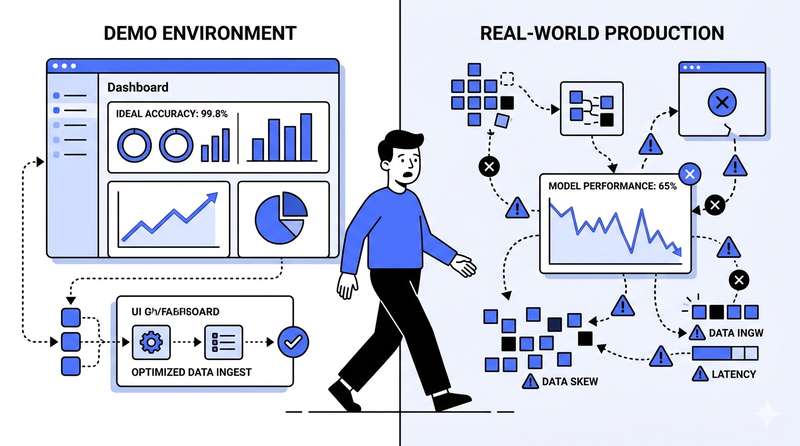
Somewhere between 80 and 90 percent of enterprise ML projects never make it to production. What is surprising is that most of these failures have nothing to do with the technology. The failure happens earlier, deeper, and in places much harder to debug than a line of code. Failure Point One: Starting With Technology Instead of the Problem This is the most common and most costly mistake. Leadership gets excited about AI, allocates budget, and the first question asked is “what should we build?” instead of “what problem are we solving and how will we know if we solved it?” Machine learning is a tool – its value is entirely dependent on whether it is applied to the right problem with a measurable definition of success. Failure Point Two: Underestimating the Data Problem Ask any experienced ML engineer what they spend most of their time on and the answer is almost always data. US enterprises consistently underestimate both the quality and volume of data required to build a functional model. Typical issues include data spread across multiple systems with no unified schema, missing values, inconsistent formatting, historical data that does not reflect current business conditions, and labels created inconsistently over time. Poor data quality is the leading cause of ML project failure in US enterprises Failure Point Three: Building for the Demo, Not Production A data science team builds a model that performs beautifully in a controlled environment. Leadership approves further investment. Then the wheels come off during deployment. Production environments are messy. Data pipelines break. Edge cases appear that never showed up in training data. The model that scored 94 percent accuracy in testing suddenly produces nonsense in the real world. Failure Point Four: No Clear Ownership After Deployment ML models require ongoing maintenance, monitoring, and periodic retraining as data distribution shifts over time – called model drift. US enterprises that treat ML deployment as the finish line rather than the starting line consistently see their models degrade quietly until someone notices the predictions no longer make sense. Failure Point Five: Misaligned Success Metrics A data science team optimizes for accuracy. The business needed to reduce churn. These are not the same objective. The right success metrics for an ML project are always defined in business terms first, then translated into technical objectives. Not the other way around. The characteristics shared by ML projects that successfully deliver business value What Successful ML Implementation Looks Like The enterprises that get this right start with a tightly scoped problem that has clear business value, invest seriously in data infrastructure before touching model development, involve end users in the design process, build monitoring and retraining into the project scope from day one, and measure success in business outcomes, not model metrics.
TensorFlow or PyTorch: A Straight Answer for US Business Decision-Makers in 2026
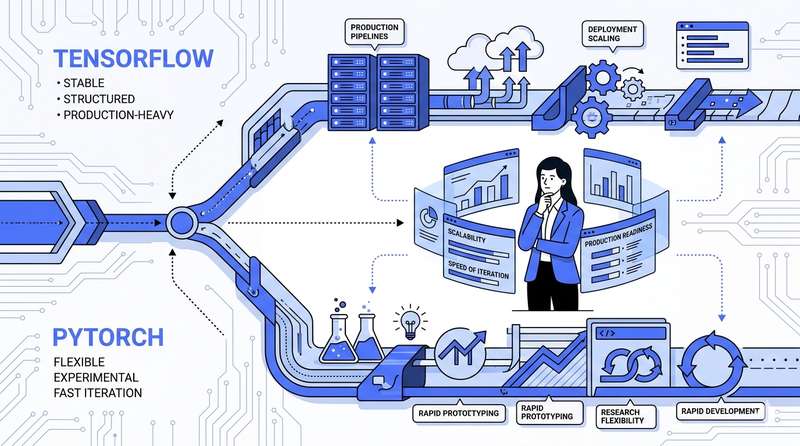
TensorFlow or PyTorch? Most content written about this debate is aimed at data scientists, not the business leaders who actually need to make a framework decision. This is a practical, honest breakdown from the perspective of what matters for a US enterprise building real AI systems in 2026. What These Frameworks Actually Are Both are open-source machine learning frameworks providing the building blocks for developing, training, and deploying AI models. TensorFlow was developed by Google and released in 2015. PyTorch was developed by Meta and released in 2016. Both are production-grade tools used by some of the largest organizations in the world. The choice affects how quickly your team can build and iterate, how easily you can deploy models at scale, and your long-term maintenance burden. Where TensorFlow Excels TensorFlow’s biggest strengths are in production deployment and scalability. Key advantages include TensorFlow Serving for high-availability model deployment, TensorFlow Lite for mobile and edge devices, native Google Cloud integration, mature tools for model monitoring and governance, and strong distributed training support across multiple machines and GPUs. TensorFlow’s production tooling makes it a strong choice for large-scale enterprise deployments Where PyTorch Excels PyTorch has become the dominant framework in research and is rapidly closing the gap in production. Its primary advantage is flexibility and development speed. A dynamic computation graph makes debugging and experimentation significantly faster. Dominance in academic research means the newest model architectures almost always appear in PyTorch first. Strong adoption in generative AI and LLM development makes it particularly well-suited for teams building on modern architectures. The current enterprise ML framework landscape in 2026 strongly favors PyTorch for new projects What the Current Landscape Looks Like Something important has happened in the past two years. PyTorch’s adoption in production has grown dramatically and is now the default choice for most new projects, including those at large US enterprises that previously standardized on TensorFlow. The shift is driven largely by the explosion of generative AI and LLM development where PyTorch’s ecosystem is simply stronger. TensorFlow remains the stronger choice for specific deployment scenarios – particularly mobile and edge – and for organizations deeply integrated with Google Cloud’s ML infrastructure. Our Recommendation For most US enterprises starting new AI development projects in 2026, we recommend PyTorch as the default starting point. The ecosystem momentum, the generative AI tooling, and the development experience advantages make it the more future-proof choice for the majority of use cases. TensorFlow remains the right answer for organizations with specific requirements around mobile deployment, existing Google Cloud MLOps infrastructure, or large legacy TensorFlow codebases that are expensive to migrate.
What Generative AI in Content Production Actually Looks Like for US Enterprises
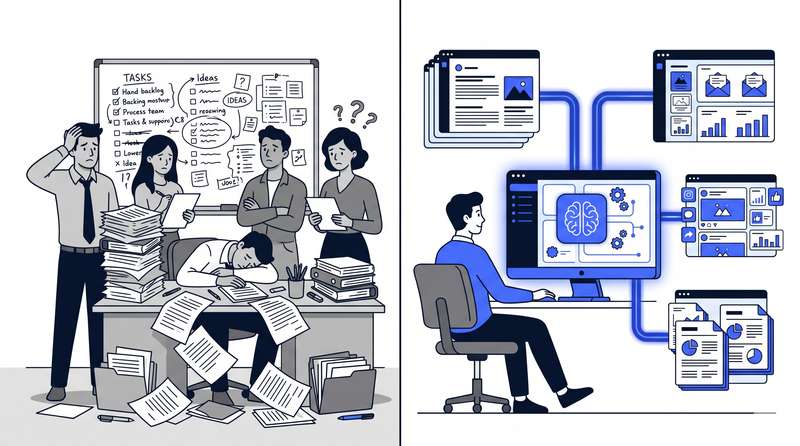
The real question for US enterprises is operational: how do we produce more high-quality content, faster, at lower cost, while maintaining consistency and accuracy? Generative AI, when implemented properly, answers that question in ways that go well beyond what most organizations have imagined. The Scale Problem Generative AI Actually Solves Enterprise content operations face a structural challenge: demand across digital channels, sales enablement, customer communications, and product documentation consistently outpaces the capacity of human content teams. Content teams that implement generative AI properly report producing three to five times more output with the same headcount. AI handles the volume work and first drafts, freeing human writers to focus on strategy, editing, and creative work that genuinely requires human expertise. The highest-value enterprise content use cases for generative AI in 2026 Where Generative AI Delivers the Most Value Product descriptions and catalog content – a US retailer with tens of thousands of SKUs can generate accurate, on-brand, SEO-optimized descriptions at scale using a system trained on your product database and brand guidelines. Personalized customer communications – email sequences that adapt to individual customer context can be generated at a scale impossible with manual writing. Content repurposing – taking a long-form research report and generating a blog post, a social media series, and a sales enablement one-pager from the same source material, with human oversight rather than human execution. What a Production-Grade Content AI System Actually Requires A brand and style knowledge layer ensures the system understands and consistently applies your specific tone and terminology. A content accuracy layer connects the generative system to your product data and factual sources. A human review workflow integrates AI output into your existing editorial process. Quality monitoring tracks the consistency and accuracy of AI-generated content over time and flags degradation before it becomes a problem. The four components that separate a production-grade content AI from a consumer tool
RAG Explained: The LLM Technique Changing Enterprise AI in the US
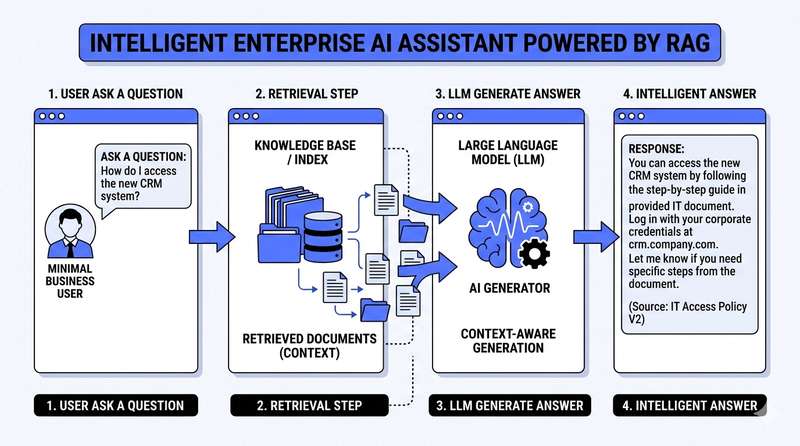
Large language models are remarkable at generating fluent, contextually aware text. They are also, by default, completely disconnected from your business. They do not know your products, your policies, or anything that happened after their training data was collected. Retrieval-Augmented Generation – RAG – is the technique that solves this problem for US enterprises. What RAG Actually Does Instead of asking an LLM to answer purely from internal training data, RAG adds a retrieval step. Before generating a response, the system searches your knowledge base – documents, databases, any structured or unstructured data – for relevant information, then passes it to the LLM as context. A standard LLM is like a brilliant consultant who has read everything ever published but knows nothing about your company. A RAG system gives that consultant instant access to your entire internal knowledge base before they answer. Why RAG Beats Fine-Tuning for Many Enterprise Use Cases Fine-tuning involves retraining the model on proprietary data – powerful but expensive and requiring retraining every time your data changes significantly. RAG does not change the model at all – it changes what information the model accesses at query time. Your knowledge base can be updated in real time without touching the model. It reduces hallucination because the model is anchored to retrieved facts, provides transparency since you can see exactly what documents were retrieved, and works with any LLM. RAG powering real enterprise use cases across industries in the US Real Enterprise Applications of RAG Internal knowledge management allows employees to query policy documents, HR handbooks, and technical documentation using natural language rather than keyword search. Customer support automation grounds the LLM in your actual product documentation so it answers questions accurately without hallucinating features that do not exist. Legal and compliance research retrieves relevant regulations and case law before generating analysis. Sales enablement gives sales teams instant access to relevant case studies and competitive intelligence. The Technical Architecture in Plain Terms A RAG system has three core components: the knowledge base and indexing layer where your documents are converted into a searchable format using embeddings; the retrieval mechanism where the system searches for semantically similar content when a query is submitted; and the generation layer where the LLM receives the query plus retrieved context and generates a response. The three-layer architecture that makes RAG systems work reliably in production What Determines RAG Quality Not all RAG systems perform equally. Quality depends on chunking strategy, embedding model quality, retrieval depth, context window management, and reranking. These details separate a RAG system that impresses in a demo from one that performs reliably across millions of real queries in production.
Predictive Analytics Is Quietly Saving US Enterprises Millions. Here Is How.
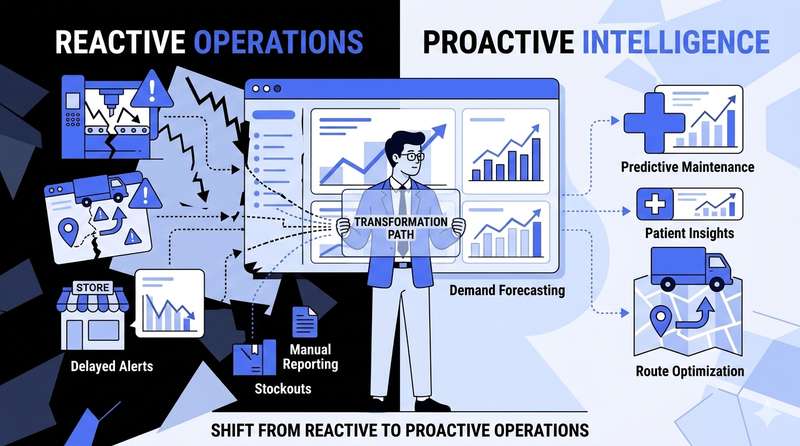
Most businesses are sitting on a goldmine they cannot see. Every transaction, every customer interaction, every equipment log generates data. For most US enterprises, that data sits in storage doing absolutely nothing. Predictive analytics changes that – turning historical patterns into forward-looking intelligence, and the companies that have embraced it are not just saving money. They are operating fundamentally differently from their competitors. What Predictive Analytics Actually Means in Practice Strip it down and predictive analytics is the use of historical data, statistical algorithms, and machine learning models to forecast future outcomes. In practical terms this might look like a manufacturing plant predicting equipment failure 72 hours before it happens, a retail chain forecasting demand spikes at individual store locations two weeks out, or a healthcare provider identifying patients most likely to be readmitted within 30 days. Predictive analytics in action across manufacturing, retail, healthcare, and logistics Where the Real Savings Come From Maintenance costs drop significantly when predictive models replace fixed maintenance schedules. US manufacturing firms report predictive maintenance alone reducing maintenance costs by 25 to 30 percent while extending equipment life. Inventory management is another major area – overstocking ties up capital while understocking leads to lost sales. Predictive models trained on sales history and seasonal patterns allow procurement teams to order with precision rather than intuition. Workforce planning is less talked about but equally impactful – predictive models can forecast staffing needs based on historical demand patterns, reducing overtime costs and improving service levels simultaneously. The Technology Stack Behind It Predictive analytics at enterprise scale is a combination of data infrastructure, machine learning models, and integration layers working together. We typically build on a foundation that includes data pipelines consolidating information from multiple sources, feature engineering processes identifying which variables drive outcomes, ensemble ML models trained on historical data, monitoring systems tracking model performance, and integration layers connecting predictions directly into the tools your teams already use. System architecture and workflow for enterprise predictive analytics implementation Why Most Implementations Fail Most predictive analytics projects fail not because of technology limitations but because of execution problems: starting with the technology instead of the business problem, using dirty or siloed data as the model foundation, building a model that is technically accurate but practically unusable, deploying once and never updating it, and measuring success by model accuracy metrics instead of actual business outcomes. We have seen enterprises spend six figures on predictive analytics platforms and walk away with nothing to show for it because these fundamentals were ignored. The Competitive Reality Your competitors are not waiting. Predictive analytics adoption among US enterprises has accelerated sharply over the past three years. The gap between companies that use predictive intelligence and those that do not is widening. The laggards are not just missing cost savings – they are making slower decisions with less confidence while competitors act faster with greater precision.