
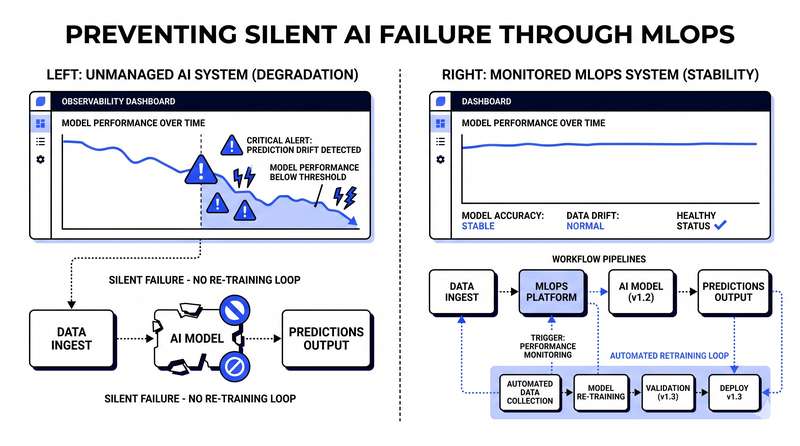
There is a moment that happens in nearly every US enterprise AI project. The model is trained. The accuracy metrics look good. The demo works beautifully. The team deploys to production and moves on. Three months later, the model’s performance has quietly degraded to the point where it is producing worse outcomes than the manual process it replaced, and nobody noticed until the damage was done. This scenario is almost entirely preventable with proper MLOps practice.
MLOps – Machine Learning Operations – is the set of practices, tools, and cultural norms governing how machine learning models are deployed, monitored, maintained, and improved in production. ML systems behave differently from traditional software. Traditional software does what it is programmed to do, consistently, until the code is changed. ML systems do what the data told them to do – and when the world changes, the patterns change, and model performance degrades even though nobody changed a line of code. This degradation, called model drift, is invisible without monitoring.
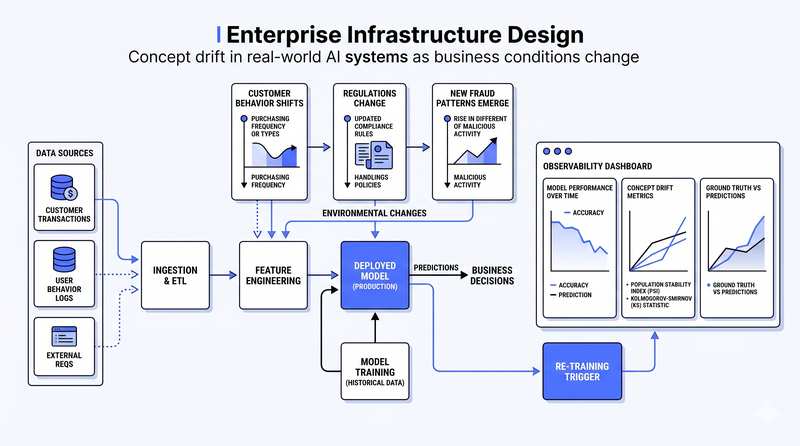
The core components of a mature MLOps practice that keeps AI systems performing reliably
Model versioning and registry provides a systematic way to track which model version is deployed where. Automated training pipelines allow models to be retrained on fresh data without requiring manual engineering intervention every time. Continuous integration and deployment for ML automates testing a new model version and deploying to production when it meets defined quality thresholds. Model monitoring tracks performance metrics in production continuously. Data quality monitoring watches for changes in the statistical properties of data flowing through the system.
Data drift occurs when the distribution of real-world inputs changes relative to training data – a fraud detection model trained before a new fraud pattern emerged will not detect that pattern. Concept drift occurs when the relationship between inputs and desired outputs changes even if the input distribution stays the same. Upstream data changes occur when systems feeding data into the model change in ways that alter the data’s meaning without changing its format.
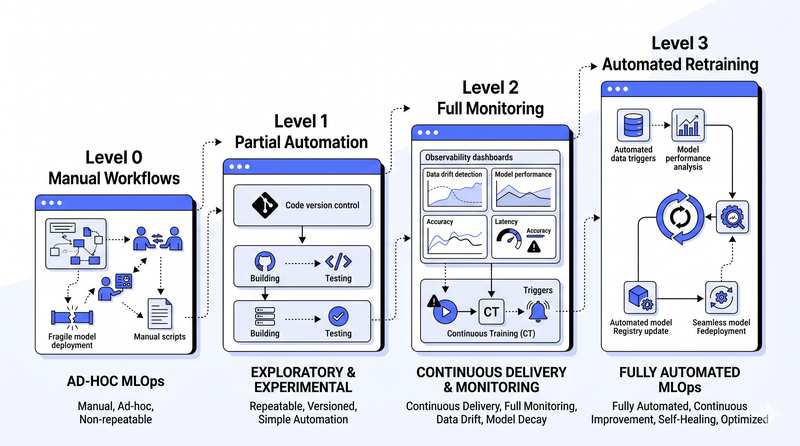
The true cost of not investing in MLOps – and why it always exceeds the cost of doing it right
Consider the cost of a customer-facing AI feature that degrades silently over six months – degraded user experience, reduced conversion, potentially incorrect decisions, and the eventual emergency effort required to diagnose and fix the problem when it becomes visible. This cost is almost always significantly larger than the cost of proper monitoring infrastructure that would have caught the drift early. MLOps is not an insurance policy. It is the operational infrastructure that makes AI systems reliably deliver the value they were built to deliver.
We help US enterprises make this decision based on their specific workload requirements, existing infrastructure, and long-term AI roadmap - not platform preference.
Get expert insights on your use case and identify the most effective path forward.