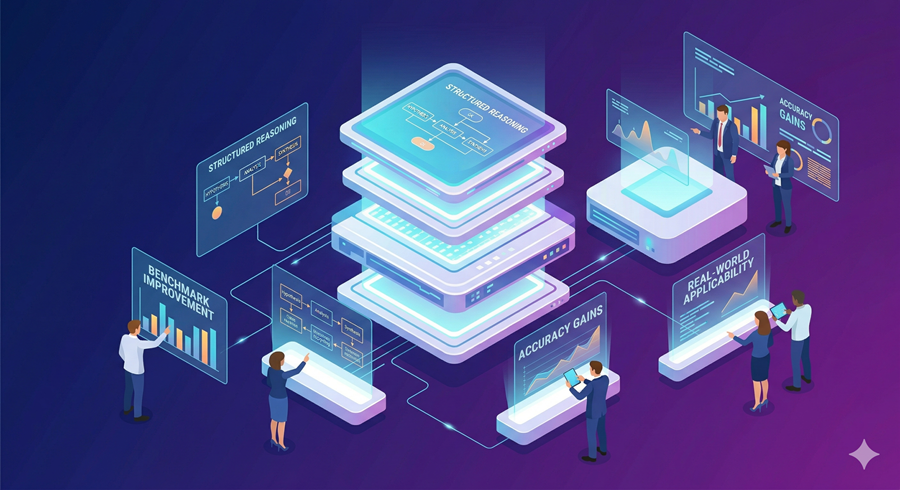
I have been following AI model updates closely, but this Gemini 3.1 Pro release stands out because it changes how the system behaves when reasoning gets difficult. Instead of small incremental improvements, the gains appear most clearly in complex, unfamiliar problems that require multiple steps of thinking. What first drew my attention was the benchmark jump and how quickly it happened compared to the previous version. I found the shift especially noticeable in reasoning benchmarks that test unfamiliar logic not memorized patterns at all here.
A Jump in Abstract Reasoning Benchmarks
One of the most striking changes is the performance on ARC AGI2, a benchmark designed to test pure abstract reasoning rather than memorized knowledge. The model reportedly reaches 77.1 percent, compared to 31.1 percent in the previous version. That is more than a twofold increase in a very short development cycle. I see this as a signal that the model is improving in genuine problem solving rather than pattern recall. It suggests stronger generalization when facing entirely new logic structures. This improvement changes how reliability is evaluated overall in practice.
Built for Long-Horizon, Multimodal Problem Solving
I have also noticed that the model is designed for long-horizon reasoning tasks that go far beyond simple question answering. It can process extremely large inputs, including text, images, audio, video, and even full code repositories, and then synthesize structured outputs across them. The context window reaches up to one million tokens, with outputs up to sixty four thousand tokens, enabling full project level reasoning. This makes it suitable for systems that need continuous understanding across complex workflows rather than isolated prompts. I find this especially relevant for research, engineering, and multi-step analytical workflows in real environments at scale today.
From Code to Real-Time Systems and Interfaces
Another capability I find impressive is the ability to turn simple prompts into executable visual systems such as animated SVGs and interactive interfaces generated entirely from code. Instead of producing static outputs, the model can generate scalable vector animations that remain sharp at any resolution and can be used in lightweight web environments. It also extends into real time simulations and interactive systems where visual behavior changes dynamically based on user input or physical parameters. This bridges the gap between abstract ideas and usable software components in a way I have not seen before today.
Enterprise Rollout Across Google Ecosystem
The rollout strategy is also important because the model is being integrated across consumer, developer, and enterprise products at the same time. I see it appearing in the Gemini app, developer tools like AI Studio and Vertex AI, and research tools such as Notebook LM. This means improvements are not isolated but shared across the entire ecosystem, which creates consistency between experimentation and production use. I think this alignment makes it easier for developers to build reliably at scale now.
What This Means for the Next Wave of AI Agents
What stands out to me most is how these improvements directly translate into stronger agentic systems that can plan, reason, and execute multi-step workflows. With gains in coding, long-horizon reasoning, and multimodal understanding, the model feels more like infrastructure than a standalone tool. I also think the broader impact will come from how widely this reasoning layer is distributed across ecosystems and partner platforms. It feels like the foundation for the next generation of AI agents is being put in place right now at scale.
Follow Us on:
Clutch
Goodfirms
Linkedin
Instagram
Facebook
Youtube