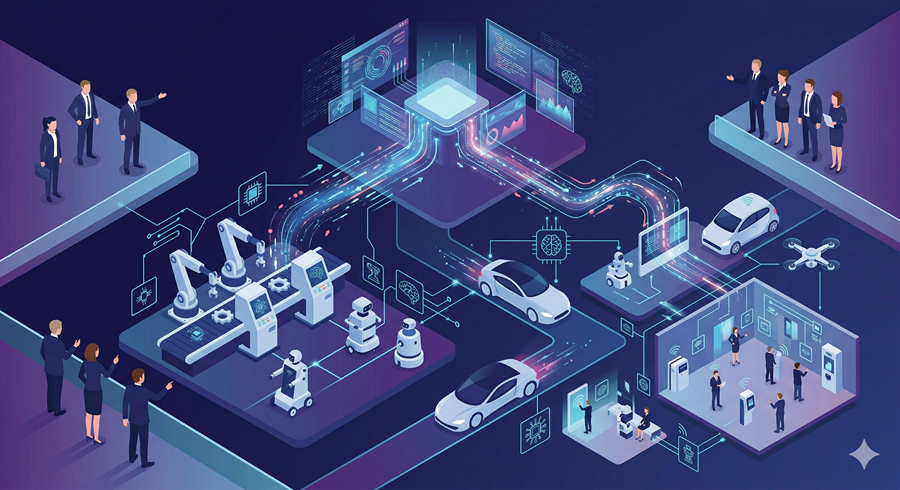
I walked through what felt less like a tech exhibition and more like a preview of the next industrial era. Day two of CES 2026 made one thing clear to me: AI is no longer trapped inside screens. It is moving into bodies, machines, vehicles, and everyday objects.
What I saw was not just software innovation. It was intelligence taking physical form.
Humanoid Robots Move Into Real Human Spaces
Robotics dominated the floor, but what stood out was how diverse the designs have become. I saw humanoids built for general-purpose work, smaller versions designed for education and research, and even care-focused robots intended for hospitals and assisted living environments.
What impressed me most was not speed or strength, but behavior. These machines are being designed to operate safely around people. They move more carefully, react more predictably, and prioritize stability over aggression.
A clear pattern emerged. One intelligence system can now control multiple robotic bodies. That means skills learned in one environment can transfer across different forms without rebuilding everything from scratch.
From Industrial Machines to Digital Nervous Systems
Beyond humanoids, industrial robotics showed a different kind of evolution. Construction and mining equipment is now being powered by onboard AI systems that do not rely on cloud connectivity.
Instead of waiting for instructions, these machines analyze terrain, weather, and operational conditions in real time. They even communicate with other machines on-site, sharing data about workflow and safety.
To me, this feels like infrastructure becoming intelligent. Entire job sites are starting to behave like coordinated systems rather than collections of independent machines.
Autonomous Systems Enter Critical Environments
One of the most striking shifts was the arrival of autonomous robotics in aviation environments. Robots designed for airport tarmacs are already being tested to support aircraft turnaround operations.
This is not experimental automation. It targets one of the most time-sensitive systems in the world. The goal is fewer delays, better coordination, and safer ground handling in environments where precision matters more than anything else.
Consumer AI Moves Beyond Phones
On the consumer side, AI is breaking away from smartphones. I saw smart glasses that function independently without needing a paired device, wearable health tools that track dozens of biomarkers, and audio devices designed to keep users aware of their surroundings while still delivering intelligence assistance.
What stood out to me is how minimal these interfaces are becoming. Instead of overwhelming users with data, they deliver short, context-aware inputs when needed.
AI Enters Cars as a Core System, Not an Add-On
Automotive AI was another major theme. Vehicle systems are now being designed with built-in assistants that can answer questions about diagnostics, performance, and maintenance in natural language.
At the same time, the push toward full autonomy is accelerating. Some platforms are already designed around dedicated onboard supercomputers capable of handling perception, prediction, and decision-making entirely within the vehicle.
The direction is clear. Cars are becoming AI-native systems rather than mechanical machines with added software.
The Bigger Pattern Behind Everything
When I step back, the pattern is obvious. AI is no longer a feature. It is becoming the foundation layer of physical systems.
Robots, vehicles, industrial machines, wearables, and even consumer gadgets are now being built around the assumption that intelligence is always present, always active, and deeply embedded.
What we are witnessing is not just better technology. It is a structural shift in how machines interact with the world, and if this is only day two, the pace of what comes next is worth paying attention to.
Follow Us on:
Clutch
Goodfirms
Linkedin
Instagram
Facebook
Youtube