


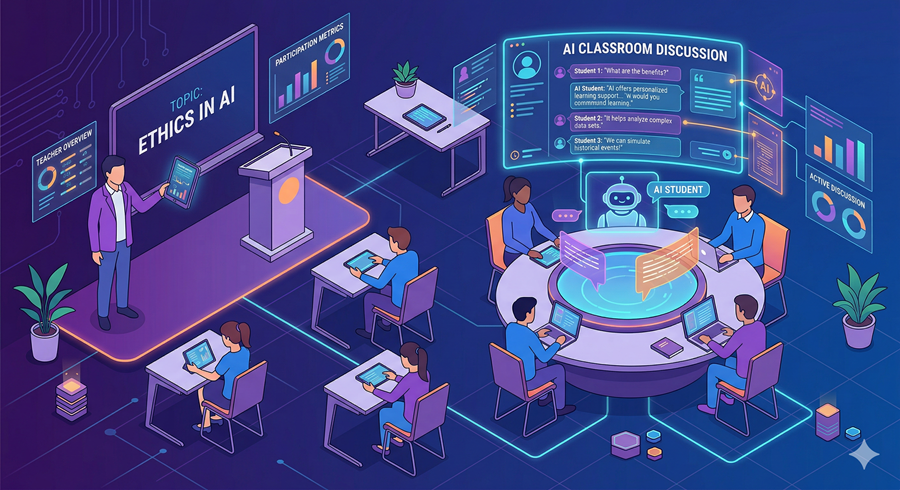
I have been watching how quickly artificial intelligence is entering education, but seeing it placed inside a real classroom changes the way I think about it. In one Tokyo elementary school, students interact with a chatbot presented as a classmate. It does not simply answer questions. It participates in discussions, challenges assumptions, and pushes children to think more deeply. The goal is not replacement but dialogue, and that shift feels important for the future of learning.
An AI That Joins the Classroom Conversation
Instead of acting like a search tool, the AI is used as a conversational partner during lessons. Students hear different perspectives that sometimes contradict their own reasoning, which encourages them to reconsider their answers. This creates a dynamic where learning becomes less about memorizing facts and more about exploring uncertainty together with a system that responds instantly.
When a Chatbot Challenges Student Thinking
One of the most interesting effects is how students respond when the AI disagrees with the majority view. Instead of accepting the group’s answer, they begin questioning their assumptions. This kind of structured disagreement helps them explore moral and logical problems from multiple angles, something that can be difficult in a traditional classroom setting.
The Promise of Personalized Learning
At the same time, educators see value in using AI to fill gaps in understanding. It can adapt explanations, offer examples, and help students who are hesitant to speak in class. This makes learning more accessible and gives children another way to engage with difficult material at their own pace.
The Risks Schools Cannot Ignore
But the adoption of AI is not without concern. There are real risks around privacy, misinformation, and overreliance. Children may trust incorrect answers or share personal data without understanding the consequences. There is also the worry that students might stop thinking independently if they turn to AI too quickly for solutions.
Teachers in the Middle of a Fast Transition
Teachers are now navigating unfamiliar territory. Many are unsure how to balance innovation with responsibility. While AI can enrich lessons, it also demands new training and careful timing to ensure it supports critical thinking rather than replacing it. The challenge is not whether to use it, but how to use it well in shaping the next generation.
Follow Us on:
Clutch
Goodfirms
Linkedin
Instagram
Facebook
Youtube
