I have watched AI evolve from software tools into systems that increasingly interact with the physical world. What stands out to me now is not just model improvement, but the rapid construction of an entire ecosystem around robotics, simulation, and real-world deployment. It feels like we are moving from digital intelligence into physical intelligence.
A Shift From Software to Physical Intelligence
I see a new architecture emerging where intelligence is no longer confined to cloud-based software. Instead, AI is trained in simulation environments, refined using synthetic data, and then deployed into machines that operate in physical spaces. This creates a continuous loop that connects learning, testing, and real-world execution in a unified system.
Three Layers of Modern AI Systems
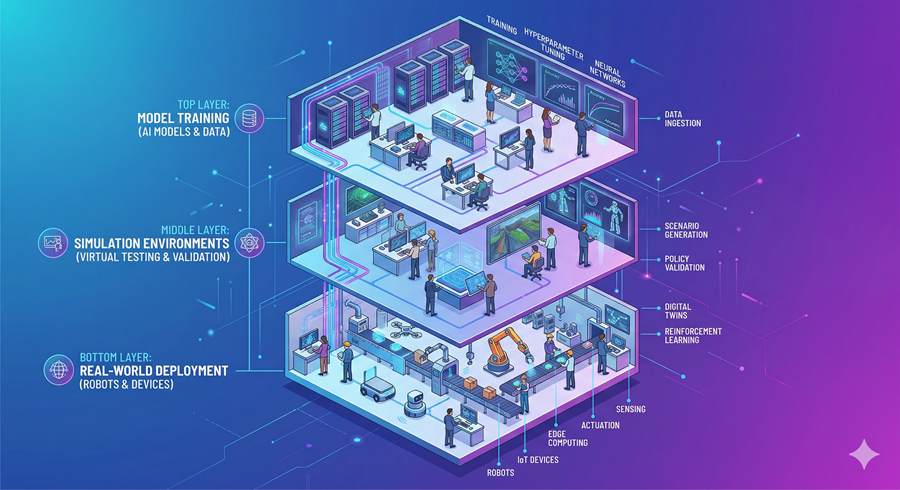
What interests me is the idea of three interconnected layers working together. One layer focuses on training large models, another generates realistic simulations for safe practice, and the final layer runs directly inside robots and devices. This makes AI feel less like a single product and more like an entire operational stack spanning multiple realities.
Robots Enter Industrial Reality
I see robotics moving quickly into industrial environments such as factories, logistics centers, and large-scale manufacturing systems. Instead of being manually programmed for every task, machines are increasingly trained through simulation and reinforcement learning. This allows them to adapt more naturally to real-world conditions and handle complexity with greater flexibility.
Autonomous Mobility and Connected Systems
Transportation is also shifting toward autonomy at scale. Vehicles are being designed not just as individual machines, but as part of coordinated networks. I think the most important change here is connectivity, where cars, infrastructure, and software systems communicate continuously to optimize flow, safety, and efficiency across entire cities.
The Convergence of Simulation, Graphics, and Trust
Another major shift I notice is the blending of simulation, graphics, and generative AI. Highly realistic virtual environments are becoming essential training grounds for physical systems. At the same time, structured data is being used to make AI outputs more reliable and controllable. This balance between creativity and precision feels critical for building systems we can actually trust.
In my view, we are entering a phase where AI is no longer just a tool but a layer embedded across both digital and physical reality. The speed of this integration is what makes this moment feel historically significant.
Follow Us on:
Clutch
Goodfirms
Linkedin
Instagram
Facebook
Youtube