


I feel like robotics has quietly crossed a threshold that most people have not fully processed yet. For years, progress looked impressive in demos but limited in real-world use. Now, multiple breakthroughs are aligning at once, and the shift feels different.
From Isolated Systems to Unified Intelligence
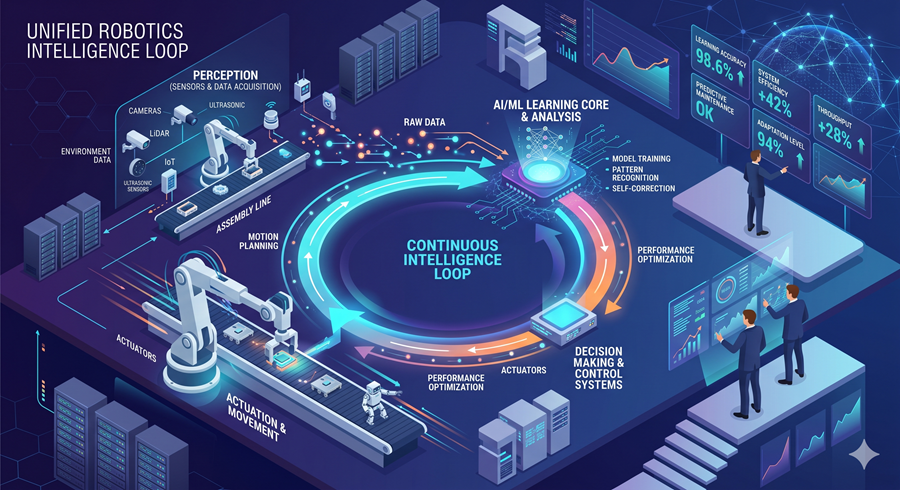
What stands out to me is how robotics is moving away from fragmented design. Instead of treating movement, manipulation, and interaction as separate challenges, new systems are combining them into a single loop.
This unified approach changes everything. A robot is no longer just executing tasks. It is continuously learning from them. Every movement becomes data, and every interaction improves future performance. That feedback loop is what finally makes large-scale deployment possible.
Hardware That Feels Closer to Biology
The hardware side is evolving just as quickly. I am seeing robots designed with lightweight materials, efficient power systems, and the ability to operate for extended periods with minimal downtime.
But what really caught my attention is the emergence of adaptive components. Artificial muscles that can reshape themselves and even repair damage are no longer theoretical. These systems can reconfigure their internal structure while operating, switching between different types of motion depending on the task.
That is a major shift. Traditional machines are fixed. These new systems are flexible, almost biological in how they respond to stress and damage.
Dexterity and Coordination Are Finally Catching Up
One of the biggest limitations in robotics has always been manipulation. That gap is starting to close.
With highly dexterous robotic hands that include tactile sensing and fast response times, robots are beginning to handle objects with a level of precision that was previously difficult to achieve. At the same time, coordination across multiple robots is improving dramatically.
Instead of a single machine performing a task, we are now looking at fleets that can synchronize in real time. That changes the scale of what robots can accomplish in environments like logistics, retail, and manufacturing.
Autonomy Is Becoming the Default
Another clear shift is autonomy. Robots are no longer just remotely controlled tools. They are becoming systems that can navigate, decide, and act independently.
Whether it is in inspection, emergency response, or industrial workflows, the expectation is moving toward robots that operate continuously without constant human input. That reduces friction and opens the door to entirely new use cases.
At the same time, data collection is becoming part of the workflow itself. Instead of separating training from execution, robots now learn while they work.
The Rise of General Purpose Robot Intelligence
What I find most important is what is happening on the intelligence side. New models are showing early signs of generalization, meaning they can take what they have learned and apply it to unfamiliar tasks.
This is a big departure from traditional systems that require specific training for every action. Now, a robot can adapt, combining existing knowledge to solve new problems without needing a completely new dataset.
It is not perfect yet. These systems still need guidance for complex tasks. But the direction is clear. We are moving toward machines that learn once and apply that learning broadly.
Performance Is No Longer Just Theoretical
Even in physical benchmarks, progress is becoming visible. Robots are improving in speed, efficiency, and endurance in ways that translate beyond controlled environments.
While some demonstrations may push the limits of interpretation, the underlying improvements in motion control, thermal systems, and structural design are real. These are the foundations that matter for industrial deployment.
Where This Is Heading
When I step back, I see three layers advancing at the same time. Physical capability is improving. Materials are becoming adaptive. Intelligence is becoming more general.
That alignment is what makes this moment different from previous waves of robotics progress.
We are no longer just building machines that perform tasks. We are building systems that learn, adapt, and operate continuously in the real world.
And once those three layers fully converge, the pace of change will not feel gradual anymore. It will feel sudden.
