


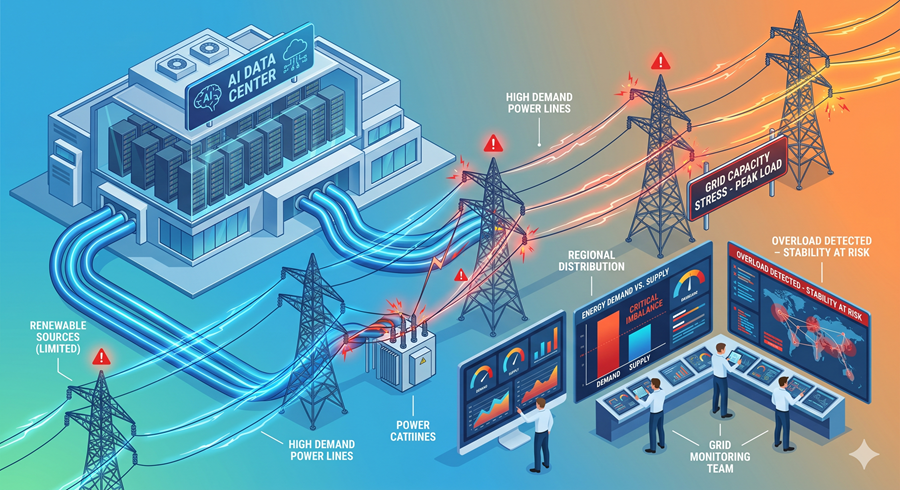
Artificial intelligence has become a major part of daily life. Millions of people now use tools like ChatGPT, Gemini, Claude, and other AI systems for writing emails, generating images, coding, research, and productivity. While AI responses appear instantly on our screens, most users rarely think about the massive infrastructure operating behind the scenes. Every AI prompt triggers powerful computations inside enormous data centers that consume huge amounts of electricity and water.
As the popularity of AI continues to rise, experts are becoming increasingly concerned about the environmental impact of these systems. The growth of AI is creating a global demand for larger data centers, stronger computer chips, and more advanced cooling systems capable of handling the intense heat generated by modern processors.
How AI Data Centers Work
Whenever someone submits a prompt to an AI model, the request is processed across networks of high-performance servers. These servers contain advanced graphics processing units, also known as GPUs, that perform billions of calculations every second. The more users interact with AI tools, the harder these systems must work.
This process generates extreme heat. Without proper cooling, servers can quickly overheat and fail. To prevent this, data centers use large cooling systems involving fans, water, air conditioners, and liquid cooling technologies.
Researchers estimate that even simple AI requests consume measurable resources. A basic task, such as rewriting an email, may use enough electricity to power a small LED light bulb for several minutes. While one request seems harmless, the scale becomes enormous when billions of prompts are processed every day worldwide.
OpenAI reportedly handles billions of daily queries, and the number of AI users is expected to increase dramatically over the next few years. This means the environmental footprint of AI could grow much larger if more efficient systems are not developed.
The Water and Electricity Problem
Cooling systems represent one of the biggest challenges for modern AI infrastructure. Many hyperscale data centers consume enormous amounts of electricity just to keep their servers cool.
Some facilities rely on evaporative cooling systems that use water to absorb heat. These systems are often built near major freshwater sources because access to cold water significantly improves cooling efficiency. Regions around the Great Lakes in North America have become important hubs for large data centers because of their freshwater supply.
However, using water for cooling creates environmental concerns. Massive amounts of water are required daily, which can place pressure on local water resources, especially during periods of drought or climate stress.
Other facilities located in dry regions avoid water cooling and instead use large air cooling systems powered by electricity. While this reduces water usage, it greatly increases energy consumption. In some countries, data centers now account for a significant share of national electricity demand.
Advanced Cooling Technologies
Technology companies are now racing to develop smarter and more sustainable cooling methods. One important innovation is direct-to-chip liquid cooling. Instead of cooling an entire room, liquid coolant flows directly across hot computer chips using metal plates.
Liquid cooling is much more efficient than traditional air cooling because liquids absorb heat faster and more effectively. This reduces the need for large fans and lowers electricity consumption.
Another growing solution is immersion cooling. In this method, entire servers are placed inside special nonconductive liquids that absorb heat directly from the hardware. Since no air cooling is needed, immersion systems can dramatically reduce energy waste.
Some companies are even experimenting with underwater data centers placed deep in the ocean. Cold seawater naturally cools the systems, reducing the need for additional electricity. Others have explored the idea of space-based data centers powered by solar energy, although researchers say cooling hardware in space presents major technical challenges.
The Future of Sustainable AI
The rapid expansion of AI technology means the world must find ways to balance innovation with environmental responsibility. Researchers are now exploring smaller and more efficient AI models that require less computing power while still delivering strong performance.
Many experts believe companies should also improve transparency around energy and water usage so users can better understand the environmental cost of AI services. Smarter infrastructure planning, renewable energy adoption, and efficient cooling technologies will all play important roles in reducing AI’s impact on the planet.
For everyday users, understanding the hidden physical cost of AI is becoming increasingly important. Behind every quick chatbot response is a global network of servers, electricity systems, water supplies, and cooling technologies working nonstop to power the future of artificial intelligence.
