


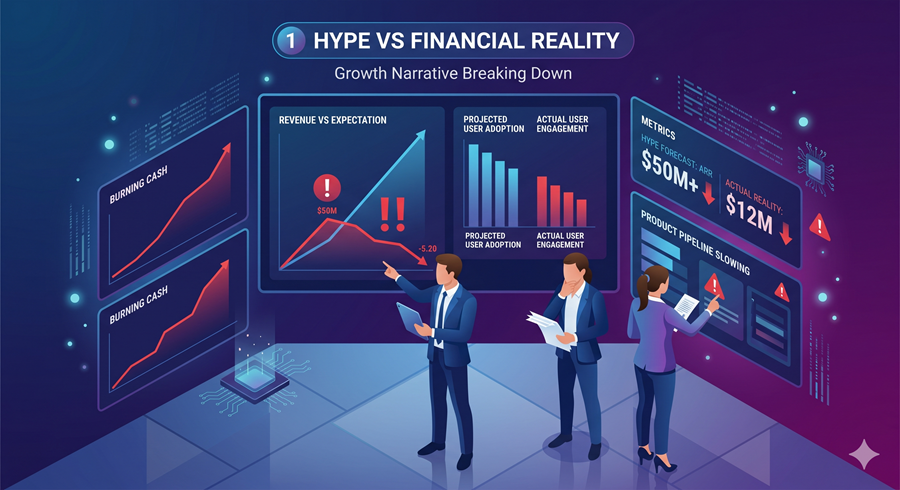
I keep seeing the same pattern repeat itself in the AI space. Big promises, massive spending, and then quietly, the numbers start to miss expectations. What caught my attention this time is not just another headline, but the growing gap between hype and financial reality.
When Growth Narratives Start to Slip
The most striking signal for me is the failure to meet internal targets. We are not talking about minor misses. We are seeing gaps in user growth, revenue expectations, and overall monetization. That becomes a serious issue when a company is operating at this scale and preparing for something like a public listing.
What makes it harder to ignore is that even leadership is starting to acknowledge the pressure. When concerns are raised about whether future compute costs can be sustained, that tells me the business model is still under stress. It is one thing to invest heavily in growth, but another to question whether you can keep paying for the infrastructure behind it.
The Cost Problem No One Can Ignore
AI is expensive in a way most software businesses are not. Every interaction, every generated output, every automated workflow depends on compute. That means costs scale with usage, not just development.
If revenue does not grow at the same pace, the model starts to strain. Attempts to monetize through ads or new features do not seem to be closing that gap fast enough. That creates a situation where growth alone is no longer enough. Profitability starts to matter, and that is where things get uncomfortable.
Big Bets and Signs of Urgency
Moves into hardware and new product categories feel less like natural expansion and more like a search for new revenue streams. The idea of AI-driven devices replacing traditional apps sounds ambitious, but I cannot help seeing the risks.
If every action on a device requires compute, then every action potentially becomes a cost. That shifts the user experience from ownership to metered usage. I start to question whether people actually want that model, especially when simpler alternatives already exist.
It feels less like a clear next step and more like a high-stakes bet to unlock new monetization paths.
Why Big Tech Is Quietly Adjusting
What I find most telling is how partners are reacting. Large infrastructure providers are beginning to create distance, not necessarily cutting ties, but reducing dependency.
That kind of shift is rarely random. It usually reflects a desire for flexibility and risk management. If the market evolves differently than expected, these companies want the freedom to support multiple systems, not just one.
It suggests that even within the industry, there is uncertainty about who the long-term winners will be.
The Bubble Question That Keeps Coming Back
I do not think the technology itself is going away. The demand is real, and the capabilities are improving. But the structure around it feels fragile.
When spending keeps rising, revenue struggles to keep up, and expectations remain extremely high, the system starts to depend on continued belief as much as actual performance. That is where the idea of a bubble begins to enter the conversation.
What This Means Going Forward
For me, the biggest takeaway is not that everything will collapse overnight. It is that the current trajectory may not be sustainable in its current form.
Some companies will adapt, some will dominate, and others may fade despite early leadership. That is how most major technology cycles play out.
What feels different this time is the scale of the investment and how deeply it connects to infrastructure, energy, and the broader economy. If anything shifts significantly, the impact will not stay contained within the AI industry.
It will ripple outward.
Follow Us on:
Clutch
Goodfirms
Linkedin
Instagram
Facebook
Youtube
