At first glance, Google releasing a powerful open-weight model for free looks irrational. It is not.
Companies do not spend hundreds of millions training advanced models and then hand them out without a revenue plan. What looks like generosity is strategy. Google is not monetizing the model directly because the model itself is not the product. It is leverage.
The real story is that Google has recognized something many people still treat as temporary: the AI market has already split into two distinct tiers.
One is closed: premium models accessed through APIs, priced per token, optimized for convenience. The other is open: downloadable models run on your own infrastructure, optimized for control, cost, and independence.
Most major labs have chosen one side. Google is one of the few trying to win both.
Google Is Playing Two Markets at Once
This is what makes Google’s position structurally different.
Gemini serves the closed tier: high-performance models, managed infrastructure, premium access. Gemma serves the open tier: permissive licensing, self-hosting, fine-tuning, and local deployment.
That is not internal conflict. It is market segmentation.
Google is not cannibalizing Gemini by releasing Gemma. It is capturing a class of customer Gemini was never built to serve: teams that will not tolerate API economics at scale and would otherwise default to open alternatives.
That is the strategic advantage. Google can charge where premium pricing works and give away where distribution matters more.
The Model Is Free. The Infrastructure Is Not.
The first payoff is commercial.
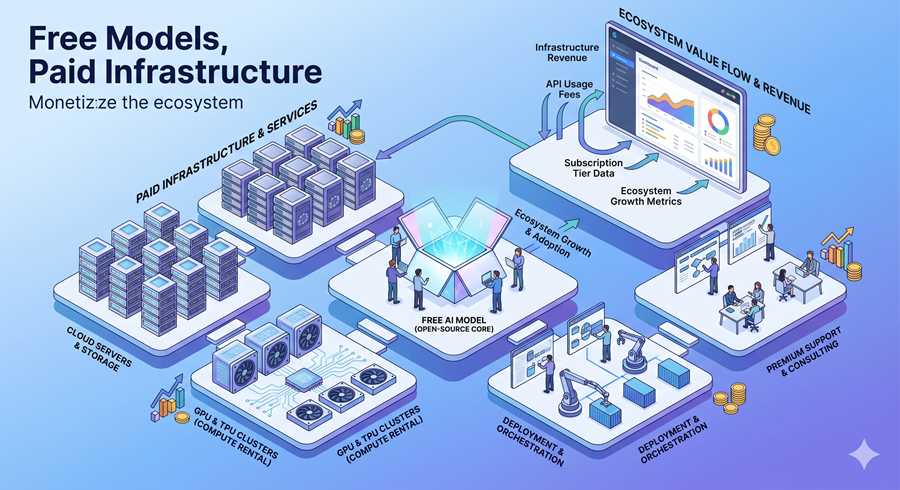
Gemma is free to download, but serious use still requires infrastructure: GPUs, orchestration, deployment, fine-tuning, and hosting. Google does not need to monetize the model if it can monetize the compute, cloud stack, and surrounding tools.
The same logic applies on-device. Lightweight open models strengthen Android, Chrome, and Pixel by making local AI more useful inside Google’s ecosystem. The model may be free, but it still reinforces the platforms that generate revenue.
The asset is not the model alone. It is the ecosystem the model makes more valuable.
This Is Also a Competitive Blockade
The second payoff is strategic denial.
Google is not only competing with Western labs. It is preventing Chinese open-weight models from becoming the default infrastructure layer for Western enterprises.
That matters more than most people realize. If companies running self-hosted AI begin standardizing on Chinese open models, Google does not just lose model usage. It risks losing the cloud, tooling, and enterprise stack those workloads pull behind them.
Gemma is not just a product. It is a geopolitical counterweight.
At the same time, it puts pressure on premium closed-model pricing. A capable free alternative does not need to beat the best proprietary systems. It only needs to be close enough to make their margins harder to defend.
The Real Product Is Platform Control
The third payoff is the most durable: ecosystem capture.
Every developer who builds on Gemma becomes more fluent in Google’s stack. That matters less today than it will in three years, when those same developers influence infrastructure decisions, procurement, and platform standards inside their companies.
This is the long game.
Gemma is not just a model. It is distribution, competitive pressure, and developer capture wrapped into one.
Google is not giving away its most expensive asset. It is using it to make sure the next layer of the AI market is built on Google anyway.
Follow Us on:
Clutch
Goodfirms
Linkedin
Instagram
Facebook
Youtube