Most people think AI struggles with complexity. I don’t think that’s the real issue.
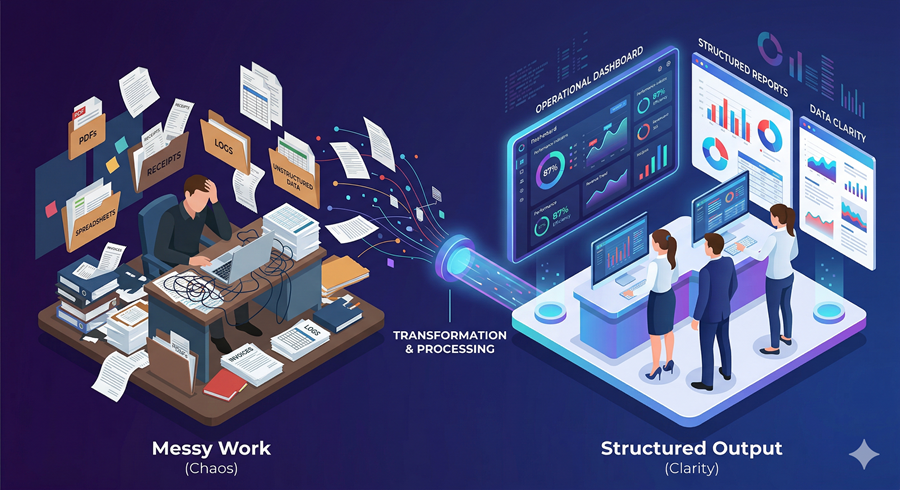
The real problem is messy work.
Not writing a paragraph or answering a question, but dealing with scattered files, inconsistent formats, missing context, and half-finished tasks. Receipts, PDFs, logs, spreadsheets, exports. The kind of work that quietly piles up and never gets done.
That is exactly where this new system is focused.
From One Model to Coordinated Systems
What stands out immediately is the shift in architecture.
Instead of relying on a single model, this system coordinates multiple ones. Each model handles a specific strength. Deep reasoning, fast responses, long context, or clean multimodal output.
That combination matters because real work is not one-dimensional. It requires switching between thinking, scanning, validating, and presenting. A single model rarely does all of that well.
This feels less like a chatbot and more like a system designed to execute.
Turning Inputs Into Finished Work
The most interesting part is not the interface. It is the outcomes.
Give it a folder of expense reports, and it does more than summarize. It audits, cross-checks, flags inconsistencies, and produces a structured report with clear actions.
Feed it logs and incident data, and it reconstructs what happened. Not just a guess, but a timeline, root cause, and remediation plan.
Even in business workflows, it moves beyond organization. It analyzes supplier data, compares pricing shifts, pulls external context, and turns everything into decision-ready outputs.
This is a different category of output. Not information, but usable work.
Context Is the Real Upgrade
What makes these workflows land is how context is handled.
When the system lacks information, it does not fill gaps with confident guesses. It flags uncertainty. When the data supports an answer, it cites it directly.
That behavior changes trust. It feels less like generation and more like analysis.
Even in content workflows, the difference shows up. Instead of generic repurposing, the outputs adapt to tone, platform, and subject matter in a way that reflects understanding rather than pattern matching.
Context is no longer just input. It becomes a structure.
From Assistant to Operator
The biggest shift I see is in how the system behaves during execution.
You can watch it plan tasks, break them down, and work through them step by step. It feels active, not reactive. Less like asking questions, more like assigning work.
That distinction matters.
We are moving from tools that respond to prompts to systems that take ownership of tasks. The role of the user changes with that. Less doing, more directing, and if this direction holds, the real transformation will not come from better answers.
It will come from finished work appearing where there used to be friction.
Follow Us on:
Clutch
Goodfirms
Linkedin
Instagram
Facebook
Youtube