CES 2026 Day 2 made one thing very clear. Artificial intelligence is no longer just running in apps or cloud systems. It is now embedded directly into physical machines that move, sense, and act in the real world. Across robotics, vehicles, healthcare devices, and consumer gadgets, AI has shifted from being a feature to becoming the core operating system of hardware.
The floor in Las Vegas was dominated by robots of all shapes and sizes, each designed for specific real-world tasks instead of general demonstration. Unlike earlier years, where robots were mostly prototypes or scripted showcases, this year’s systems showed continuous movement, adaptive control, and real-time decision making.
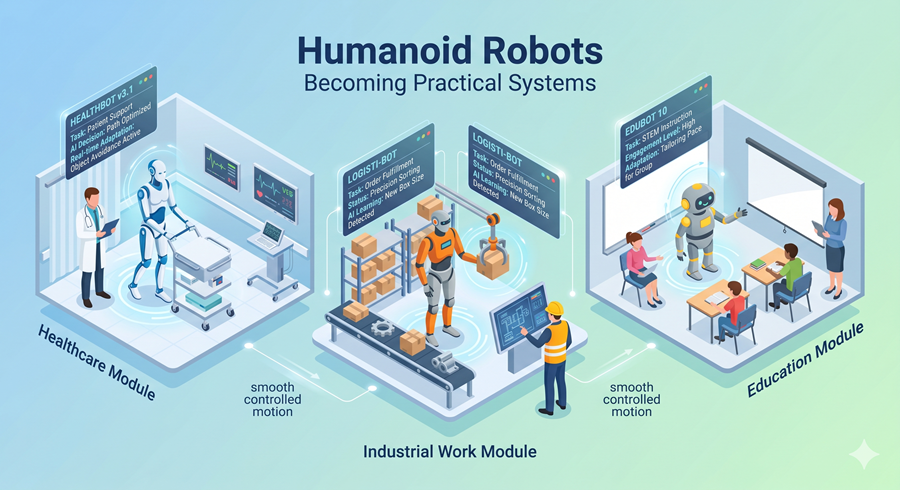
Humanoid Robots Become More Practical
Multiple companies introduced humanoid robots built for different environments rather than one universal design. Neurobotics presented its 4NE1 humanoid, focused on smooth movement, balance recovery, and safe interaction in human spaces. The emphasis was not speed but control and reliability.
Nura introduced a smaller humanoid designed for education and research, sharing the same intelligence system as its larger counterpart. This allowed skills learned in one robot to transfer to another platform without retraining from scratch. The company also demonstrated a quadruped robot, reinforcing the idea that different body types are needed for different environments.
Healthcare and Service Robotics Expand
Fourier Intelligence showcased the GR3 humanoid designed specifically for healthcare environments. Its slow and predictable movements were intentional, making it suitable for hospitals and rehabilitation centers where safety is critical. The robot is designed to assist patients with mobility tasks and daily support activities.
Agibot presented one of the most complete robotics ecosystems at CES. It displayed multiple humanoid series, including full-size robots for general tasks, smaller versions for education, industrial-focused models for heavy work, and quadruped robots for rough terrain inspection. It also introduced a dexterous robotic hand system for precise manipulation tasks.
Industrial AI Becomes Infrastructure
Caterpillar introduced CAT AI, a system that runs directly on construction machines instead of relying on cloud computing. Using Nvidia Jetson and Thor hardware, the system processes sensor data locally to provide safety alerts, performance optimization, and machine coordination in real time. This is especially important for mining and construction sites where internet connectivity is unreliable.
Oshkosh Corporation showcased autonomous airport robots designed to manage ground operations such as aircraft movement and turnaround tasks. These systems aim to reduce delays and improve safety in one of the most time-sensitive environments in transportation.
Centigon Technology introduced the Rovar X3, a rugged inspection robot designed for stairs and uneven terrain. It is built for infrastructure monitoring in environments where wheeled robots struggle.
Experimental Robotics and New Approaches
Dream Technology showed a different approach with its CyberX system. Instead of forcing a vacuum robot to climb stairs, it designed a mechanical carrier system that transports the robot between floors. This separates movement and cleaning into two different problems, making each more efficient.
Flywing presented a folding VTOL aircraft combining vertical takeoff with fixed-wing flight. It includes FPV streaming with head tracking, long-range control, and high-speed flight capabilities. The system is designed for immersive remote piloting rather than autonomous flight.
Smart Glasses and Wearable AI
RayNeo introduced X3 Pro smart glasses that operate without requiring a smartphone connection. The glasses handle notifications, navigation, and AI assistant tasks directly on the device. They use lightweight displays for short, contextual interactions rather than full augmented reality immersion.
Luna Band introduced a screen-free wearable focused on fitness and health tracking, delivering coaching through voice instead of visual interfaces. This reflects a growing trend of reducing screen dependency in personal devices.
Health, Safety, and Everyday AI Devices
Wings Body Scan 2 was one of the most advanced health devices at CES, capable of measuring more than 60 biomarkers in under 90 seconds. It tracks heart, nerve, and metabolic health, turning medical-style data into long-term trends.
Timely Flashlight combined GPS tracking, LTE connectivity, and emergency response into a compact safety device designed for personal security.
Bird Buddy 2 Mini brought AI-powered bird recognition into a smaller and more affordable smart feeder, showing how AI is entering everyday hobbies.
AI in Vehicles and Autonomous Systems
Ford introduced a new AI voice assistant integrated directly into vehicles. It can answer questions about maintenance, range, battery health, and system status using natural language. Ford also outlined its future platform targeting partial autonomy by 2028.
Tensor presented a Level 4 autonomous vehicle powered by a supercomputer delivering over 8,000 trillion operations per second. It uses advanced lidar and sensor fusion systems designed for full urban self-driving. The vehicle is being developed with ride-hailing integration through Lyft.
Chips, Displays, and Computing Power
Intel launched its Panther Lake processors with major improvements in efficiency and battery life. AMD highlighted its AI-focused roadmap, predicting massive growth in AI usage worldwide. NVIDIA emphasized physical AI and robotics rather than gaming GPUs, reinforcing its shift toward infrastructure-level computing.
Display technology also advanced significantly, with Samsung and LG showcasing large MicroRGB TVs, while Dell introduced high-resolution 6K monitors for professional use.