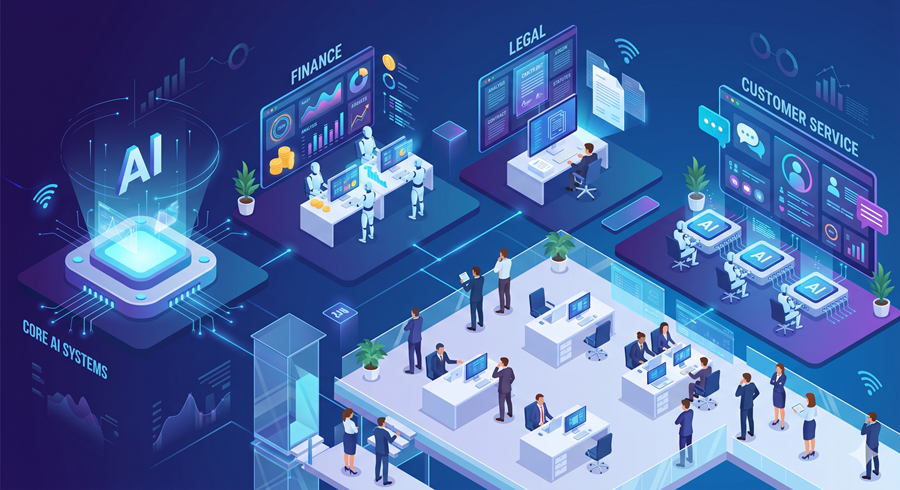
For decades, students were told that a college degree guaranteed stability, high salaries, and long term career growth. That promise is starting to break apart as artificial intelligence rapidly changes the white-collar job market. Across industries like finance, law, consulting, customer service, and technology, companies are replacing junior employees with AI systems that can complete the same tasks faster and at a lower cost.
Stories like Sarah’s are becoming increasingly common. After graduating at the top of her finance class, she applied to hundreds of entry-level jobs without receiving callbacks. At the same time, companies are openly discussing how AI can reduce hiring needs. In 2025, Dario Amodei warned that AI could eliminate nearly half of entry-level white-collar jobs within five years. He specifically pointed to sectors such as technology, finance, law, and consulting as being highly vulnerable.
Companies Are Already Cutting Jobs
The warnings are not theoretical anymore. Major corporations have already begun restructuring around AI systems. Large customer service departments are shrinking because chatbots now handle most basic support requests. AI-powered systems can answer questions, process refunds, and troubleshoot issues without human employees.
Companies like Salesforce have reduced thousands of customer support positions after integrating AI agents into their workflows. Banks are also slowing hiring. Reports showed that managers at JPMorgan Chase were encouraged to avoid expanding headcount as AI tools became more capable.
The legal industry is experiencing the same disruption. AI software can now review contracts, summarize documents, and conduct legal research in minutes. Tasks that once required teams of junior lawyers or paralegals are increasingly automated. Entry-level legal workers face some of the highest automation risks in the modern economy.
Why AI Feels Different This Time
Past technologies usually helped workers perform tasks more efficiently. Spreadsheets improved accounting, but accountants still controlled the process. AI changes that dynamic because it can complete entire workflows independently.
Modern AI agents are capable of understanding instructions, planning tasks, interacting with software tools, and generating outputs with minimal supervision. Companies see this as an opportunity to reduce labor costs dramatically. AI does not need salaries, benefits, office space, or training periods. It operates continuously and scales instantly.
Research from major consulting firms suggests that generative AI could automate large portions of office work. Repetitive cognitive tasks are especially vulnerable because AI systems excel at pattern recognition, summarization, and data processing.
Internships Are Becoming a Battlefield
The crisis is hitting young workers the hardest. Internships and graduate roles are disappearing while competition explodes. Applications per internship posting have surged in industries like technology and finance. Some students now begin applying for internships during their freshman year because opportunities have become so limited.
At the same time, wages for entry-level professional jobs have weakened. Companies no longer need large groups of junior workers to handle basic operational tasks. Instead, businesses are investing heavily in AI infrastructure while reducing hiring budgets.
This creates a dangerous long-term problem. Senior professionals do not appear overnight. Experienced managers, lawyers, analysts, and consultants all begin as inexperienced junior employees learning through practice. If companies eliminate entry-level roles, the future pipeline of skilled workers could collapse.
The Shift Toward Skilled Trades
Interestingly, many manual labor jobs appear safer from AI disruption than office jobs. Electricians, construction workers, mechanics, and plumbers continue to face strong demand because physical work remains difficult to automate reliably.
Even leaders in the AI industry acknowledge this shift. Jensen Huang has argued that massive AI infrastructure projects will create significant demand for workers who build and maintain data centers. While software engineers face growing uncertainty, skilled trade workers are gaining leverage in the labor market.
A New Economic Reality
The rise of AI is forcing society to rethink the value of education, employment, and career security. White-collar work was once considered the safest path into the middle class. Now, many graduates are competing against software systems capable of performing the same tasks instantly and cheaply.
The biggest question is no longer whether AI will reshape office work. That transformation has already begun. The real question is how economies and governments will respond as millions of workers face an uncertain future in a rapidly automated world.