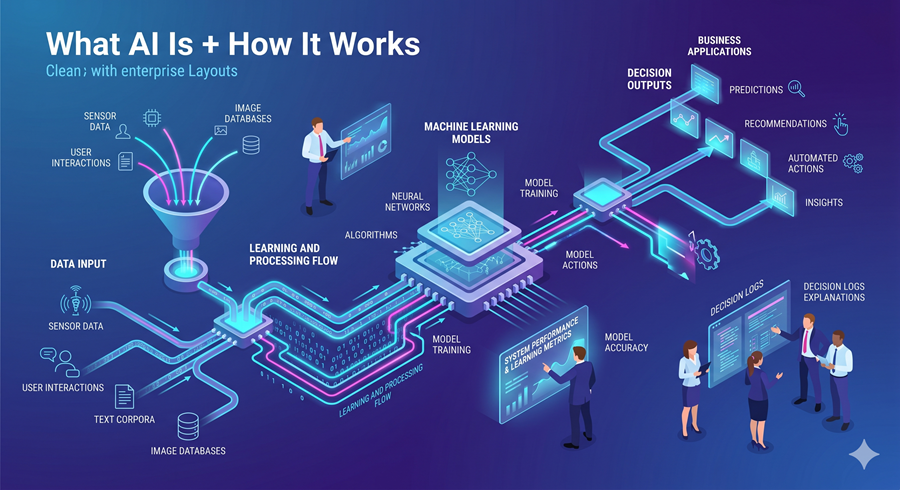
Have you ever asked Siri or Alexa to play your favorite song? If yes, then you have already interacted with Artificial Intelligence (AI). In simple terms, AI refers to computer systems that can perform tasks that normally require human intelligence. These tasks include learning, problem-solving, understanding language, recognizing speech, and making decisions.
AI combines computer science, large datasets (information), and advanced problem-solving techniques to function. Most AI systems today are designed for automation, meaning they can perform repetitive or complex tasks without constant human intervention. You may already experience AI when you use online customer support systems, voice assistants, or even recommendation systems on streaming platforms.
How AI is Used in Real Life
AI is widely used in different industries. For example, in customer service, AI-powered chatbots use voice recognition and machine learning to answer questions quickly and accurately. In robotics and engineering, AI helps perform dangerous tasks like handling toxic chemicals or operating machines in extreme environments such as space exploration.
Self-driving systems, medical diagnostics, fraud detection in banking, and smart assistants are all examples of AI applications. These systems are designed to improve efficiency and reduce human workload while increasing accuracy.
Types of Artificial Intelligence
There are three main types of AI:
1. Artificial Narrow Intelligence (ANI)
This is the most common type of AI today. ANI is designed to perform a specific task, such as facial recognition, internet searches, or voice assistance. However, it cannot perform tasks outside its programming.
2. Artificial General Intelligence (AGI)
AGI refers to AI systems that can think, learn, and perform any intellectual task like a human being. This type of AI is still under research and development.
3. Artificial Super Intelligence (ASI)
ASI is a theoretical form of AI that would surpass human intelligence in all aspects. It does not exist yet, but is often discussed in science fiction and future technology studies.
Pros of Artificial Intelligence
AI offers many advantages:
- It automates repetitive tasks, saving time and effort
- It reduces the need for humans to perform dangerous jobs
- It increases efficiency and productivity
- It helps in scientific and technological discoveries
- It minimizes human errors in critical operations
These benefits make AI extremely valuable in industries like healthcare, transportation, education, and manufacturing.
Cons of Artificial Intelligence
Despite its benefits, AI also has disadvantages:
- It is very expensive to develop and maintain
- It may lead to job displacement in certain industries
- It consumes large amounts of energy and resources
- It can be misused for plagiarism or misinformation
- It poses cybersecurity risks if hacked or misused
These challenges show that AI must be developed and used responsibly.
Future of Artificial Intelligence
The future of AI is both exciting and uncertain. While it is improving rapidly, experts believe it is still far from replacing human intelligence completely. Instead, AI is expected to work alongside humans, helping them make better decisions and complete tasks more efficiently.
However, issues like ethics, job impact, and safety must be carefully managed. Governments and organizations around the world are already working on regulations to ensure AI is used in a safe and beneficial way.
Follow Us on:
Clutch
Goodfirms
Linkedin
Instagram
Facebook
Youtube