When we talk about AI in healthcare, it is important to understand it as a foundational change in the tools we use to understand and treat disease. In the same way that algebra transformed mathematics and our ability to model the world, artificial intelligence is now transforming how medicine is practiced, diagnosed, and delivered.
AI as a New Medical Toolkit
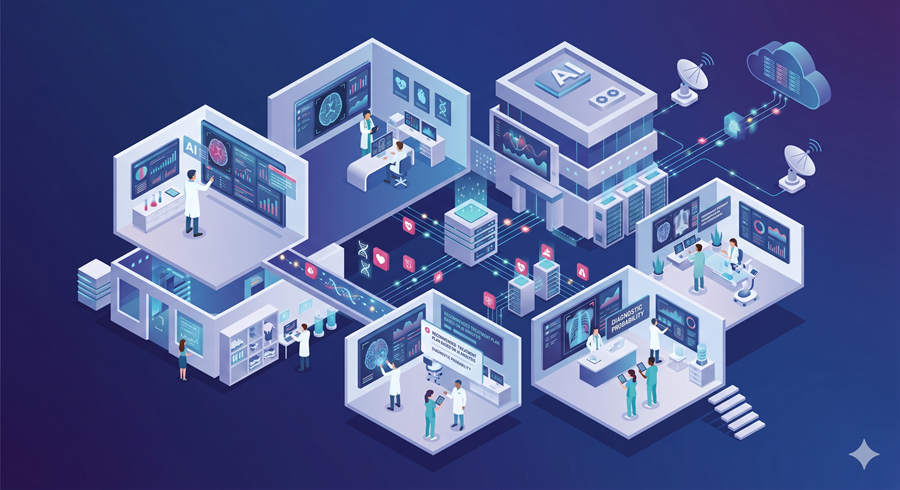
In healthcare, AI is not just a single technology but a new toolkit. It is changing diagnostic testing, improving the interpretation of medical data, and reducing the level of expertise required for certain analytical tasks. Traditional patterns of care are evolving into more data-driven and automated systems, where AI supports clinicians in making faster and more informed decisions.
Artificial intelligence itself is not new—it has existed in healthcare for decades in limited forms. It has been used for transcribing medical notes, supporting chatbots for patient interaction, and assisting with administrative efficiency. However, the rise of generative AI has significantly accelerated its impact. Now, AI systems can predict health risks, assist in diagnosing diseases more accurately, and even contribute to drug discovery and the development of new therapies.
The Rise of Generative AI in Medicine
The real transformation in healthcare began over the last five years, as machine learning models became powerful enough to process complex medical data. These systems are now helping define new approaches to treatment and diagnosis. They can also identify personalized medical patterns, showing how individual patients might respond to specific treatments.
Despite these advances, AI is not replacing medical professionals. Instead, it is augmenting their capabilities. Doctors are still central to patient care, especially in interpreting AI-generated outputs and making final clinical decisions.
Trust, Risk, and Responsibility in AI Systems
As AI becomes more advanced, concerns about safety, accuracy, and responsibility are growing. Patients and clinicians often ask important questions: What if AI makes a mistake? Who is responsible for incorrect diagnoses? How do we manage false positives or false negatives?
To address these concerns, regulatory bodies such as the US Food and Drug Administration (FDA), along with organizations like the American Medical Association (AMA) and the National Academy of Medicine, are developing guidelines to ensure responsible use of AI in healthcare. These frameworks aim to ensure safety, fairness, and ethical deployment of AI systems before they are widely used in clinical settings.
AI Research, Investment, and Academic Innovation
There is also a growing divide between large AI companies and academic research institutions. Tech companies like Google and OpenAI are focused on large-scale deployment and innovation, while academic institutions often prioritize safety, ethics, and domain-specific medical applications.
Investment in AI healthcare has increased significantly, with billions of dollars flowing into startups and research initiatives. Universities such as Yale have also made major investments in AI-driven healthcare research, including cardiovascular data science and precision medicine projects.
The Future of AI in Clinical Practice
AI is increasingly being used in medical imaging, diagnostics, and personalized treatment planning. However, experts emphasize that regulatory oversight will be essential before these systems become standard in hospitals. The goal is not to replace doctors but to enhance their ability to deliver faster, more accurate, and more accessible care.
Even though AI may occasionally make errors, current systems still rely on human supervision. This ensures that final medical decisions remain in the hands of trained professionals.
Follow Us on:
Clutch
Goodfirms
Linkedin
Instagram
Facebook
Youtube