I used to think the biggest challenge in robotics was capability. Making machines move naturally, think clearly, and operate in the real world felt like the hard part. But now I am starting to question something else entirely.
What happens when robots become too capable?
This question hit me while watching the latest humanoid systems move outside controlled environments and into the real world. Not in polished demos, but in raw, unfiltered conditions. And what I saw was both impressive and slightly unsettling.
When Movement Starts to Feel Human
The first thing that stood out was how natural these robots have become. Running, balancing, adjusting stride, and even bending at the toes to mimic human motion. It is no longer stiff or mechanical. It feels fluid.
At certain speeds, the difference between human and machine starts to blur. A robot running at over 6 miles per hour is not just a technical milestone. It is a shift in how we perceive physical intelligence.
But there is still something slightly off. The upper body can feel rigid, almost like evolution has not fully caught up yet. That gap, though small, is a reminder that we are watching something in transition.
Performance vs Safety
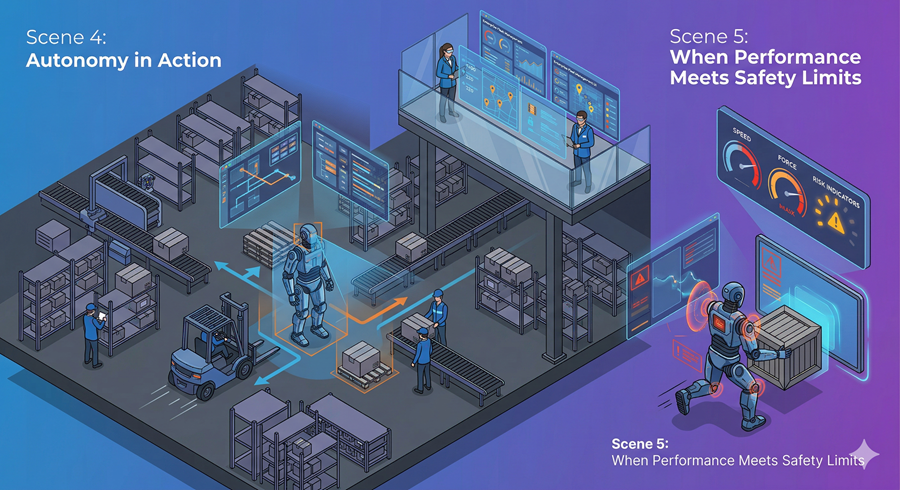
Here is where things get complicated. The more capable these robots become, the harder it is to control risk.
Speed, strength, and autonomy are powerful on their own. Combined, they create a system that can act faster than humans can react. Even if everything works perfectly, the margin for error shrinks.
So I find myself asking a simple question. Should there be limits?
Should robots be restricted in how fast they move or how much force they can apply? Not because they cannot do more, but because safety demands restraint.
Designed for the Real World
Another interesting shift is in how these machines are built. New designs are focusing on durability and longevity. Covered joints, fewer exposed components, and fewer failure points.
This is not just about performance. It is about surviving real environments. Dust, debris, long working hours, and unpredictable conditions.
It signals something important. These robots are no longer experimental. They are being prepared for deployment at scale.
Autonomy Is the Real Leap
What matters even more than movement is independence.
Modern systems are not just controlled remotely. They are making decisions using onboard AI, cameras, and processing power. They see, interpret, and act in real time.
This is a fundamental shift. A robot that moves well is impressive. A robot that decides what to do next is transformative.
But it also introduces new risks. Misinterpretation, unexpected actions, or edge cases can lead to outcomes we did not plan for.
The Future Is Closer Than It Feels
What surprised me most is how close all of this is to becoming mainstream. These machines are already working long hours in industrial settings. Mass production is no longer theoretical.
Prices are approaching that of a car. That alone changes the conversation. Ownership becomes possible, not just for corporations, but eventually for individuals.
And that brings me back to the original question.
If a robot can move like us, think independently, and operate continuously, at what point does performance stop being the goal and safety become the priority?
We are not just building better machines anymore. We are deciding how much power they should have.
Follow Us on:
Clutch
Goodfirms
Linkedin
Instagram
Facebook
Youtube