Anthropic has suddenly become one of the most important companies in artificial intelligence, and the reason goes far beyond Claude. What started as a smaller, safety-focused alternative to OpenAI is now turning into a massive infrastructure and compute powerhouse connected to some of the biggest names in technology.
Over the past few months, Anthropic has been linked to enormous funding discussions, giant cloud partnerships, military tensions, cybersecurity projects, and one of the strangest alliances in AI today, a partnership with Elon Musk’s SpaceX. The company is reportedly chasing a valuation close to $1 trillion while simultaneously trying to maintain its image as the responsible AI lab focused on safety and alignment.
That combination is creating one of the most interesting power shifts in the entire AI industry.
Why the SpaceX Partnership Matters
One of the biggest recent developments was Anthropic’s partnership with SpaceX. For months, Elon Musk openly criticized Anthropic and Claude. Since Musk owns xAI and competes directly with Claude through Grok, most people assumed the two sides would never work together.
Then suddenly, Anthropic gained access to massive compute infrastructure connected to SpaceX’s Colossus data center. Reports suggest the deal includes access to more than 220,000 NVIDIA GPUs and hundreds of megawatts of compute power.
This matters because Anthropic’s biggest issue was never model quality. Claude was already considered one of the best AI assistants for coding, reasoning, and enterprise workflows. The real problem was capacity.
Users constantly complained about limits inside Claude Code and restricted access during peak hours. Developers paying for premium subscriptions still hit usage walls, and enterprise teams wanted more reliable infrastructure for large-scale deployments.
After the SpaceX partnership, Anthropic quickly expanded limits across Claude Code and increased API capacity for Claude Opus. That move made it obvious that the company had finally secured more computing power to support growing demand.
The Real Battle in AI Is Infrastructure
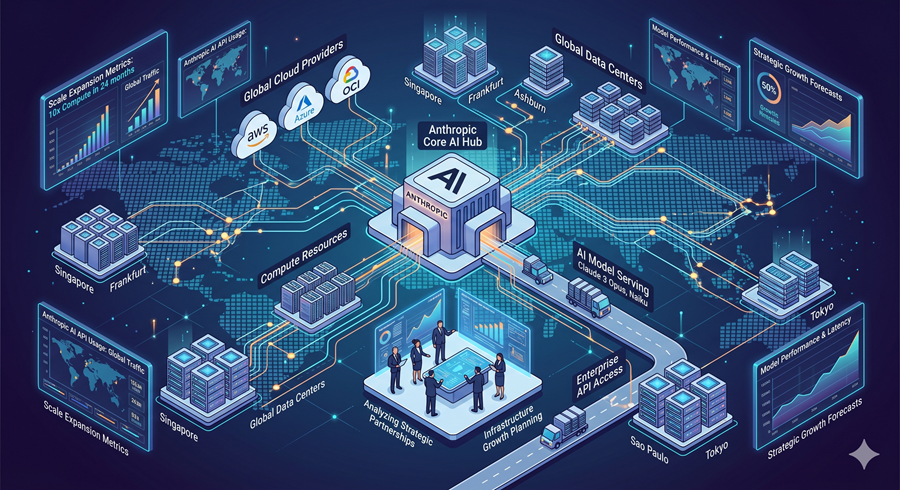
Most people still think the AI race is mainly about chatbots, but the industry is now shifting toward something much larger. The real competition is about infrastructure.
Training and running advanced AI models requires huge amounts of electricity, GPUs, cooling systems, networking hardware, and cloud capacity. Frontier AI companies are starting to look less like software startups and more like industrial operations.
Anthropic is aggressively expanding across every major infrastructure provider. The company reportedly has major agreements involving Amazon, Google Cloud, Microsoft Azure, NVIDIA, and Broadcom. There are also reports of a huge long-term cloud commitment with Google worth hundreds of billions of dollars.
This creates a strange situation where nearly every major tech company is both competing with and supporting each other at the same time.
Google competes with Claude through Gemini while also supplying Anthropic with cloud infrastructure. Microsoft backs OpenAI but still has partnerships connected to Anthropic infrastructure. Amazon is building its own AI ambitions while also supporting Claude deployments.
The lines between rivals and partners are becoming impossible to separate.
Claude Mythos and the Cyber Security Fear
Another reason Anthropic is attracting attention is its secretive AI model called Claude Mythos Preview. According to reports, this system became so powerful at finding software vulnerabilities that Anthropic decided not to release it publicly.
Instead, Mythos is being used only with selected organizations to identify security flaws before hackers can exploit them. Reports claim the model found vulnerabilities that had remained hidden for years inside major software systems.
That sounds useful from a defensive perspective, but it also raises major concerns.
If AI becomes extremely effective at discovering weaknesses in software, then similar systems could eventually help attackers automate cybercrime at a completely different scale. Experts worry that advanced AI models may soon outperform most human security researchers when it comes to finding exploitable flaws.
And the risk may extend far beyond cybersecurity. Researchers increasingly believe AI could become highly effective at identifying loopholes inside legal systems, financial rules, tax structures, and other complex systems built around regulations and incentives.
Anthropic’s Biggest Challenge
Anthropic is now trying to balance two completely different identities. On one side, it wants to become one of the most valuable AI companies in the world. On the other side, it still wants to maintain credibility as the cautious and safety-focused AI lab.
That tension is becoming harder to manage.
The company reportedly clashed with the Pentagon over military AI usage policies because Anthropic wanted stronger restrictions around how Claude could be deployed. At the same time, government contracts and national security partnerships are becoming increasingly important in the AI industry.
Anthropic now sits at the center of a much bigger conflict involving compute, cybersecurity, cloud infrastructure, regulation, and geopolitical influence.
Claude may still be the public face of the company, but the real story is much larger. Anthropic is no longer just building an AI assistant. It is becoming one of the key players shaping the future infrastructure of artificial intelligence itself.