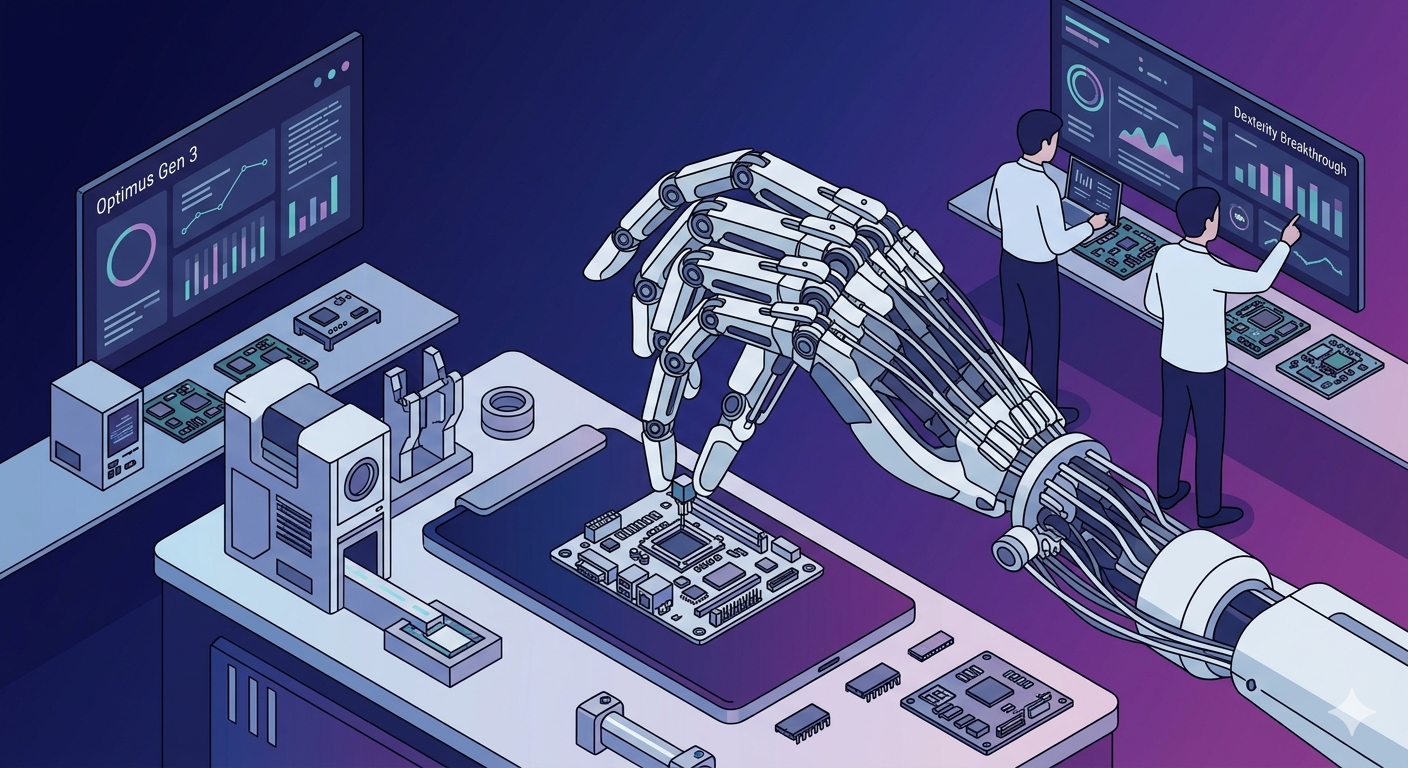
Humanoid robotics is no longer limited to lab demos or staged presentations. The latest developments around Tesla’s Optimus program suggest a shift toward real industrial deployment at scale. What was once an experimental robot project is now being positioned as a core pillar of Tesla’s long-term strategy. With production planning, factory restructuring, and AI integration happening simultaneously, Optimus is evolving into a full workforce system rather than a prototype.
Optimus Gen 3 Hardware and Dexterity Upgrade
The biggest leap in Optimus Gen 3 lies in its mechanical design, especially the hand system. Tesla has focused heavily on solving one of robotics’ hardest challenges: human-like dexterity. The new hand reportedly includes over 20 degrees of freedom, tendon-driven actuation, and forearm-mounted motors to reduce weight and increase precision. This design allows fine manipulation of objects with millimeter-level accuracy, enabling tasks such as assembly, sorting, and handling fragile items.
Compared to earlier versions, the system is not just more complex but also more manufacturable at scale. This is important because Tesla’s goal is not a single advanced robot—it is mass production at scale.
AI Architecture: Vision, Learning, and Real-Time Control
Optimus Gen 3 is powered by Tesla’s vision-based AI stack, derived from its self-driving system. Using multiple cameras, the robot builds a real-time 3D understanding of its environment. Instead of relying on fixed programming, it operates through neural networks that allow adaptive decision-making.
The training approach combines simulation-based learning with real-world imitation. This means the robot practices millions of scenarios virtually before executing tasks physically. Over time, it improves through continuous feedback loops, allowing it to adjust movements dynamically when errors occur.
Production Strategy and Industrial Scaling
Tesla is restructuring parts of its manufacturing ecosystem to support Optimus production. Internal plans suggest shifting factory capacity away from traditional vehicle lines toward robotics. Early deployment is expected inside Tesla facilities before expanding to broader industrial applications.
Target production numbers are extremely ambitious, ranging from hundreds of thousands to potentially millions of units annually. Pricing is expected to be significantly lower than most competitors, positioning Optimus as a mass-market industrial robot rather than a niche enterprise product.
Ecosystem Integration: AI Chips and Infrastructure
A key part of Optimus development is Tesla’s custom silicon strategy. The AI compute stack is designed to run directly on onboard chips optimized for low-latency decision-making. This reduces dependency on cloud systems and enables real-time physical interaction.
Alongside Tesla, companies like SpaceX and xAI are also contributing to broader compute and infrastructure ambitions, showing how interconnected AI systems are becoming across industries.
Competitive Landscape in Humanoid Robotics
The race is not limited to Tesla. Companies like Figure AI, Boston Dynamics, and Engine AI are exploring different philosophies ranging from industrial precision to agility and even high-impact performance robotics.
Each company is targeting a different future: some focus on safety and workplace collaboration, others on raw physical capability or research-driven agility. Optimus, however, is primarily focused on scalability and integration into economic systems.
Conclusion: Transition From Prototype to Workforce
Optimus Gen 3 represents a broader shift in robotics from demonstration machines to working systems designed for real environments. While challenges remain in reliability, scaling, and autonomy, the direction is clear. Humanoid robots are moving into factories, logistics, and eventually daily life.
If Tesla achieves its production and AI integration goals, Optimus could become one of the first truly mass-deployed humanoid robots in history, marking a turning point in how automation reshapes global industries.