Humanoid robotics is accelerating at a pace that feels almost unreal. Figure AI has officially locked the design of its next-generation robot, F.04, signaling a shift from concept development to actual hardware production. According to CEO Brett Adcock, this is not a routine upgrade but the most significant leap the company has made between robot generations. The design lock means core engineering decisions such as structure, weight distribution, power systems, and mobility architecture are finalized. Now, parts are already being manufactured and shipped, indicating that Figure is transitioning into serious large-scale robotics development.
What makes this moment important is the discipline behind it. Unlike companies that rush out prototypes, Figure is taking a more structured engineering approach, ensuring every subsystem is validated before public demonstration. While Figure 03 already demonstrated impressive mobility and task execution, Figure 04 is expected to push boundaries even further in strength, intelligence, and real-world adaptability.
LG’s Multi-Robot Warehouse Coordination System
While Figure focuses on a single advanced humanoid, LG has demonstrated something even more systemic robot collaboration. In a warehouse demo in Seoul, four different robots from different manufacturers worked together as a single coordinated workforce. The task involved picking, transporting, and stacking packages across multiple zones without direct human control.
The process started with a humanoid robot picking items from a conveyor belt. A wheeled robotic unit then transported the package across the warehouse floor. Another humanoid received the package and placed it on high shelving units using extended arms capable of reaching over two meters. The entire operation took roughly 90 seconds, but the real breakthrough was coordination. These robots were not remotely controlled; instead, they operated through LG’s “Physical AI” platform, which allows different machines to interpret tasks, make decisions, and dynamically adjust roles.
Even more impressive, when one robot was reassigned mid-task, the system redistributed responsibilities automatically without disruption. This shows a future where warehouses may run like intelligent ecosystems rather than manually controlled systems.
Sony Project Ace Challenges Human Players
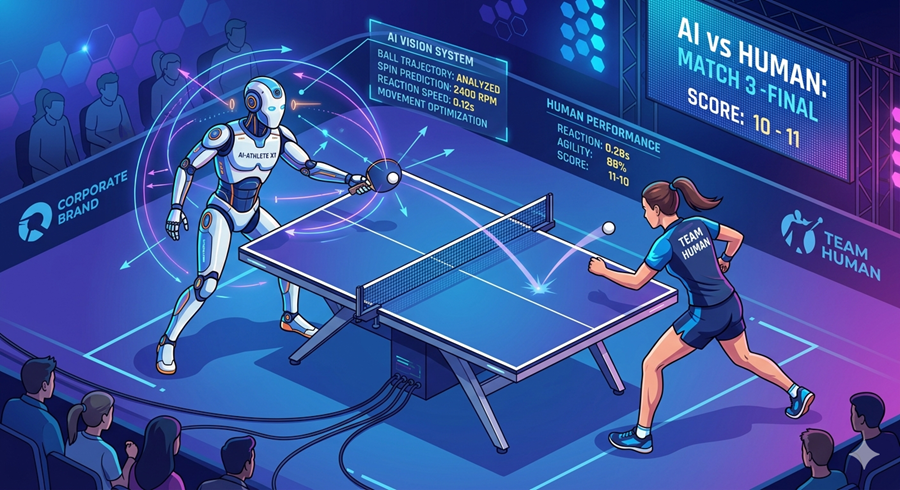
Sony has entered the robotics competition space with Project Ace, a table tennis robot capable of playing against skilled human athletes under official match conditions. Unlike simple training bots, this system operates under real tournament rules, complete with referees and competitive scoring.
Table tennis is an extremely fast sport where balls can exceed 30 mph and spin at thousands of rotations per minute. To handle this, Project Ace uses a high-speed perception system combining multiple cameras that track ball movement, spin, and player behavior in real time. Advanced reinforcement learning allows the robot to improve through simulation and real-world gameplay experience.
Its robotic arm is engineered for rapid response, combining precision mechanics with dynamic wrist motion to generate spin and control return angles. Reports indicate it has even defeated strong amateur and professional players, making it one of the most advanced sports robotics systems ever built.
Rotaku Domo Brings Low-Cost Humanoids To Market
At the other end of the spectrum, Rotaku has introduced Domo, a humanoid robot priced at approximately $2,999. This dramatically lowers the entry barrier for robotics experimentation. Domo stands under one meter tall and includes multiple joints for movement, balancing, and basic manipulation tasks.
It supports reinforcement learning, simulation training, and VR-based control, allowing users to experiment without advanced robotics expertise. With swappable components and open development tools, Domo is aimed at developers, students, and hobbyists rather than industrial users.
This pricing shift is important because it signals the beginning of consumer-accessible humanoid robotics. What was once limited to research labs is slowly moving into homes and classrooms.
A Unified Direction For Robotics Evolution
Across all these developments, a clear pattern is emerging. Robotics is no longer just about building machines that move—it is about building systems that think, collaborate, and adapt. Whether it is Figure pushing toward advanced humanoids, LG building coordinated robot ecosystems, Sony challenging humans in real-time sports, or startups like Rotaku democratizing access, the field is converging toward one goal: general-purpose physical intelligence.
The next phase of robotics will not be defined by individual breakthroughs alone, but by how seamlessly machines integrate into human environments, industries, and daily life.