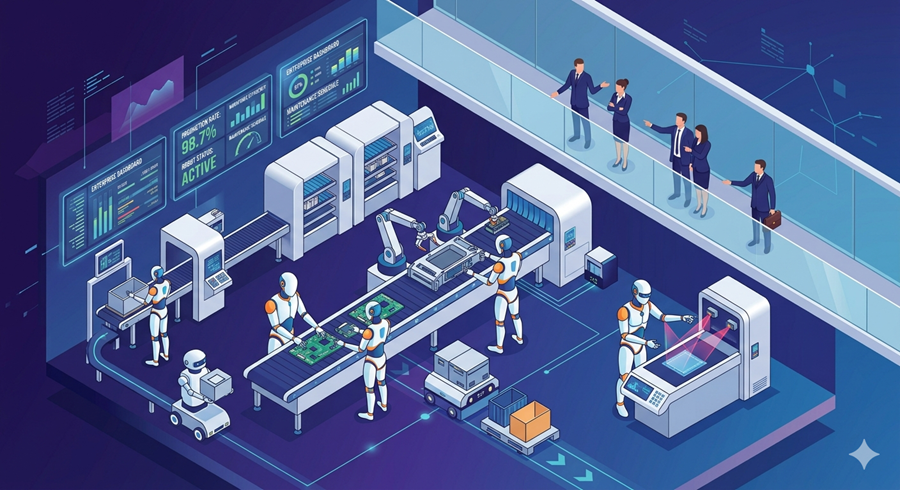
Tesla’s Optimus project is no longer limited to being a humanoid robot demonstration. The company has developed a vision to transform it into a full-scale AI ecosystem and a future industrial platform. Tesla is building Optimus Gen 3 as a product that can do far more than walk or perform basic tasks. The goal is to create a robot capable of autonomously handling complex real-world work. This shift means Tesla no longer sees Optimus as an experiment, but as a potential future workforce replacement system.
AI 5 Chip and On-Device Intelligence
One of the most important parts of Tesla’s Optimus roadmap is the AI 5 chip. This chip is not simply a computing upgrade—it serves as the core intelligence engine of the robot. According to Elon Musk, the AI 5 chip could be several times more powerful than Tesla’s AI 4 hardware and may approach the performance levels of advanced platforms such as Hopper and Blackwell-class systems.
Its primary purpose is to provide real-time decision-making capabilities without depending on cloud computing. Optimus must be able to react instantly in any environment, whether it is working on a factory floor, in a kitchen, or in a public setting.
This level of processing power is necessary because humanoid robots operate in highly unpredictable environments. Compared to autonomous vehicles, robots must handle much more complex physical interactions, such as lifting fragile objects, predicting human movement, and maintaining balance in constantly changing surroundings.
Tesla’s Robotics-AI Integrated Ecosystem
Optimus is not just a robot—it is becoming an extension of Tesla’s entire AI technology stack. The ecosystem includes several interconnected components:
Full Self-Driving (FSD) vision system
Grok AI language and reasoning model
Vision-Language-Action architecture
Dojo and Cortex training infrastructure
The goal of this integrated system is to enable the robot to understand tasks rather than simply follow programmed instructions. For example, if given the command “fold the shirt,” Optimus should be able to interpret the request, understand its surroundings, and complete the task appropriately.
Manufacturing Expansion and Industrial Scale
Tesla is preparing Optimus for mass production. Parts of the Fremont factory are being repurposed for robot manufacturing, while additional large-scale production lines are planned at Giga Texas.
The company’s long-term vision is extremely ambitious, targeting annual production in the millions and eventually aiming for as many as 10 million robots per year.
This production strategy reflects Tesla’s broader transformation from an electric vehicle company into a robotics and AI manufacturing powerhouse.
AI Training Loop and Real-World Learning
Another key factor in Optimus development is real-world data collection. Hundreds of robots are already working within Tesla facilities, generating valuable learning data from every interaction.
Tesla uses a feedback-loop system similar to the one behind its self-driving technology. Every failure, correction, and successful task becomes part of a training dataset that helps improve future versions of the robot.
This continuous learning cycle allows Optimus to become smarter, more reliable, and more capable over time.
Gen 3 and Tesla’s Hidden Development Strategy
Tesla has not fully revealed Optimus Gen 3 to the public. This decision is both strategic and competitive.
According to Elon Musk, revealing advanced designs too early could give competitors an opportunity to study and replicate Tesla’s innovations, particularly in fast-moving manufacturing ecosystems.
As a result, Tesla is developing Gen 3 through a controlled product evolution strategy, focusing on performance, reliability, and real-world capability rather than attention-grabbing demonstrations.
Robot Hands and the Real-World Usability Challenge
One of the most complex parts of Optimus is its hands. Tesla believes that achieving human-level dexterity represents a major portion of the overall engineering challenge.
The robot’s hands are being developed using a tendon-driven design, with actuators placed in the forearm rather than directly inside the hand. This approach reduces weight while improving flexibility, precision, and control.
The true test of success will not be whether the robot can walk, but whether it can perform delicate tasks such as picking up a glass, using tools, and completing assembly work with human-like accuracy.
Competition and the Global Robotics Race
Tesla is not the only player in the humanoid robotics industry. Companies such as Figure AI have already demonstrated functional humanoid robots capable of performing domestic and industrial tasks.
This growing competition is pushing Tesla to move beyond prototypes and demonstrations toward delivering a scalable, production-ready robot that can operate effectively in real-world environments.
Future Outlook and the Vision of Physical AGI
Elon Musk often describes Optimus as a step toward “physical AGI” a form of artificial general intelligence that can operate not only in the digital world but also in the physical world.
If Tesla successfully aligns its AI software, custom chip technology, manufacturing systems, and training infrastructure, Optimus could become a major component of the future workforce.
Such a development could dramatically impact productivity, labor markets, and the global economy.
Conclusion
The story of Tesla Optimus Gen 3 is not simply about upgrading a robot. It represents a broader technological transformation in which artificial intelligence, advanced chips, large-scale manufacturing, and real-world learning systems are coming together into a single platform.
The question is no longer whether a robot can walk or perform basic tasks. The real challenge is whether it can reliably operate in the complex, unpredictable, and messy environments that humans navigate every day.
If Tesla achieves its ambitious goals, Optimus may become far more than just another product. It could redefine industrial operations, reshape economic systems, and play a major role in the future of work.