The AI industry has entered a new phase where the future is no longer centered around chatbots alone, but around fully autonomous AI agents. Google I/O 2026 officially defined this transition. While companies like OpenAI and Anthropic continue to offer chatbot-based products such as ChatGPT and Claude, Google has transformed its entire product ecosystem into an integrated AI agent platform. The impact extends far beyond software, with the potential to reshape how people interact with the internet itself.
Gemini Spark: A 24/7 Personal AI Agent
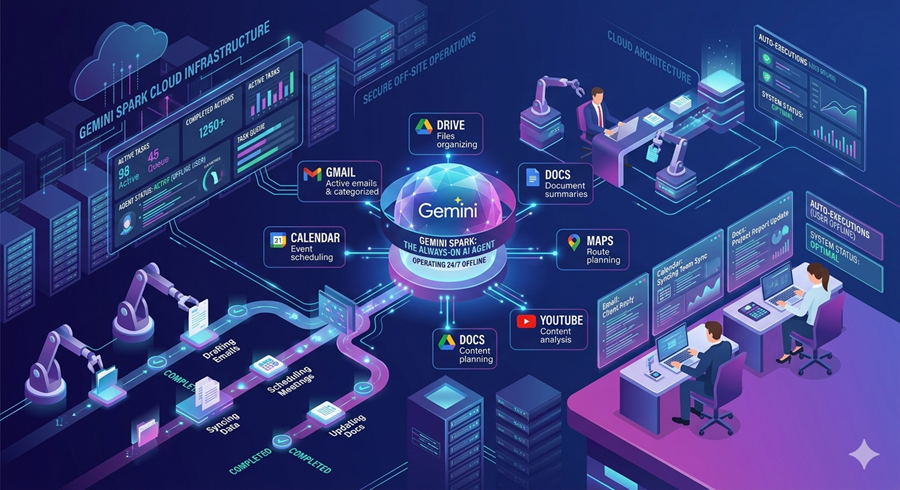
Google’s biggest announcement was Gemini Spark, an always-on personal AI agent designed to work continuously on behalf of users. Running on dedicated virtual machines in Google Cloud, Spark continues operating even when the user’s device is turned off.
This means users can assign a task, close their laptop or phone, and allow Spark to continue working in the background until the task is completed. Gemini Spark is directly connected to Gmail, Calendar, Drive, Docs, Sheets, YouTube, and Maps, enabling it to manage workflows across Google’s ecosystem.
Google described the experience with the phrase, “throw it over your shoulder and it catches it.” In simple terms, users no longer need to manually handle repetitive digital tasks, as the AI agent can take responsibility for much of the workflow on its own.
Gemini 3.5 Flash and the Omni Model
Alongside Spark, Google introduced Gemini 3.5 Flash, which has already become the default model across Search and the Gemini application. The model is specifically optimized for agentic workflows, automation tasks, and software development. According to Google, it has the potential to significantly reduce enterprise AI operating costs at scale.
Perhaps the most ambitious announcement was Gemini Omni, described as a “world simulation model.” Omni can understand and process text, images, audio, and video while generating outputs based on an understanding of real-world physics.
This represents a major shift in AI development. Rather than functioning solely as a prediction engine, Omni moves closer to becoming a system capable of simulating aspects of reality itself.
Search, Chrome, and Ecosystem Transformation
Google is rebuilding its core products around AI agents. Search is no longer limited to presenting a list of links. Instead, it can generate dynamic interfaces that adapt to individual queries and user needs.
Chrome, Gmail, and YouTube are also being redesigned with embedded AI agents capable of taking actions on behalf of users rather than simply providing information.
For online shopping, Google introduced Universal Cart, a system that automatically tracks deals, monitors price drops, and can assist throughout the checkout process. This signals a future where both internet browsing and e-commerce become increasingly autonomous and personalized.
The Competition: Google vs OpenAI vs Anthropic vs xAI
The AI race is no longer solely about building the most powerful model. It has become a battle for ecosystem control.
ChatGPT and Claude primarily operate as standalone chatbot applications where users manually interact with AI. Google’s advantage lies in embedding AI throughout its entire product ecosystem, allowing agents to operate directly within services that billions of people already use every day.
Anthropic and OpenAI continue focusing heavily on enterprise and developer workflows, while leveraging advanced models for professional use cases. However, neither company currently possesses a distribution network comparable to Google’s.
Meanwhile, Elon Musk’s xAI is pursuing an aggressive strategy centered on expanding infrastructure, computing capacity, and large-scale AI deployment.
Anthropic and the AI Safety Debate
Anthropic has positioned itself as a company focused on AI safety and alignment. While this approach has helped establish its reputation in responsible AI development, it has also introduced challenges related to compute availability and usage limitations.
In contrast, Google and OpenAI are pursuing more aggressive scaling strategies. Anthropic has also taken a more cautious approach toward government and defense partnerships, while other major AI companies have generally adopted broader collaboration strategies.
As a result, the AI industry increasingly appears divided into two competing philosophies:
This tension is likely to shape the future direction of artificial intelligence development.
The Emergence of an AI-Powered Internet
Google I/O 2026 made one thing clear: the future belongs to AI agents rather than traditional chatbots.
With innovations such as Gemini Spark, Gemini Omni, and agent-driven Search, Google is transforming the internet from a passive information tool into an active digital assistant capable of performing tasks on behalf of users.
The key question is no longer what AI can do. Instead, the more important question is how much control people will be willing to hand over to AI systems.
The next few years will determine whether AI remains primarily a productivity tool or evolves into the operating system that powers the entire digital world.
Conclusion
Google’s vision for AI extends beyond smarter chatbots. The company is building an ecosystem where autonomous agents can understand context, make decisions, complete tasks, and manage workflows across multiple products and services.
If this vision succeeds, the internet may shift from being a place where users search for information to a place where AI actively performs work on their behalf. The transition from chatbot-based interaction to agent-based automation could become one of the most significant technological transformations of the decade.