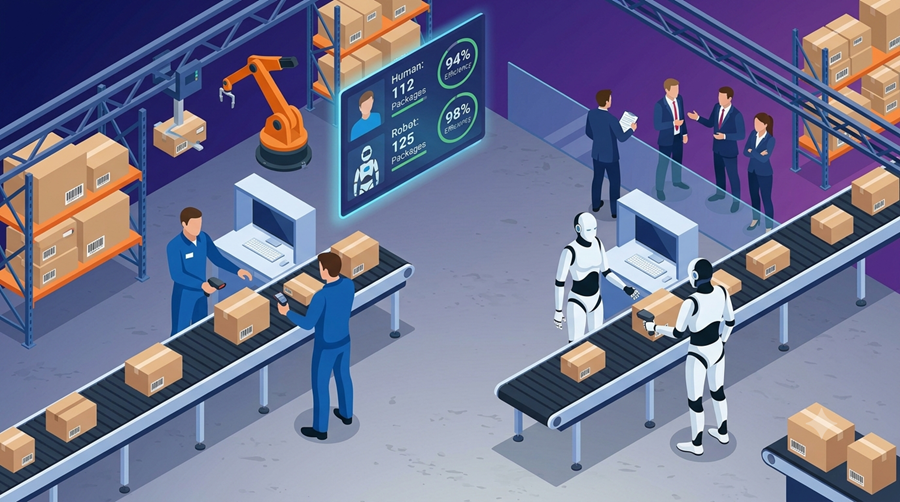
The robotics industry recently witnessed a fascinating competition that has sparked new discussions about the future of automation and artificial intelligence. Figure AI organized a live “man versus machine” warehouse challenge, where 22-year-old intern Amae Girard worked alongside a humanoid robot named Figure 03, also known as “Bob,” for a continuous 10-hour shift.
Their task was simple but demanding: pick packages from a conveyor belt, identify barcodes, and place them in the correct positions. By the end of the challenge, Amae had processed 12,924 packages, while Bob handled 12,732 packages. The human competitor ultimately won but by a surprisingly small margin of just 192 packages.
A Human Victory, But a Different Story Behind the Numbers
At first glance, the results suggest that humans still hold the advantage. However, a closer look tells a more interesting story. The difference between Amae and Bob amounted to roughly 0.04 seconds per package.
During the early hours of the challenge, Amae maintained a clear lead thanks to natural human dexterity, faster reactions, and the ability to make small adjustments instantly. Human hands remain remarkably efficient when dealing with unpredictable physical tasks.
As the hours passed, however, fatigue began to take its toll. Amae needed water breaks, restroom visits, and moments of rest, while Bob continued working without interruption. The gap gradually narrowed, highlighting one of the biggest differences between humans and machines.
The Robot’s Greatest Advantage: Consistency
Figure 03’s most impressive strength was not speed it was consistency.
Throughout the entire 10-hour shift, the robot maintained nearly the same pace without any noticeable decline in performance. In contrast, Amae was capable of short bursts of higher productivity but gradually experienced the effects of physical exhaustion.
Reports following the challenge revealed that Amae developed blisters on his hands due to constant contact with cardboard boxes, and his forearm experienced significant strain. This demonstrates an important reality about modern robotics: robots do not necessarily need to be faster than humans to become valuable workers. Their ability to perform repetitive tasks continuously without fatigue can be a major advantage in industrial environments.
Figure 03 and the Power of the Helix 02 AI System
What makes Bob particularly impressive is its advanced Helix 02 AI system.
The robot was not remotely controlled by a human operator. Instead, it functioned entirely autonomously. Using cameras, sensors, and advanced AI models, Figure 03 could identify packages, locate barcodes, determine proper grasping points, and place items correctly in real time.
Helix 02 operates through multiple processing layers that manage reasoning, motion planning, and balance simultaneously. This architecture allows the robot to perform complex warehouse operations while continuously adapting to changing conditions.
The result is a humanoid robot capable of carrying out practical industrial work with minimal human intervention.
Tesla Optimus and the Next Stage of the Robotics Race
While Figure AI continues developing its next-generation Figure 04 platform, global attention is also focused on Tesla’s Optimus Gen 3 project.
Tesla’s vision goes beyond building a humanoid robot. The company aims to integrate advanced AI chips, large-scale manufacturing systems, and autonomous learning capabilities into a complete robotics ecosystem.
The competition between Figure AI, Tesla, and other robotics companies is no longer simply about creating robots. It has evolved into a race to build the most capable AI-powered workforce platform capable of operating across factories, warehouses, logistics centers, and eventually homes.
Could Warehouse Jobs Be About to Change Forever?
This challenge raises an important question about the future of work.
If robots can maintain stable performance for long periods without breaks, fatigue, or productivity loss, what will happen to warehouse jobs and other repetitive occupations?
Humans won this challenge, but the margin was extremely narrow. More importantly, the robot demonstrated that endurance and consistency are improving at an extraordinary rate.
Over the next several years, warehouse automation may become increasingly common. In some environments, humans and robots will likely work side by side, combining human adaptability with robotic endurance. In other cases, robots may eventually take over tasks that are repetitive, physically demanding, and highly structured.
Conclusion
The Human vs Humanoid Robot Warehouse Challenge was more than a simple competition. It offered a glimpse into the future of labor, automation, and AI-powered robotics.
Amae Girard may have won the contest, but Figure 03 proved that humanoid robots are rapidly closing the gap. The challenge showed that while humans still excel in adaptability and dexterity, robots are becoming increasingly capable of matching human productivity through relentless consistency and endurance.
The real question is no longer whether robots can compete with humans. The question is how quickly they will become an essential part of the workforce and what that transformation will mean for industries around the world.