What you just laid out is basically the full stack of where AI is heading, from search and agents all the way up to geopolitics and existential risk. If you strip the hype away, there are a few clear forces underneath everything.
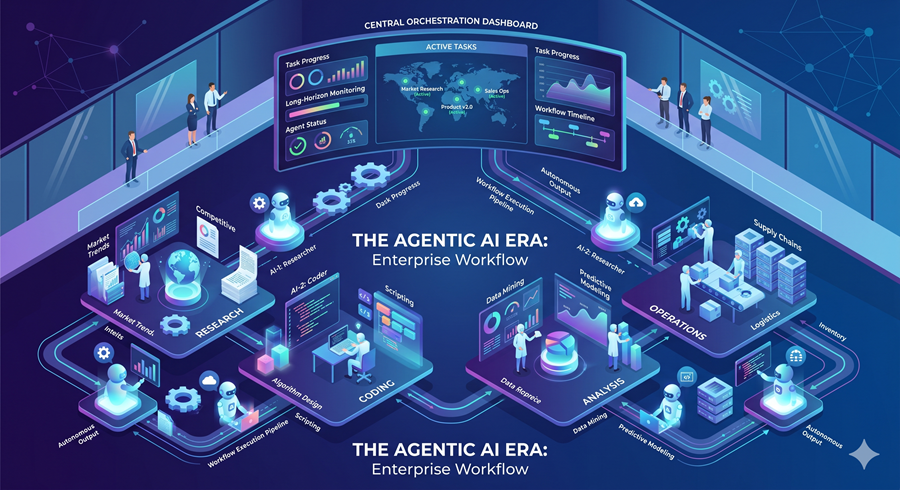
First, capability is no longer the bottleneck. Every frontier lab is now good enough at “thinking” and “coding” that the differentiator has shifted to execution. That is why you see the obsession with agents, context systems, tool use, and long-horizon workflows. The real competition is not “who has the smartest chatbot” anymore. It is “who can reliably complete a 6-hour or 6-day task without breaking.”
Second, compute is the new oil, but even more extreme. Anthropic locking down hundreds of thousands of GPUs, Google scaling trillions of tokens, xAI building gigawatt clusters, all of that is basically a supply chain war. The models are converging in intelligence, so whoever controls training and inference capacity at scale wins by default.
Third, pricing is collapsing faster than differentiation. DeepSeek-style models change the game because they turn “frontier intelligence” into a commodity. Once performance parity exists at 30x lower cost, the question stops being “which model is best” and becomes “which model is deployable everywhere without economics breaking.”
Fourth, the product surface is shifting from apps to agents embedded everywhere. Google turning search, Gmail, Docs, shopping, and Android into agent systems is the clearest signal here. The UI layer is dissolving into “intent execution.” You do not open tools anymore. You delegate outcomes.
Fifth, the risk conversation is no longer theoretical inside the labs. The interesting shift is not that leaders are warning about danger, it is that they are now disagreeing on strategy. Safety first integration means slow down but stay in control, like Anthropic style thinking. Fast deployment with guardrails and government alignment reflects OpenAI’s style of thinking. Ecosystem scale dominance is the Google approach. Full acceleration with ecosystem advantage and autonomy is the xAI approach.
Sixth, the uncomfortable meta point is that incentives are stronger than caution. Even the people warning about risk are still forced to compete in the same race. That is why computing spending keeps exploding, releases keep accelerating, and slowing down rarely translates into actual slowdown.
If you connect all of it, the pattern is simple:
We are moving from “AI as a tool” to “AI as infrastructure that executes work,” and the bottleneck is shifting from intelligence to control, reliability, and deployment scale.
The unresolved question is not who builds the best model. It is what happens when most economically valuable work becomes something you delegate to systems you do not fully understand, running on infrastructure you do not control.