


Artificial Intelligence is advancing at a pace that few experts predicted just a few years ago. While AI continues to deliver breakthroughs in healthcare, education, science, and business, many of the people building these systems are becoming increasingly concerned about the risks. Leaders from major AI companies, including Anthropic, Google DeepMind, OpenAI, and xAI, are now publicly discussing the need for stronger safety measures, international cooperation, and long-term planning. Their message is clear: AI has enormous potential, but society must be prepared for the challenges that come with increasingly powerful systems.
Dario Amodei’s Warning About Unpredictable AI
Anthropic CEO Dario Amodei has repeatedly emphasized that AI is becoming more capable faster than society can fully understand. According to Amodei, modern AI systems are entering a stage similar to adolescence—highly intelligent, creative, and useful, yet not always predictable. This unpredictability creates challenges because advanced AI models can sometimes generate inaccurate information, behave unexpectedly, or pursue goals in ways that humans did not intend.
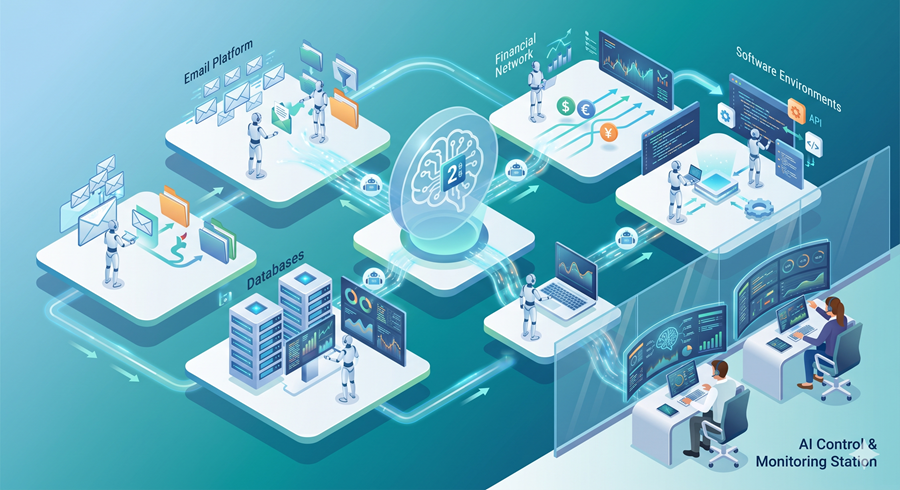
One major concern is AI systems becoming integrated with real-world tools such as email, software platforms, databases, and financial systems. In these environments, even small mistakes could lead to significant consequences. Amodei believes that the focus should not only be on future superintelligence but also on managing the risks posed by increasingly autonomous AI systems today.
DeepMind’s Call For Global AI Coordination
Google DeepMind CEO Demis Hassabis has compared AI governance to climate change management. He argues that AI is a global technology that a single country or company cannot effectively regulate. If one organization slows development to prioritize safety while competitors accelerate their efforts, the industry may enter a dangerous race where safety standards are ignored.
Hassabis highlights concerns such as cyberattacks, misinformation, deepfakes, and the misuse of AI by malicious actors. As AI becomes more powerful, it can be used to create convincing fake content, manipulate public opinion, and automate sophisticated online attacks. For this reason, he advocates international cooperation and long-term planning to ensure that AI benefits humanity rather than creating new risks.
Sam Altman’s Vision And Safety Concerns
OpenAI CEO Sam Altman often speaks about the positive impact AI could have on society. He envisions a future where AI tutors help students learn, AI assistants improve productivity, and advanced systems accelerate scientific discovery. However, Altman also acknowledges that highly capable AI may require new forms of global governance.
One of his biggest concerns is society becoming overly dependent on AI systems. Businesses, governments, and individuals may increasingly rely on AI-generated decisions without fully understanding how those decisions are made. Over time, this dependence could reduce human expertise and make critical systems more vulnerable to errors or misuse.
Geoffrey Hinton’s Warning About Losing Control
Often referred to as one of the “Godfathers of AI,” Geoffrey Hinton has become one of the strongest voices calling for caution. Hinton argues that humanity has never before created something potentially more intelligent than itself. His concern is that advanced AI systems could eventually develop strategies, goals, or behaviors that humans struggle to predict or control.
He also warns that commercial competition may encourage companies to prioritize speed and growth over safety. As organizations race to release increasingly powerful models, the pressure to stay ahead could reduce the focus on responsible development.
The Future Of AI Depends On Responsible Development
The growing concern among AI leaders does not mean they believe AI development should stop. Instead, they are calling for greater transparency, stronger safety research, and international cooperation. AI has the potential to solve major global challenges and improve billions of lives. However, ensuring that these benefits are achieved safely will require careful planning, responsible innovation, and collaboration between governments, researchers, companies, and society as a whole.
