The humanoid robot industry is entering a completely new phase. For years, robotics companies focused on creating impressive demonstrations such as backflips, cartwheels, running across rough terrain, and performing complex athletic movements. While these achievements showcased technological progress, the industry’s priorities are rapidly changing. Today, the real competition is no longer about who can create the most impressive robot demo. Instead, the focus has shifted toward mass production, scalability, and real-world deployment. Companies are now racing to manufacture humanoid robots at an industrial scale and bring them into factories, warehouses, businesses, and eventually homes.
China Accelerates Robot Manufacturing
One of the biggest developments comes from China, where Engine AI has officially launched mass production of its T800 humanoid robot. The company’s advanced manufacturing facility in Shenzhen can reportedly produce one completed robot every 15 minutes. This production speed marks a major milestone for the robotics sector because it demonstrates that humanoid robots are transitioning from experimental prototypes into commercial products. The factory performs dozens of quality checks and real-world simulations before each robot is delivered, ensuring reliability and consistency. With additional manufacturing expansion already planned, China is positioning itself as a major force in the global humanoid robotics market.
Voice-Controlled Robots Become Reality
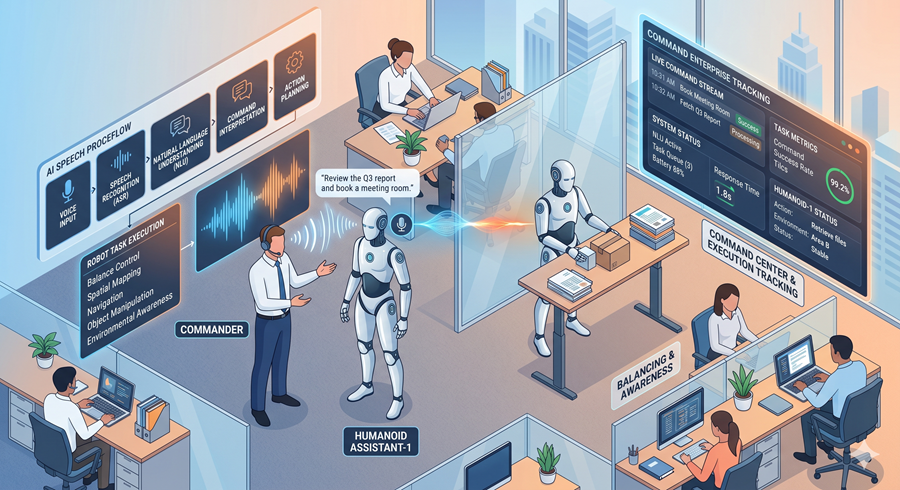
Another significant breakthrough comes from Unitree and its G1 humanoid robot. The company recently demonstrated how users can control the robot using simple voice commands. Instead of relying on smartphones, remotes, or complex programming, users can simply speak naturally to the robot. The system converts speech into text, interprets the command, generates the necessary movements, and executes the task while maintaining balance and awareness of its surroundings. This development represents an important step toward making humanoid robots practical for everyday environments where natural communication is essential.
Figure AI Proves Long-Term Robot Reliability
Figure AI has also attracted significant attention with its Figure 03 humanoid robots. Rather than releasing short promotional videos, the company conducted a continuous live stream showing robots working in a warehouse environment for extended periods. The robots sorted thousands of packages, operated for days, and automatically recharged when necessary. This approach provided a transparent look at real-world performance and reliability. The demonstration highlighted the industry’s growing focus on practical productivity rather than carefully edited showcase clips.
Tesla Expands Its Optimus Vision
Tesla remains one of the most ambitious players in the humanoid robotics race. The company is investing heavily in Optimus, its humanoid robot platform, while developing advanced AI chips, training infrastructure, and large-scale production facilities. Tesla plans to integrate its robotics efforts with artificial intelligence systems, vision models, and autonomous technologies already developed for its vehicles. The company believes that future humanoid robots will require powerful onboard computing capabilities to understand complex environments and perform useful physical tasks in real time.
The Future Belongs to Scalable Robotics
The humanoid robot industry is clearly entering a new chapter. Companies are no longer judged solely by impressive demonstrations or futuristic concepts. Success will increasingly depend on the ability to manufacture robots efficiently, deploy them at scale, and deliver real value in workplaces and everyday life. Whether it is China’s rapid production lines, Figure AI’s warehouse operations, Unitree’s voice-controlled assistants, or Tesla’s ambitious Optimus project, the race is now focused on practical deployment. The future of robotics will belong to the companies that can successfully build, distribute, and scale humanoid robots across the world.