Something interesting is happening in the AI industry right now. Over the last two years, AI subscriptions have exploded everywhere. Claude offers expensive Max plans. OpenAI has premium ChatGPT and Codex subscriptions. Almost every serious AI company now wants users locked into a monthly payment system.
But recently, a growing number of developers and power users are starting to realize something important. The model itself may no longer be the real product.
What people are actually paying for is the surrounding ecosystem.
The Rising Cost of AI Subscriptions
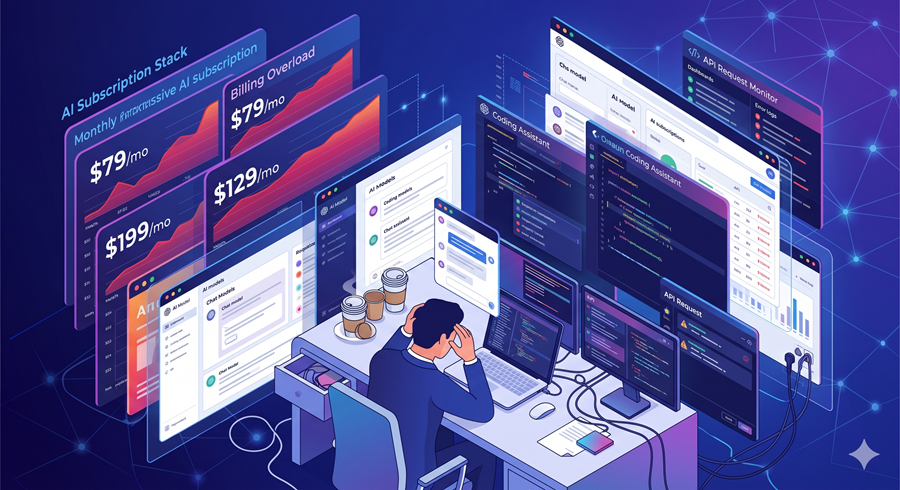
For many developers today, having one subscription is no longer enough. A typical setup may include Claude for coding, ChatGPT for testing new models, API credits on OpenRouter, and backup access to open source systems like DeepSeek or Qwen.
Individually, each subscription may seem manageable. But combined, the costs quickly become heavy.
A developer could easily spend over $100 every month just to maintain access across different AI tools and workflows. And the frustrating part is that even premium plans still come with strict usage limits.
Many users now experience situations where they hit token limits, rate caps, or temporary lockouts despite paying high monthly fees.
This creates a strange contradiction. AI companies advertise unlimited productivity while simultaneously restricting access during heavy use.
API Credits Are Surprisingly Cheap
What makes this situation even more interesting is how cheap API access has become.
Open source and open weight models like DeepSeek, Qwen, and MiniMax can already perform extremely well for coding, reasoning, and technical workflows. When accessed through APIs, these models often cost only a few dollars for millions of tokens.
That creates a major pricing imbalance.
A user may spend $100 on a premium subscription, while another user performs nearly the same work using API credits costing less than $10.
This is pushing many developers toward direct API workflows instead of expensive subscription ecosystems.
The Model Is Losing Its Competitive Advantage
A few years ago, frontier models had a massive quality advantage. GPT models and Claude models were clearly ahead of open-source systems.
That gap is shrinking rapidly.
Today, open models are improving at incredible speed. Every time a frontier company releases a stronger model, the open source ecosystem catches up shortly afterward.
This means the model itself is becoming less defensible as a business advantage.
Eventually, if open models reach near parity with closed systems, companies like OpenAI and Anthropic will no longer win simply because they have the smartest AI.
Instead, the competition shifts toward tools, infrastructure, integrations, workflows, and enterprise ecosystems.
AI Companies Are Building Ecosystems Instead of Just Models
This explains why companies are aggressively expanding beyond pure model access.
Anthropic is building Claude Code, desktop apps, remote computer control systems, and collaborative workflows.
OpenAI is pushing deeper into coding tools, agents, automation, enterprise integrations, and multimodal applications.
These companies understand that raw intelligence alone is not enough anymore.
They are trying to become the operating systems of AI.
The strategy resembles the difference between iOS and Android. Closed ecosystems attempt to lock users into tightly integrated experiences, while open ecosystems allow flexibility and customization.
The difference is that software ecosystems in AI are much easier to replicate than hardware ecosystems.
Open Source Models Could Reshape the Entire Market
Unlike smartphones, AI models can often be hosted anywhere, integrated anywhere, and orchestrated through independent software layers.
This creates a dangerous long-term problem for closed AI companies.
If a future open model reaches the same capability level as a frontier closed model, another company could simply build a better application layer on top of it.
For example, a company like Adobe could integrate advanced open models directly into its products without relying heavily on Anthropic or OpenAI.
In that scenario, the underlying model provider loses leverage because the value shifts to workflow integration and customer ownership.
This is why many people believe the AI market could eventually resemble Android more than iPhone.
Why Developers Are Experimenting With Open Models
More developers are now testing open workflows because the cost difference is impossible to ignore.
With a small amount of API credits, users can access powerful models without committing to expensive subscriptions.
Many are discovering that open models are already good enough for daily development work, coding assistance, debugging, and automation tasks.
For users who only rely on standard chat interactions and basic coding workflows, subscription plans may eventually feel unnecessary.
The more capable open models become, the harder it will be for premium subscriptions to justify extremely high prices.