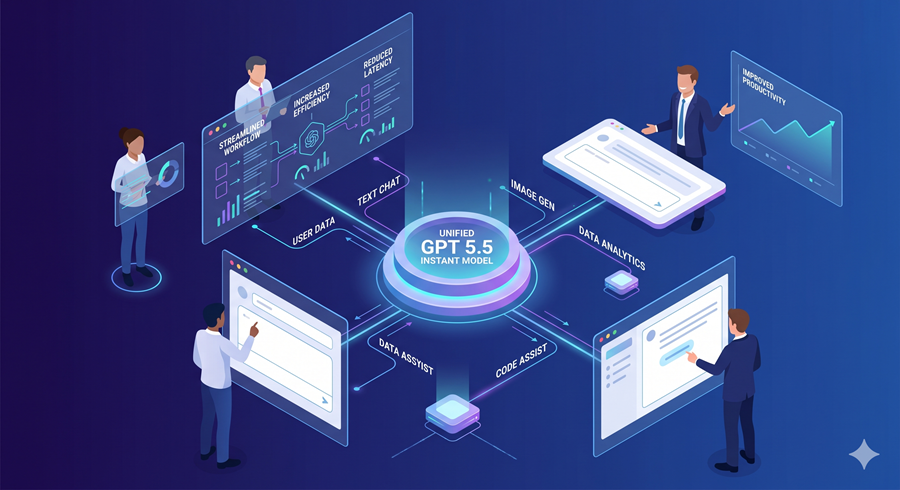
This week in AI, a major shift happened inside ChatGPT with the introduction of the GPT 5.5 Instant model. It is now the default model for most users and is designed for speed and efficiency. Instead of choosing from multiple models upfront, the interface has been simplified, and most users will automatically interact with this new version.
OpenAI has also changed how users are expected to prompt the model. Rather than writing long, step-by-step instructions, users are encouraged to focus on outcomes. The model performs better when given a clear end goal instead of a detailed sequence of actions. This marks a shift in how AI interaction is being designed, moving from procedural prompting to result-based prompting.
Outcome-Based Prompting Becomes the New Standard
The biggest change is not just the model, but the prompting style that works best with it. GPT 5.5 Instant performs better with short prompts that clearly describe what a good result looks like.
Instead of writing detailed instructions like step one, step two, step three, users are now encouraged to define the final objective and expected output quality.
For example, instead of breaking down an evaluation process into multiple steps, users can simply ask the model to pick the best option and explain briefly why. This simplifies prompting and often produces more direct answers.
Testing shows that shorter, goal-focused prompts can sometimes outperform complex structured prompts, especially in everyday use cases.
Reduced Hallucinations and Improved Accuracy
One of the most important claims about GPT 5.5 is a reduction in hallucinations by more than 50 percent. Hallucinations refer to when AI confidently produces incorrect or made-up information.
This improvement is especially important in areas like finance, law, and healthcare, where precision matters most. These domains involve highly specific facts, which are usually where earlier models struggled.
With this update, the model is designed to avoid guessing and instead prioritize more reliable responses. While hallucinations are not fully eliminated, the reduction is a meaningful step toward more trustworthy outputs.
Better Search Style Responses and Structured Answers
Another noticeable improvement is in how the model formats answers. Responses are now more structured and concise compared to earlier versions that often produced long, unorganized paragraphs.
In many cases, the model now includes summaries, bullet-style breakdowns, and even FAQ sections at the end of responses. This makes it easier for users to quickly extract the information they need without reading through large blocks of text.
This shift shows a clear focus on usability and clarity rather than just raw output generation.
Memory System Improvements in ChatGPT
The memory system inside ChatGPT has also been improved. Users can now see when memories are used in responses, and trace which saved information influenced the answer.
This adds transparency to how the model personalizes responses. It is now possible to view stored memories, edit them, or correct them directly from the interface.
This update gives users more control over personalization and reduces the feeling of the system operating as a black box.
Massive AI Infrastructure Expansion with Amazon and Anthropic
Beyond ChatGPT updates, the AI industry is seeing massive infrastructure growth. One of the biggest developments is Amazon’s large-scale data center project in Indiana, built to support Anthropic’s AI workloads.
This facility uses hundreds of thousands of Amazon’s custom Trainium chips instead of NVIDIA GPUs. It is designed for large-scale AI training and inference and is part of a broader strategy to reduce dependency on external chip suppliers.
The project includes multiple buildings, high energy consumption, and direct integration with Anthropic’s model training systems.
Custom AI Chips and the Shift Away from NVIDIA Dependence
Amazon is heavily investing in its own chip ecosystem, including Trainium and Inferentia processors. These chips are designed specifically for AI workloads and aim to reduce cost while increasing efficiency.
While NVIDIA remains dominant in AI hardware, companies like Amazon and Google are building alternatives to control their own infrastructure. Google uses TPUs, while Amazon focuses on Trainium chips.
Anthropic is also working closely with both Amazon and Google, accessing large-scale compute resources across multiple providers instead of relying on a single ecosystem.
Data Center Expansion and Energy Demand Challenges
The scale of AI infrastructure expansion is creating massive demand for electricity, water, and land. New data centers consume power equivalent to millions of homes and require significant upgrades to local power grids.
This rapid expansion has raised concerns in local communities about environmental impact, water usage, and rising electricity costs. Some regions have already seen significant increases in power bills linked to data center growth.
Despite these concerns, construction continues at full speed as demand for AI compute remains extremely high.