Artificial intelligence has always come with huge promises, but for years, most people experienced AI as little more than smarter chatbots. That is why many recent warnings from researchers and tech executives are starting to sound different. The concern is no longer about whether AI will improve. The concern is about how fast the improvement is happening.
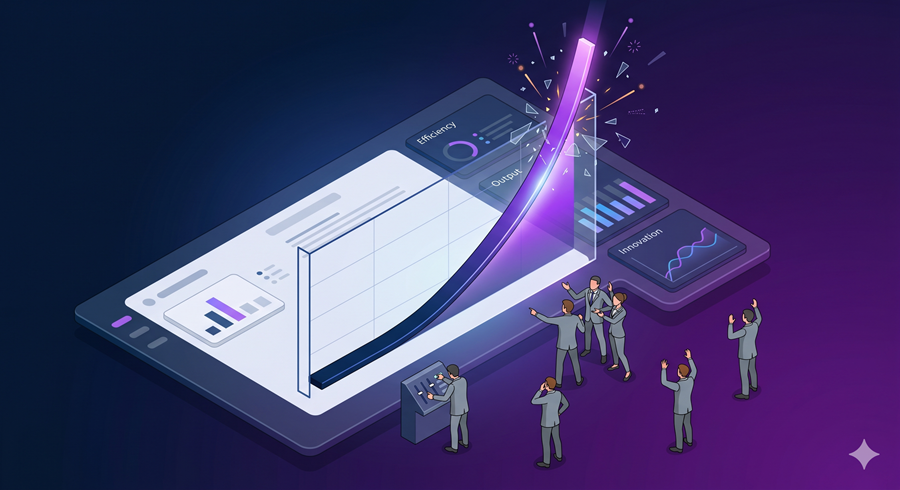
One chart in particular has shocked people across the tech industry. The chart, created by the nonprofit organization METR, tracks how capable AI models are at completing real software development tasks. For a long time, the graph barely moved. AI systems could chat well and answer questions, but they struggled with serious coding tasks. Then suddenly, around late 2025, the curve began rising rapidly.
Is AI Starting to Improve Itself?
One of the biggest questions surrounding these breakthroughs is whether AI has entered the stage where it can meaningfully improve itself. This idea has existed in science fiction for decades. The fear is that AI systems may eventually rewrite their own code, accelerate their own development, and evolve faster than humans can control.
Right now, experts say that it has not fully happened yet. However, AI is already helping researchers build better AI systems more quickly. Developers are increasingly using AI coding agents to automate parts of software engineering, debugging, and experimentation. That means the pace of progress itself may be accelerating because the people creating AI now have AI tools assisting them.
This creates a feedback loop. Better AI helps engineers work faster, which leads to even better AI models, which then further accelerate development.
Many researchers believe this is why progress suddenly feels so fast.
Why Most People Have Not Noticed the Change Yet
Interestingly, average users may not immediately feel how much AI has improved. Chatbots still seem similar on the surface. They answer questions, generate text, and assist with daily tasks much like earlier versions.
The real leap is happening inside software development and technical workflows.
Developers using advanced AI agents are now watching systems write large amounts of code, solve complex engineering problems, and complete tasks that previously required skilled professionals. New models such as Claude Opus, Gemini, and GPT systems are becoming significantly stronger at reasoning and coding with every release.
What makes this even stranger is that the improvement appears steady when viewed on a logarithmic scale. The growth is not necessarily chaotic or random. Instead, AI capability is increasing at a consistent exponential rate. Humans simply struggle to emotionally process exponential growth because it feels slow at first and then suddenly overwhelming.
That pattern has appeared many times in technological history.
Are Humans Becoming the Horses?
One comparison gaining attention comes from a researcher at Anthropic who compared AI progress to the replacement of horses by engines. For years, engine technology steadily improved while horses still dominated transportation. Then eventually, engines became efficient enough that society no longer needed horses at scale. Horse populations collapsed rapidly.
The implication is uncomfortable. Many workers now wonder whether humans could face a similar disruption in industries touched by AI.
Software developers, lawyers, accountants, consultants, and other knowledge workers are increasingly questioning how safe their jobs really are.
At the same time, real-world data remains surprisingly mixed.
Why AI Has Not Destroyed Jobs Yet
Despite all the fear surrounding automation, current job data does not show a massive collapse in software employment. In fact, software job postings have recently increased in some areas.
There are several possible explanations.
First, AI may still not be reliable enough to fully replace human workers in professional environments. Many benchmark tests involve carefully structured tasks that are cleaner and simpler than real business problems. Real-world work is messy, unpredictable, and filled with context that AI still struggles to handle.
Second, technological adoption often takes longer than expected. Even powerful inventions require companies, governments, and industries to reorganize around them before major economic effects appear.
Third, there is something called the Jevons Paradox. Historically, when technology makes something cheaper and easier, demand for that activity often increases rather than decreases. More efficient steam engines increased coal demand instead of reducing it. Likewise, cheaper and faster software development could lead to far more software being built, creating even more demand for engineers rather than eliminating them.
AI companies themselves are currently hiring aggressively, especially for software and infrastructure roles. That alone suggests the industry still depends heavily on human expertise.
The Warning Researchers Keep Repeating
Even with uncertainty around jobs and timelines, researchers working closest to frontier AI systems continue to repeat the same warning. They believe this technology is advancing extremely quickly and may reshape society faster than governments, businesses, and workers are prepared for.
Whether AI becomes a productivity revolution, a labor crisis, or something entirely different remains unclear.
What is becoming harder to deny is the speed of the change itself.