For the past year, most AI coding tools have operated like extremely capable assistants. They generate code, explain bugs, and automate fragments of development work, but they still depend heavily on human coordination.
That model is starting to break down.
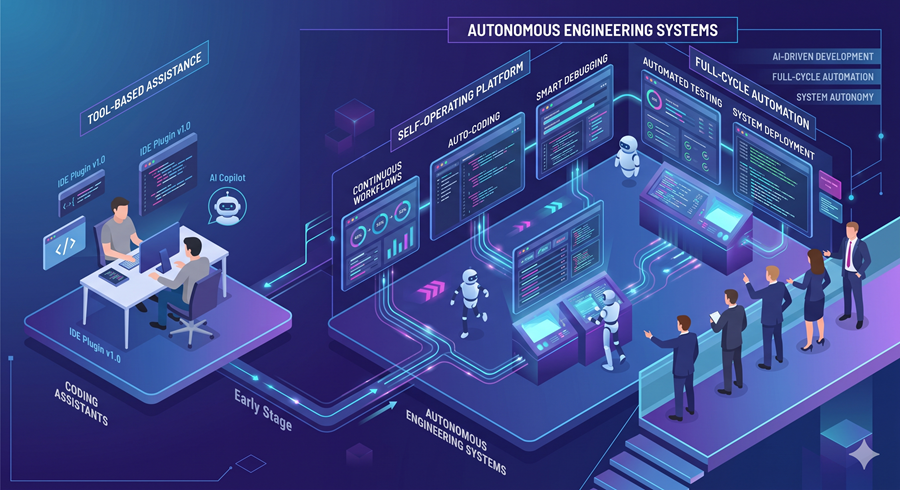
The latest direction emerging from Anthropic suggests something much larger: a transition from single AI assistants toward persistent, coordinated software engineering systems that operate more like autonomous teams, and the implications are bigger than another benchmark release.
AI Agents Are Becoming Long-Horizon Systems
One of the most important themes emerging in AI right now is persistence.
Instead of resetting after every interaction, newer systems are being designed to retain memory across projects, sessions, repositories, and workflows. Anthropic’s focus on long-term reasoning and “dreaming” systems points toward agents that continuously learn from previous work rather than treating every task as isolated.
That changes the nature of AI assistance entirely.
A coding model with memory is not just answering prompts. It is gradually developing an operational context around how you work, what systems you maintain, and how decisions evolve.
The difference between temporary assistance and persistent collaboration is enormous.
Multi-Agent Coordination Changes the Scale of Automation
The second major shift is orchestration.
Rather than relying on one model handling everything sequentially, Anthropic is pushing toward systems where lead agents delegate work to specialized sub-agents operating in parallel across front-end development, debugging, research, architecture, and testing.
This is structurally important because software engineering is already a coordination problem more than a pure coding problem.
The closer AI systems get to distributed teamwork, the closer they move toward replacing not just isolated tasks, but entire operational workflows.
That is why the industry is increasingly focused on “agent swarms” rather than smarter standalone chat interfaces.
Infrastructure Is Becoming the Real Competitive Weapon
What stood out to me most was not even the model roadmap. It was the infrastructure story behind it.
Massively increased rate limits, large-scale GPU expansion, and deep compute partnerships reveal something fundamental about where the market is heading: future AI products will be constrained less by model intelligence and more by sustained inference capacity.
Long-running autonomous agents consume enormous amounts of compute because they continuously reason, self-correct, coordinate, and revisit context over extended periods.
The companies that can reliably serve those workloads at scale gain a major advantage.
Benchmark Intelligence Is No Longer Enough
I think Anthropic’s emphasis on “judgment” and “code taste” is also revealing.
The next competitive layer in AI coding will probably not come from raw benchmark performance alone. It will come from whether models can make decisions that resemble experienced engineers rather than autocomplete systems.
Maintainability, architecture, tradeoff analysis, and workflow awareness matter more in production environments than isolated coding accuracy.
That is a much harder problem than generating syntactically correct code.
The AI Developer Stack Is Being Rewritten
What makes all of this important is that AI tooling is gradually evolving from utility software into operational infrastructure.
Persistent memory, infinite context ambitions, multi-agent coordination, self-evaluation loops, and autonomous workflows all point toward the same outcome: AI systems that manage increasingly large portions of the software development lifecycle independently.
We are moving past the era of “AI coding assistants.” The industry is now trying to build autonomous engineering organizations made out of models.
Follow Us on:
Clutch
Goodfirms
Linkedin
Instagram
Facebook
Youtube