


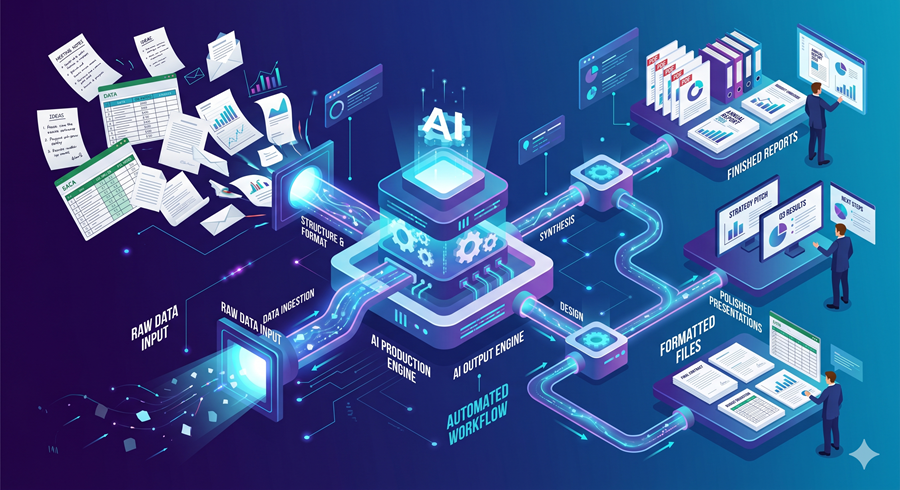
The most important part of Gemini’s latest update is not that it generates better content. It is that it now turning inputs into finished deliverables.
That sounds subtle, but it changes the role of the model. Gemini is no longer just helping create drafts. It is beginning to function like a production layer. Notes become presentations. CSVs become investor reports. Research becomes spreadsheets. Raw inputs become formatted outputs that are ready to send, publish, or export.
That is a meaningful shift. The model is moving from assistant to output engine.
The Real Upgrade Is Format Control
What makes this useful is not just content generation. It is a format generation.
The value is no longer limited to writing text. Gemini can now take the same underlying information and repackage it into different business formats: slide decks, PDFs, spreadsheets, resumes, reports, LaTeX documents, lead magnets, and technical documentation.
That matters because most professional work is not blocked by thinking alone. It is blocked by conversion. People already know what they want to say. The friction is turning that into the correct format, structure, and deliverable. Gemini is starting to remove that layer.
This Compresses Execution Time
The deeper implication is operational.
A large share of knowledge work is not original thinking. It is reformatting, restructuring, translating, and packaging information for different audiences. Internal notes become client decks. Research becomes executive summaries. Data becomes investor updates. Ideas become content calendars.
That translation layer has always consumed more time than most teams admit. Gemini is collapsing it.
The result is not just faster writing. It is faster execution across the full chain between information and output.
The Real Value Is Workflow Compression
What makes this more important than another generation feature is that it reduces tool switching.
The traditional workflow is fragmented: one tool for writing, one for formatting, one for slides, one for spreadsheets, one for documents, one for revisions. Gemini is beginning to absorb those transitions into a single environment.
That matters because productivity gains rarely come from generating more words. They come from reducing the number of handoffs between tools, formats, and systems.
Gemini is becoming less like a chatbot and more like a content operating system.
Why This Matters More Than It Looks
Most AI product updates improve generation quality. This one changes where work happens.
The real shift is not that Gemini can write more things. It is that it can now produce finished business assets in the formats work actually requires.
That makes it more than a writing tool. It makes it a production interface.
And that is the more important transition: AI is no longer just helping create content. It is starting to handle the packaging, formatting, and operational work around it.
Follow Us on:
Clutch
Goodfirms
Linkedin
Instagram
Facebook
Youtube
