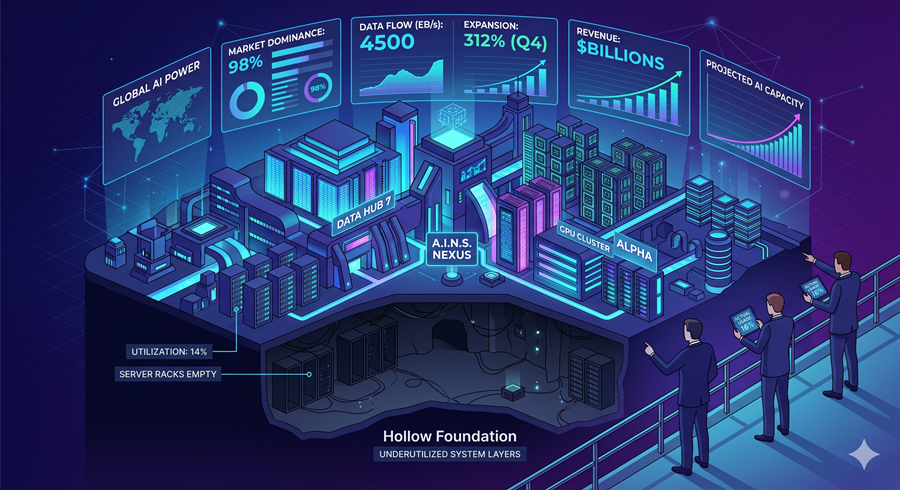
I’ve always been fascinated by bold ambition, especially when it promises to reshape the future. But there’s a point where ambition stops being inspiring and starts revealing cracks underneath. That’s exactly what I see in this story of a massive AI empire that looked unstoppable on the surface, yet quietly began to hollow out from within.
The Illusion of an Unstoppable Advantage
At first glance, the strategy seemed unbeatable. Combine massive infrastructure, cutting-edge hardware, and nearly unlimited capital, and you should win. Building one of the largest supercomputers ever, packed with hundreds of thousands of GPUs, sounds like a guaranteed path to dominance.
And speed made it even more impressive. What usually takes years was compressed into months. It created the illusion of momentum, as if brute force and urgency alone could outpace everyone else.
But I keep coming back to one uncomfortable truth. Hardware does not build intelligence. People do.
When Power Isn’t Enough
Even the most powerful systems are useless without the minds that know how to direct them. AI is not just computing. It is architecture, experimentation, iteration, and deep expertise.
While others focused on attracting and retaining top talent, this approach leaned heavily on scaling infrastructure. That imbalance matters more than it first appears. Because once the people start leaving, the system loses its ability to evolve.
And that is exactly what began happening. Quietly at first, then all at once.
The Moment Reality Became Visible
The turning point was not a dramatic failure. It was something subtler. The product simply did not live up to expectations.
Instead of leading the industry, it lagged in key areas like reasoning, coding, and content quality. Errors became more visible. Controversies added pressure. And the gap between promise and performance started to widen.
Then came the admission that everything needed to be rebuilt from the ground up. That moment matters because it signals something deeper than a product issue. It shows that the foundation itself was flawed.
For the people inside the system, that realization changes everything.
The Talent Collapse That Followed
What happens when the people who built something stop believing in it?
They leave.
One by one, key contributors walked away. Some moved to competitors. Others pursued new ventures. A few left quietly, without much explanation. But the pattern was clear. The core team was dissolving.
And in a field like AI, replacing that kind of talent is not simple. These are not interchangeable roles. They are individuals with unique insight, experience, and creative direction.
Losing them is not just a staffing issue. It is a structural loss.
Why Culture and Leadership Matter More Than Speed
I think this is where the deeper lesson sits. You cannot rush everything. Some domains require patience, clarity, and stability.
Aggressive timelines and constant pressure might work in certain industries, but AI research depends on long-term thinking. It requires space for experimentation and the ability to build gradually.
When that balance is missing, even the most talented people start to disengage. And once that happens, no amount of funding can fully compensate for it.
The Competitive Reality Setting In
While one system struggled internally, others continued moving forward steadily. They invested not just in infrastructure, but in teams, collaboration, and long-term development cycles.
That difference compounds over time. Small advantages in talent and execution turn into large gaps in capability.
And eventually, the narrative shifts. What once looked like a dominant force begins to feel like it is falling behind.
What This Really Reveals
What I take away from all of this is simple but easy to overlook. Scale does not equal success. Speed does not guarantee leadership. And capital cannot replace conviction.
In the end, the strength of any AI system is not measured by how many chips it has, but by the people shaping how those chips are used.
Without them, even the most powerful empire can start to feel empty.
Follow Us on:
Clutch
Goodfirms
Linkedin
Instagram
Facebook
Youtube