I have seen a lot of AI announcements, but this wave from Google feels different in scale and direction. It is not just one product or one model update. It feels like a coordinated push across hardware, software, and full automation systems designed to plug directly into real business workflows.
A New Generation of AI Chips Built for Scale
The first thing that stands out is Google’s new generation of TPUs. These chips are split into two roles: one focused on training AI models and the other on running them in production.
The training chip is designed to drastically reduce the time needed to build large models. Workloads that previously took weeks can now be compressed into much shorter cycles. The inference chip, on the other hand, is focused on delivering AI responses faster and at lower cost once models are already trained.
What matters here is not just raw performance, but accessibility. When the cost of running AI drops, the entire ecosystem of tools built on top of it becomes more usable, more scalable, and more integrated into everyday business operations.
From Tools to AI Workers Inside Business Systems
The bigger shift comes from Google’s move into what feels like full AI agent infrastructure. Instead of just offering models, the focus is now on systems that can operate inside businesses as autonomous workers.
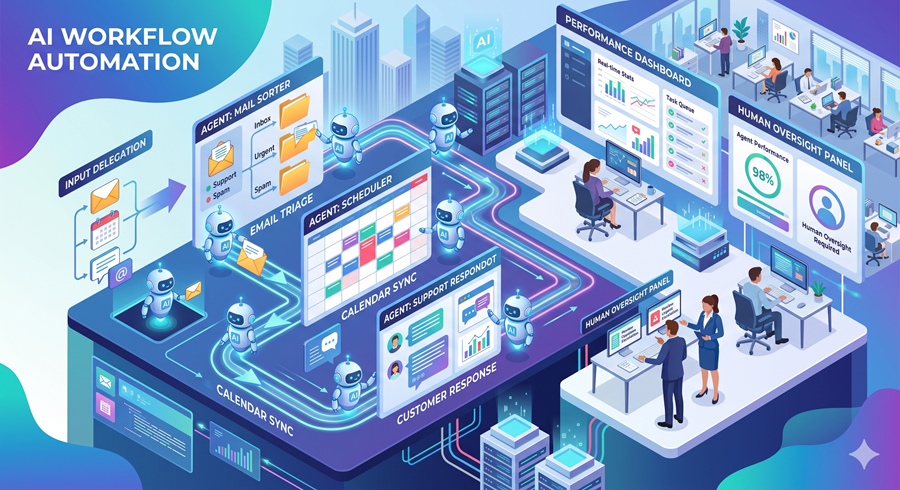
A central part of this is a platform designed to let users create AI agents without needing to write code. These agents can handle repetitive tasks like sorting emails, responding to basic queries, and prioritizing important requests.
What makes this more powerful is persistence. These agents are not limited to single interactions. They can run in the background for long periods, handling workflows continuously without supervision.
That changes the shape of work. Instead of manually managing tasks throughout the day, I can assign processes that execute on their own schedule.
Long Running Agents and Always-On Automation
One of the most significant concepts is the idea of long-running agents. These systems are designed to operate over extended periods, continuously executing tasks like lead generation, outreach, scheduling, and reporting.
This creates a model where work does not stop when I stop working. The system continues operating in the background, executing predefined goals and updating outcomes.
It is a shift from reactive tools to persistent digital operators.
Deep Research Systems That Replace Manual Analysis
Another major development is the introduction of advanced research agents. These systems can take a single question and expand it into a full research pipeline.
They search, analyze, cross-reference, and produce structured reports with sources and insights. One version focuses on speed, while another focuses on depth and extended reasoning over long periods.
What used to require hours or even days of manual research can now be condensed into a structured output generated automatically. The key shift here is not just automation, but synthesis of information across multiple sources and formats.
Search That Understands More Than Text
Google’s new embedding systems move beyond traditional text search. They allow AI to understand and retrieve information across images, videos, audio, and documents in a unified way.
This changes how information is accessed. Instead of relying on keywords, I can search based on meaning across different media types. That means finding relevant content inside videos, presentations, or large document libraries becomes significantly easier.
It turns unstructured data into something searchable in a much more human way.
Design Systems That Stay Consistent Across AI Tools
Another interesting development is a structured design format that allows AI systems to understand branding rules. By defining style rules in a simple format, any AI tool can generate content that matches a brand automatically.
That removes a lot of repetitive design work. Instead of correcting layouts or reworking visual consistency, the system follows predefined rules from the start.
It also means design becomes portable across tools rather than locked into one platform.