I keep noticing the same pattern whenever I look at where artificial intelligence is heading. The conversation is shifting away from isolated breakthroughs and toward systems, workflows, and real-world integration. If I step back and map it out, there are six trends that stand out as especially important for 2026.
AI Models Are Becoming Commodities
One thing I cannot ignore is how similar top AI models are becoming. The performance gap that once separated them is shrinking quickly, and in many cases, they are clustering at the top of the same performance range.
What this tells me is simple. The question is no longer which model is the best, but what I can actually do with any of them. As models converge in capability and become cheaper to run, they start behaving more like utilities than products.
That shifts the competition toward distribution, integration, and ecosystem control rather than raw intelligence.
Workflows Matter More Than Autonomous Agents
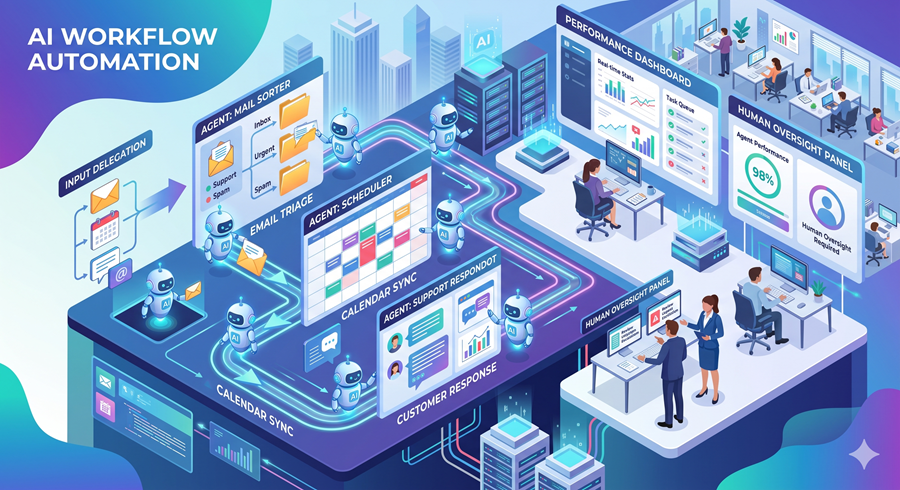
There is a lot of excitement around fully autonomous AI agents, but what I see in practice is something more grounded. Most real value today is coming from structured workflows rather than fully independent systems.
Instead of replacing entire jobs, AI is being inserted into specific steps of existing processes. I see this in areas like data analysis, customer support, and software migration, where AI handles repetitive work while humans oversee decisions.
It feels less like full automation and more like targeted acceleration of existing systems.
The Technical Barrier Is Disappearing
One of the biggest changes I notice is that technical skill is no longer the gatekeeper it used to be. People who were previously dependent on engineers can now build tools, automate processes, and analyze data on their own.
This does not eliminate expertise, but it redistributes capability. Non-technical users are closing the gap faster than expected, which changes how teams operate and how value is created inside organizations.
Context Is More Important Than Prompting
I used to think the quality of AI output depended mainly on how well I wrote prompts. That is becoming less true. What matters more now is the context I provide.
These systems are powerful, but they still lack awareness of personal or organizational information. Without access to files, goals, and history, they operate in isolation.
This is why platforms are racing to integrate AI into emails, documents, and productivity tools. Whoever controls context controls usefulness.
It also forces me to think differently about organization. If my information is scattered, the AI cannot help me effectively.
Advertising Inside AI Systems Is Inevitable
Another shift I see coming is the introduction of ads into conversational AI systems. While it may feel uncomfortable, it also solves a distribution problem.
If advanced AI remains locked behind paid tiers, access becomes uneven. Advertising creates a way to subsidize access for broader users.
The likely format will not disrupt conversations directly. Instead, it will resemble separate, clearly defined placements that sit alongside responses rather than inside them.
It is a tradeoff between purity of experience and accessibility.
AI Is Moving Into the Physical World
The final trend is the most visually obvious. AI is no longer just software. It is starting to control physical systems like vehicles, warehouses, and industrial machines.
Autonomous transport systems, robotic warehouses, and large-scale automation are already demonstrating measurable efficiency gains. The key shift is that these machines are no longer static tools. They improve through software updates over time.
That turns physical infrastructure into something closer to evolving software systems.
What I Take Away From All This
When I connect these trends, a clear picture forms. AI is moving from standalone intelligence into embedded infrastructure. It is becoming less about individual models and more about systems that operate inside workflows, tools, and physical environments.
The biggest opportunity is not predicting the future perfectly, but learning how to work inside this shifting structure before it fully stabilizes.