


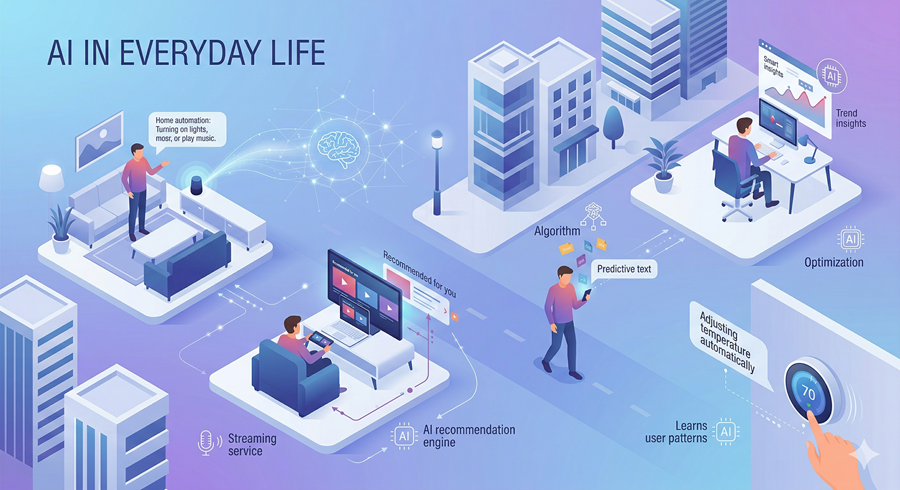
I often think about how quickly artificial intelligence has become part of everyday life, yet many people still struggle to define what it actually is. To me, it is best understood as a system that allows machines to perform tasks that normally require human thinking, such as learning, reasoning, and decision-making.
Understanding Intelligence and AI
When I think about intelligence, I see it as the ability to learn new information and apply it to solve problems. Humans do this constantly, from learning language as children to solving complex challenges as adults. Artificial intelligence works similarly, but instead of being biological, it is built through algorithms and data.
I see AI as a different form of intelligence because it does not “think” like a human. Instead, it processes information, identifies patterns, and produces outputs based on training data. Over time, these systems can adapt and improve as they are exposed to more examples.
How AI Shows Up in Daily Life
I notice AI everywhere once I start paying attention. Voice assistants that respond to questions, recommendation systems that suggest content, and facial recognition used to unlock phones are all powered by AI. Even self-driving vehicle systems rely on AI to interpret roads, detect obstacles, and make driving decisions.
What surprises me is how normal these tools have become. Many people use them daily without realizing the level of intelligence working behind the scenes.
Why AI Is So Powerful Across Industries
One reason I find AI so impactful is its ability to process massive amounts of data quickly. In fields like healthcare, finance, and retail, this capability is extremely valuable. AI can analyze patterns, detect risks, and support decision-making faster than humans alone.
In healthcare, it can help identify conditions earlier. In finance, it can detect fraud or predict market trends. In business, it helps companies understand customer behavior and improve services. This speed and scale of analysis is what makes AI such a transformative technology.
Risks, Responsibility, and Human Impact
At the same time, I also think about the risks. Relying too heavily on AI can reduce human effort in learning and problem-solving. There is also concern that automation may replace certain jobs, leading to unemployment in some industries.
Because of this, I believe AI needs to be developed and used responsibly. It should support human capability, not replace human judgment entirely. Ethical design and careful regulation are important to ensure it benefits society as a whole.
A Brief Look at AI History
When I look back at the history of AI, I am reminded that it has been evolving for decades. Early systems were simple programs designed for tasks like playing chess. Over time, these systems improved significantly. A major milestone came when a computer defeated a world chess champion, showing that machines could outperform humans in highly structured tasks.
Since then, AI has continued to grow rapidly, moving from basic rule-based systems to advanced learning models that can handle complex real-world problems.
Short paragraph
To me, artificial intelligence is not just a technology trend. It is a shift in how humans and machines interact, and it will continue shaping how we live, work, and solve problems in the future.
