


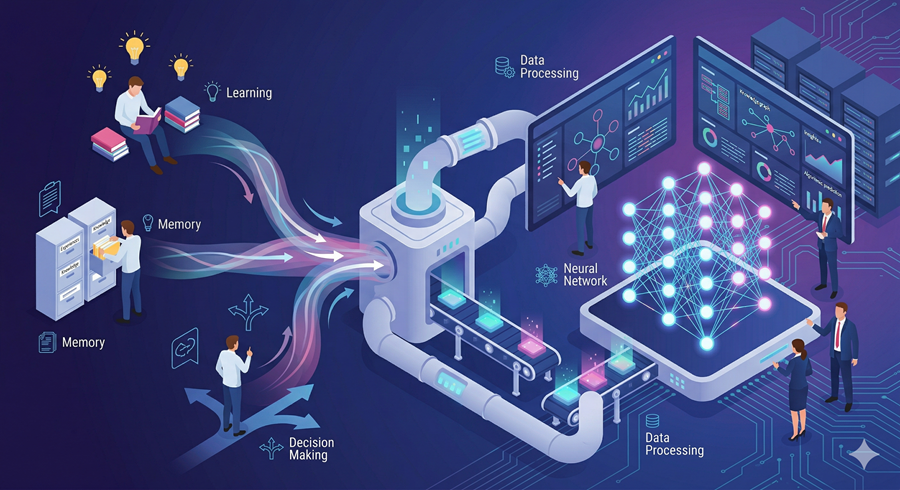
I see artificial intelligence as a way of creating systems that can replicate parts of human thinking in a mechanical form. When I think about intelligence, I think about learning from experience, storing knowledge, and using it to solve problems in new situations.
AI tries to mirror that process, even though it does not truly understand the world the way humans do. What interests me most is how quickly it has shifted from a technical idea into something that quietly shapes everyday life. Many tools I already use rely on it in ways I do not always notice at first.
How AI Learns and Makes Decisions
From my understanding, AI works by processing large amounts of data and finding patterns hidden within it. Instead of following fixed instructions for every possible situation, it learns from examples and adjusts its behavior based on what it has seen before.
I find it fascinating that this allows systems to improve over time without being manually rewritten. They compare new inputs with past data and generate outputs based on probability and pattern matching. This is why AI performs well in tasks like recognition, prediction, and sorting complex information into useful categories.
Where I See AI Being Used Today
I already see AI integrated into many parts of daily life. Voice assistants, recommendation systems, navigation apps, and facial recognition tools all depend on it in different ways. Beyond personal use, it is also deeply embedded in industries such as healthcare, finance, retail, and manufacturing.
In these fields, AI helps process huge amounts of data faster than humans can, supporting decisions that need speed and accuracy. I also notice its role in automation and robotics, where machines perform tasks that are repetitive, dangerous, or require high precision, reducing human effort and increasing efficiency.
The Benefits and Concerns I Cannot Ignore
What stands out to me is that AI is both an opportunity and a challenge. It clearly brings benefits like improved productivity, faster decision-making, and the ability to solve problems at a scale that was not possible before.
At the same time, I cannot ignore the concerns that come with it. There is the risk of people becoming overly dependent on technology, which could reduce certain skills over time. There is also the question of how it will affect jobs, especially in areas where routine work can be automated. Looking back at early milestones like chess-playing programs and systems such as Deep Blue, I realize that machines have been surpassing humans in specific tasks for decades, but the pace today feels much faster. That makes it important to think carefully about how this technology is developed and used.
AI feels like a powerful tool that is still unfolding. For me, the real challenge is not just understanding how it works, but deciding how to use it responsibly as it becomes more deeply integrated into everyday life.
