


I have been trying to stay level-headed about AI, but it is getting harder as each new chart or benchmark drops. What stands out to me is not any single breakthrough, but the shape of progress itself. On the surface, it still feels gradual. Yet when I step back, it looks like something closer to an exponential curve that only reveals itself over time.
There is a benchmark chart tracking how well AI models perform on software engineering tasks, and it tells a very specific story. For years, progress has looked slow and almost flat. Models improve at chatting and basic coding, but real software engineering ability barely moves. Then, suddenly, in recent years, the curve began to bend upward sharply as new agent-based systems entered the picture.
The Shift From Chatbots to Engineering Agents
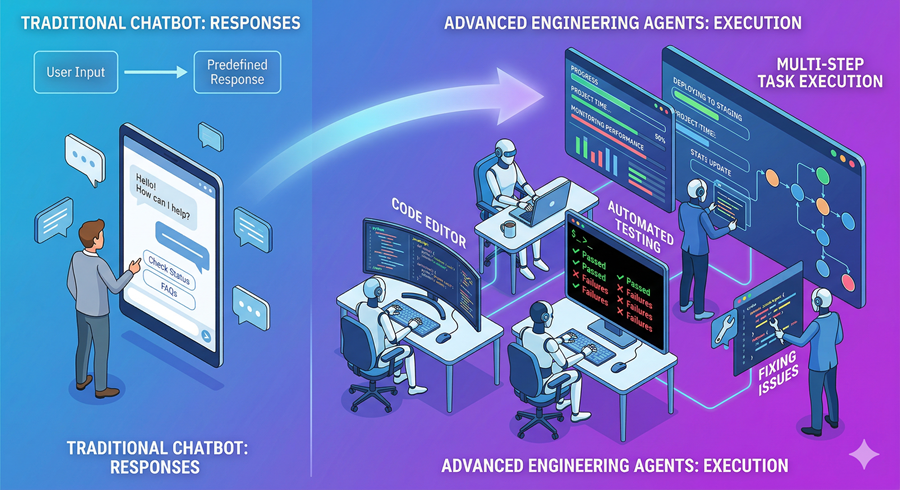
I see a clear difference between older AI systems and current ones. Earlier models were mostly conversational. They could explain code or generate snippets, but they were not reliable at handling full workflows.
Now, AI systems are increasingly acting like engineering agents. They can explore codebases, identify bugs, run tests, and iterate on fixes. Instead of responding to isolated prompts, they are beginning to operate across entire projects. This shift is what makes the benchmark curve feel different today. It is not just better answers, it is task completion over longer horizons.
Why Progress Feels Invisible Day to Day
One thing I find interesting is that most people using AI tools do not feel this acceleration strongly. If I only use chat-based systems for writing or simple tasks, improvements feel incremental. Each model is slightly better, but not dramatically different.
However, the biggest gains are happening in structured environments where AI agents are allowed to act over multiple steps. In those contexts, performance jumps become much more obvious. That creates a gap between perception and reality. Day-to-day use feels smooth and gradual, while behind the scenes, capability is compounding.
Jobs Data and the Missing Shock
When I look at job data, especially in software development, I do not see a dramatic disruption yet. Hiring trends do not show an immediate collapse, even with all the advances in AI capability.
This raises a question. If AI is becoming so powerful, why is the labor market not reacting faster? One explanation is timing. Adoption always lags behind invention. Another is that technology often changes the nature of work rather than eliminating it immediately.
There is also the possibility that benchmarks overestimate real-world readiness. Real jobs are messy, collaborative, and full of unpredictable constraints that are hard to simulate in controlled tests.
Benchmarks vs Reality
I think this gap between benchmarks and reality is important. Benchmarks measure performance in structured environments where tasks are clearly defined. Real work involves ambiguity, shifting priorities, and human coordination.
So even if AI is improving rapidly in controlled tests, that does not automatically translate into instant transformation everywhere. It may still take time for organizations to adapt, integrate, and trust these systems at scale.
What Still Feels Like the Key Signal
Even with all the uncertainty, one thing feels consistent to me. AI systems are steadily getting better at handling multi-step reasoning, especially in software and analytical tasks. They are also starting to accelerate their own development by helping engineers build better systems faster.
That feedback loop is what makes this moment feel different. Progress may not look explosive in every dataset, but the underlying trajectory is still moving upward.
Short Paragraph
What I take away is that AI progress does not feel dramatic in real time, but it compounds quietly until it becomes undeniable. The gap between perception and underlying capability is widening, and that gap is where most of the uncertainty about the future seems to live.
