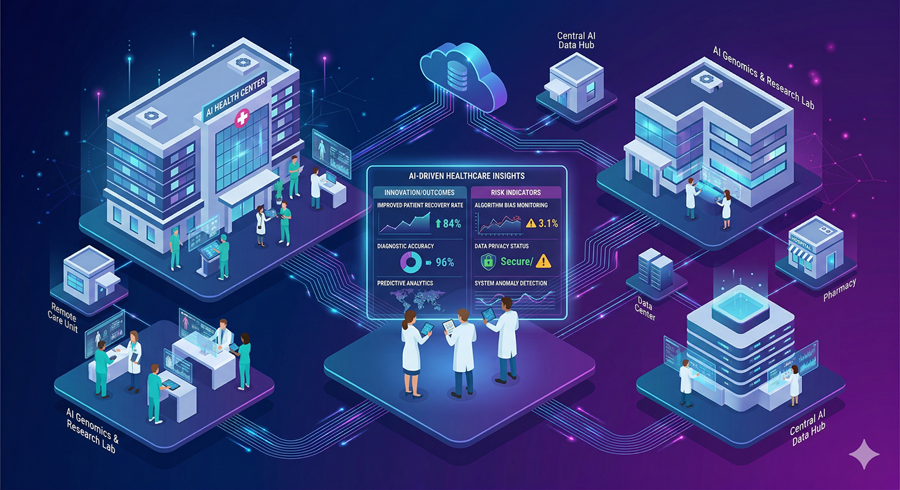
I see artificial intelligence rapidly reshaping healthcare, not just in research labs but inside everyday clinical practice. From diagnosing complex diseases to reducing administrative burden, AI is solving problems that doctors have struggled with for years. At the same time, it is introducing new challenges around trust, privacy, and misinformation that cannot be ignored.
AI Scribes Changing the Doctor’s Workflow
I notice one of the most immediate changes happening inside consultation rooms. AI scribes are quietly listening, transcribing, and structuring doctor-patient conversations into clinical notes. This allows doctors to focus more on patients instead of screens. I find this shift important because it improves both efficiency and patient experience. However, I also see that these systems must be treated as assistants, not decision-makers. Doctors still need to review and validate everything to ensure accuracy.
AI Driving Breakthroughs in Disease Research
I also see AI unlocking new ways to understand complex diseases like cancer. Instead of viewing tumors as uniform masses, researchers can now analyze the structure of individual cells within them. This helps identify which cells are growing aggressively and which are hiding, making treatment strategies more precise. I find this especially powerful because it opens the possibility of eliminating all cancer cells early, reducing the chances of recurrence and improving long-term outcomes.
The Growing Concern Around Data Privacy
At the same time, I cannot ignore the concerns around patient data. AI systems depend heavily on large datasets, which means sensitive health information is constantly being processed and stored. While companies use encryption and strict policies, there is always some level of risk when dealing with digital data. I think this is one of the biggest challenges moving forward, balancing innovation with strong privacy protections.
Misinformation in the Age of AI
I also see a different kind of risk emerging outside clinical settings. AI-generated content is becoming so realistic that it is difficult to distinguish from human communication. This has led to the spread of medical misinformation, especially on social platforms. False narratives around vaccines and treatments are not just online issues; they have real-world consequences, including reduced vaccination rates and increased public health risks.
Balancing Innovation With Responsibility
What stands out to me is the dual nature of AI in healthcare. On one hand, it is accelerating discoveries, improving efficiency, and supporting better patient outcomes. On the other, it is raising complex ethical and societal questions. I believe the future of AI in medicine will depend on how well we manage this balance, ensuring that technology enhances healthcare without compromising trust, safety, or human judgment.